A product inspection checklist gives you a controlled way to verify whether a batch matches approved requirements before goods move deeper into the supply chain. In many organizations, the same document is also described as a quality inspection checklist because it standardizes how inspectors apply the same checkpoints across factories, production runs, and suppliers. That consistency matters because the checklist connects product specifications, sampling logic, evidence capture, defect classification, and shipment decisions in one place.
A strong checklist also makes quality control more repeatable. Instead of asking an inspector to rely on memory or broad judgment, it turns requirements into observable checks, measurable values, and clear pass/fail criteria. It tells the team what will be checked, how it will be checked, what proof is required, and how the result affects the accept-or-reject decision.
That is why a quality control agency treats the checklist as an operating document rather than a generic form. When the structure is clear, the inspection report becomes easier to defend, corrective action becomes easier to target, and the final release decision becomes less subjective. The sections below show how to build that control into the document itself.
What is a product inspection checklist?
A product inspection checklist is a structured QC document that lists the criteria, specifications, and checks a product must meet before release, shipment, or market distribution. You use it inside product inspection, which is the examination of goods during or after production to verify predefined quality standards. In practice, the checklist translates approved requirements into observable checkpoints that an inspector can verify on the factory floor.
That structure matters because the document does more than list tasks. It records conformity against approved specifications, supports objective checking, and creates a repeatable basis for documenting findings. Many sourcing teams use it as the operational version of the approved standard: one sheet that connects product requirements, evidence rules, reporting fields, and final disposition. In plain terms, it is the control document that turns requirements into inspection actions and traceable quality records. It is also the document that keeps the inspection team focused on the same approved standard from start to finish.
Why does a product inspection checklist matter operationally?
A product inspection checklist matters operationally because it reduces subjectivity and makes inspection results more consistent from one inspector, supplier, and shipment to the next. When two inspectors use the same criteria, the same defect categories, and the same evidence requirements, you get cleaner decisions and fewer disputes about what the product was supposed to meet. That consistency also helps your supplier understand what will be checked before goods are presented for inspection.
The operational effect shows up after the inspection as well. A stronger checklist helps lower returns and rework, improves customer satisfaction, supports better supply-chain efficiency, and gives you earlier cost control. It also improves communication between buyer, supplier, and inspector because everyone works from the same reference point.
The opposite is costly. If the checklist is vague, incomplete, or outdated, inspectors can miss defects, sample the wrong items, or document findings in a way that weakens the final decision. That is why preparation comes first. A reliable outcome starts before inspection day.
How should you prepare before using a product inspection checklist?
You should prepare for a product inspection checklist by aligning the approved documents, locking the sampling plan, and confirming site readiness before the inspector starts. There are 3 preparation steps that matter most: review the source documents, set the sampling logic, and confirm logistics, tools, and supplier readiness. If any of those steps are weak, the checklist may still look complete on paper while the inspection itself becomes inconsistent.
A strong preparation process prevents a common failure point: treating inspection as an isolated event instead of a controlled operation. Before anyone opens cartons, scans labels, or measures units, you need agreement on the exact requirement set, the sampling logic, the stage of production, and the equipment that will be used on site. You also need to decide whether the supplier will receive the checklist in advance and whether a supplier self-inspection is expected before the visit.
Preparation also establishes ownership. Someone has to confirm that the latest drawings, artwork, packaging references, and product specifications are the ones the inspector will use. Someone also has to confirm who provides the tools, who checks calibration status, and whether the goods will actually be available in the quantity and stage required for inspection.
- Review and approve the source documents that define the product and packaging requirements.
- Set the sampling plan before the first unit is checked, including defect categories and sample-size logic.
- Confirm factory access, goods availability, equipment readiness, and supplier alignment on the checklist.
What should be reviewed in the documentation before inspection starts?
You should review every approved source document that defines what “acceptable” means before inspection starts. That includes the purchase order, specification sheet, technical file, artwork file, packaging specification, compliance documents, manuals, approved samples, and the release criteria for the order. If those records conflict, the checklist will inherit the conflict.
The safest approach is to mirror the approved documents line by line. Your checklist should use the same product identifiers, the same revision status, the same labeling rules, and the same packaging references that appear in the source set. When you do that, the inspector checks the current approved standard rather than a memory of it.
How should the sampling plan be set up?
You should set up the sampling plan by fixing the lot size, inspection level, defect categories, sample size, and acceptance or rejection thresholds before inspection begins. That decision needs to be made before the inspector starts selecting units, because sample logic drives how many pieces are checked and how failures are counted. It also determines which checkpoints are sampled and which are verified more broadly.
For example, a visual checkpoint may be checked on 10 sampled units, while a destructive verification may be limited to 2 units because the test damages the product. That is why the sampling plan should also state which checkpoints need special handling. Once you lock that logic, the later AQL decision becomes traceable instead of arbitrary.
How should logistics, equipment, and supplier readiness be confirmed?
You should confirm logistics, equipment, and supplier readiness by verifying that the goods, tools, people, and schedule required for the inspection will all be available together. An inspector cannot produce an objective result if the factory presents unfinished goods, the right tools are missing, or the approved checklist never reached the supplier.
Before inspection day, confirm these points:
- Factory access and schedule, including the contact person, production status, and location of the goods.
- Goods availability, including whether the order is at the right stage and whether cartons are accessible for random selection.
- Equipment availability, including calibrated calipers, barcode scanners, voltage testers, weighing devices, and any product-specific tools.
- Equipment ownership, so you know whether the factory or the inspector provides each tool and who confirms calibration.
- Supplier alignment, including checklist pre-sharing so the supplier can run a self-inspection before the visit.
What should a product inspection checklist include?
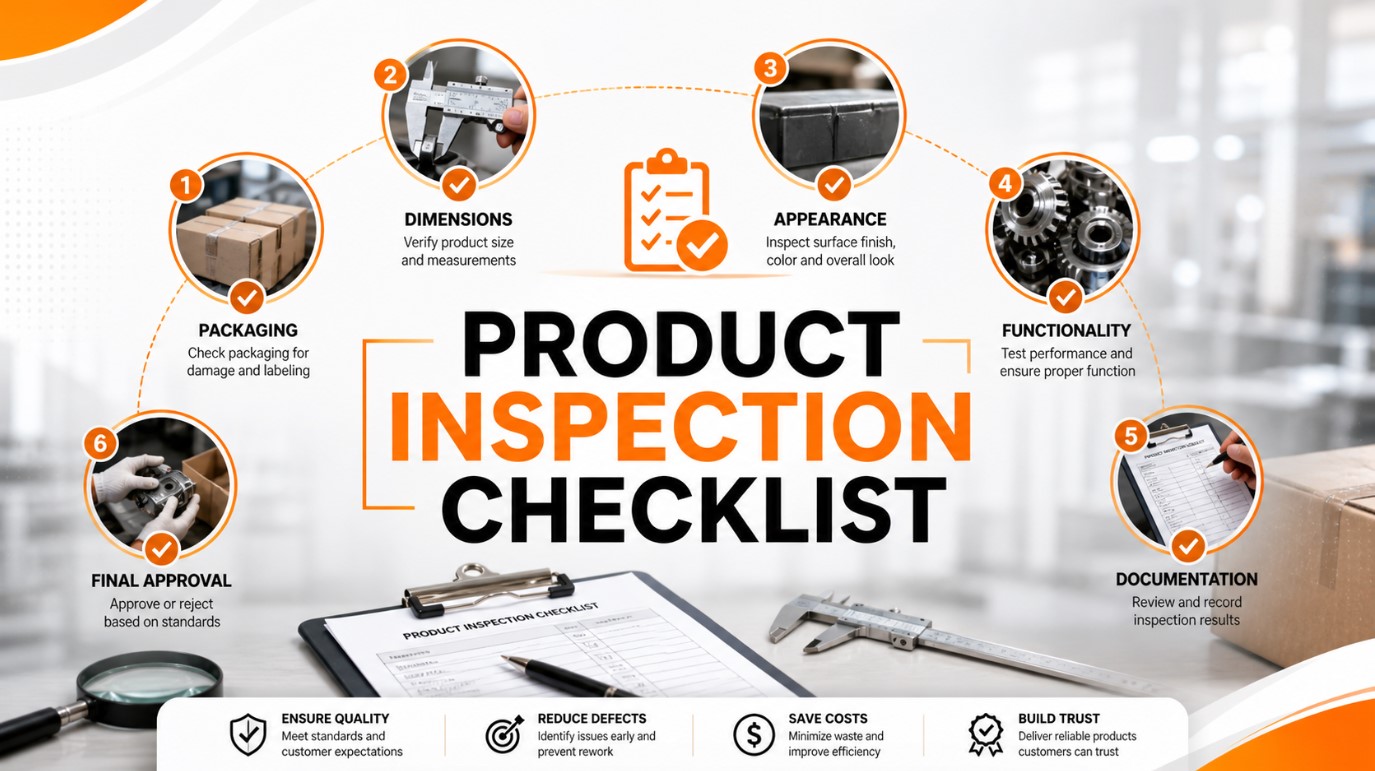
A product inspection checklist should include the identification fields, inspection criteria, test instructions, sampling rules, evidence requirements, and reporting fields needed to confirm conformity objectively. Many teams use the terms product inspection checklist and quality inspection checklist interchangeably when the document serves as the master control sheet for a factory visit. In most cases, the document covers product details, visual inspection, measurement and specifications verification, functional tests, packaging and labeling, barcode verification, compliance checks, defect logging, and final sign-off.
Think of the checklist as the inspection design itself. It tells the inspector what to look at, how to verify it, how many units to check, what proof to capture, and how the result will be classified. It should also name the tools required for each checkpoint, such as a barcode scanner, caliper, scale, or voltage tester, so the check can be repeated and audited later.
A stronger checklist also makes room for product specifications, evidence standards, and safety or regulatory standards instead of hiding those requirements in scattered attachments. Once preparation is complete, this field-by-field structure becomes the operating framework for the visit. The next sections break down the core checkpoints you should define.
What product-detail fields belong in the checklist?
The checklist should include product-detail fields that confirm the inspector is checking the correct item and the correct revision. Typical fields are product name, SKU, model number, batch number, serial number, and packaging specification. Those identifiers support traceability from the inspected unit back to the order and the approved documents.
You can also add colorway, size assortment, carton reference, or production date when those details affect sampling or acceptance. The rule is simple: if a mismatch in identity could invalidate the inspection, it belongs in the product-detail section.
How should visual inspection criteria be written?
You should write visual inspection criteria as explicit appearance rules that show what is acceptable and what is not acceptable. Typical visual-inspection fields include scratches, dents, stains, color consistency, assembly issues, and logo or label placement. Those checkpoints become far more reliable when you attach clear thresholds, reference photos, or good-versus-bad examples instead of vague phrases such as “good finish” or “acceptable color.”
A practical visual section often covers these points:
- Surface condition, including scratches, dents, stains, and contamination.
- Color and finish consistency, including gloss, texture, print registration, and coating appearance.
- Assembly quality, including gaps, loose parts, sharp edges, and visible misalignment.
- Branding details, including logo position, label placement, and print clarity.
- Acceptability references, including photos, annotated samples, or numerical tolerances where appearance can be quantified.
How should functional and performance tests be written?
You should write functional and performance tests by defining the intended use, the exact test method, the pass/fail rule, and whether the test is destructive. If those points are missing, the result can be challenged even when the inspector followed the checklist. Good functional tests show not only what to do, but also how success is measured.
Depending on the product, on-site checks may include drop tests, carton weight checks, stacking tests, moisture tests, or operation checks. A strong test section often includes:
- Operation checks, such as power-on, switch, fit, closure, or assembly-use verification.
- Performance checks, such as load, output, pressure, stability, or response verification.
- Destructive-test flags, so the inspector knows whether the tested unit remains saleable.
- Test conditions, including voltage, duration, load, or environmental requirements.
- Pass/fail limits, written as objective thresholds rather than personal judgment.
What measurement and specification fields belong in the checklist?
The checklist should include measurement and specification fields that compare actual product values against the approved technical requirements. Typical fields include dimensions, weight, capacity or load, and material compliance against the technical file or buyer specifications. Those checks need objective recording, not opinion, so the inspector should enter measured values wherever possible.
You should also define the tool and method for each measurement. A dimension taken with a caliper, a weight taken on a scale, and a material attribute checked against an approved certificate do not carry the same type of evidence. When the checklist tells the inspector exactly how to measure and what target value applies, the result becomes more defensible.
What packaging and labeling fields belong in the checklist?
The checklist should include packaging and labeling fields that confirm the goods can move through transport, customs, retail handling, and customer delivery without avoidable failure. Typical fields include label accuracy, label placement, packaging protection, carton condition, and alignment with branding requirements. Those items may look secondary until a shipment is delayed, refused, or damaged because the packing details were wrong.
A useful packaging and labeling section usually checks:
- Label content, including SKU, carton marks, country-of-origin data, and required warnings.
- Label placement, so marks appear in the required location and remain readable after handling.
- Protective packaging, including inserts, corner protection, sealing quality, and internal fit.
- Carton condition, including crushing, moisture exposure, tape security, and structural strength.
- Branding alignment, so retail or customer-facing packaging matches the approved artwork.
How should barcode and QR-code checks be written?
You should write barcode and QR-code checks as scan-based verifications rather than visual assumptions. Barcode or QR verification commonly includes scan testing, print quality, code position, and compatibility with retailer or logistics systems. A code that looks sharp to the eye can still fail when scanned.
That is why your checklist should define the device or app used for the test, the expected code result, and the location of the code on the unit or carton. When you treat barcode verification as a functional check instead of a print check, you protect inventory accuracy and downstream handling.
How should safety and compliance checkpoints be handled?
You should handle safety and compliance checkpoints by translating market-specific legal requirements into product-specific checklist items. If the product is regulated, the checklist should include safety and compliance checkpoints such as CE, FCC, FDA, warning-label, or material-restriction requirements tied to the destination market and product category. The goal is not to summarize regulations in broad terms. The goal is to make safety or regulatory standards checkable on site.
In practice, that means your checklist should reference the required label, mark, certificate, declaration, material restriction, or packaging warning that applies to the order. If a compliance requirement cannot be verified by observation alone, the checklist should state what document or evidence must be attached to the inspection record.
How should documentation, defect logging, and sign-off be captured?
You should capture documentation, defect logging, and sign-off in a way that turns observations into a traceable inspection record. Inspection results are commonly delivered in a report or checklist record that captures visual findings, functionality results, product-spec checks, nonconformities, and pass/fail outcomes. If the reporting fields are weak, the inspection can happen correctly and still produce a weak decision trail.
A robust reporting section usually includes:
- Photo evidence linked to the checkpoint or defect category.
- Actual measured values where dimensions, weight, or load were checked.
- Defect descriptions with quantity, severity, and location.
- Comments on nonconformities, special observations, or restrictions during the inspection.
- Signatures, timestamps, and final disposition fields that connect the checklist to the inspection report.
How should pass/fail criteria and defect classification be defined?
You should define pass/fail criteria and defect classification by tying each checklist line item to a method of inspection, a pass/fail rule, and a defect-severity category. Each checkpoint should state how the inspector checks the item and what counts as pass or fail. Without that pairing, defect logging becomes inconsistent because one inspector may record a failure where another records an observation.
Defect classification should then sort nonconformities into critical, major, and minor categories. That structure matters because batch disposition does not depend on a raw defect count alone. It depends on which type of defect occurred, how many sampled units failed, and whether the failure exceeded the threshold linked to that checkpoint category.
The strongest checklists also make that traceability visible. A labeling checkpoint should connect to its own defect threshold. A safety checkpoint should connect to a stricter threshold. A measured-dimension checkpoint should connect to a tolerance and a severity rule. Once line items and thresholds are connected that way, the AQL decision becomes easier to justify.
What does AQL mean in a product inspection checklist?
AQL means Acceptable Quality Limit, the statistical sampling method used to determine sample size and tolerated defect counts for a batch. In a product inspection checklist, AQL does not replace the checkpoint design. It works on top of it. The checklist defines what defect looks like, while AQL defines how many sampled defects can be tolerated before the batch is rejected.
The method uses inputs such as lot size, inspection level, and defect categories. It then produces outputs such as sample size and acceptance or rejection thresholds. That is why a checklist and an AQL sampling plan need to be aligned before inspection starts.
What AQL values are commonly used?
A commonly cited AQL setup for finished-goods inspection is General Inspection Level II with defect limits of Critical 0.0, Major 2.5, and Minor 4.0. QualityInspection.org uses that example to explain how lot acceptance is calculated in practice, and QCADVISOR’s FAQ likewise describes General Inspection Level II as the default inspection level for many product inspections.
Still, those values are not universal rules. Your final thresholds should match the product category, likely failure mode, customer expectations, and business risk.
How should the inspection flow be structured?
You should structure the inspection flow in the same order the inspector physically handles the sampled goods: outer packaging first, inner packaging second, and the product itself last. That sequence reduces wasted motion and keeps context intact because the inspector sees transport protection, retail presentation, and product condition in a logical progression. It also helps prevent missed issues that become hidden once the inspection jumps around randomly.
A typical inspection workflow then fits inside that physical sequence. The inspector confirms production status, selects random samples, reviews the specifications, performs visual inspection, runs functional or specialized testing, documents findings, and supports an accept or reject decision.
A practical flow usually looks like this:
- Check outer packaging for carton marks, quantity, damage, sealing, and transport readiness.
- Open the sampled cartons and review inner packaging, inserts, labels, accessories, and retail presentation.
- Inspect the product itself for identity, appearance, measurements, and workmanship.
- Run the required functional, performance, or specialized tests.
- Record evidence, classify defects, and finalize the disposition logic for the batch.
What inspection stages should product checklist variants cover?
Inspection-stage variants should cover the points in production where the risk profile changes, because one master checklist rarely works unchanged at every stage. In most programs, that means separating pre-production readiness, initial production output, during production inspection, pre-shipment inspection, container loading, returns inspection, and release authorization. Each stage asks a different question, so each stage needs a different checkpoint mix, evidence rule, and decision threshold.
This matters because early-stage checks are about readiness and prevention, while later-stage checks are about conformity and shipment control. A readiness checklist asks whether production can start correctly. A mid-run checklist asks whether the process is staying stable. A pre-shipment inspection checklist asks whether the finished order is safe to release. A container-loading checklist asks whether the right goods are loaded correctly and safely.
It also resolves a common terminology problem. Pre-production readiness is not the same thing as an initial production check on the first finished units. If you combine those stages, you lose clarity on what should be verified, when the check should happen, and which corrective action is still realistic.
What should a pre-production checklist verify?
A pre-production checklist should verify that the factory is ready to begin production according to the approved standard. That means checking raw materials, approved components, machinery readiness, specifications, and overall factory readiness before full production starts. The focus stays on whether the order can start correctly, not on whether finished units already conform.
You should also confirm that the approved documents, approved sample references, and critical process expectations are available on site. Material identity, component approval, and machine setup should all match the intended order. If readiness is weak at this stage, defects tend to multiply later.
What should an initial production check verify?
An initial production check should verify whether the first production output matches the approved requirements immediately after startup. This stage exists to catch early recurring defects before mass manufacturing locks those defects into the whole batch. It is the checkpoint that tells you whether the line has translated the approved sample into consistent production reality.
A useful initial production checklist concentrates on first-piece conformity, visible repeat defects, key dimensions, assembly consistency, and packaging setup on the first packed units. It gives you an early signal on whether the production line is translating the approved requirements into repeatable output.
When should a during-production checklist be used?
A during-production checklist should be used while the order is far enough along to reveal repeat defects but early enough for corrective action to matter. In GoAudits’ 2025 product-inspection guide, During Production Inspection is typically conducted when about 20% to 60% of production is complete. QCADVISOR’s product-inspection FAQ gives a similar operational signal for During Production Inspection, placing it when roughly 20% to 50% of the order has been produced.
For you, the value is simple: defects found during production inspection are usually cheaper to correct than defects found after full completion. This stage tells you whether the process is drifting, whether repeated defects are forming, and whether earlier corrective actions are actually working.
When should a pre-shipment or final random checklist be used?
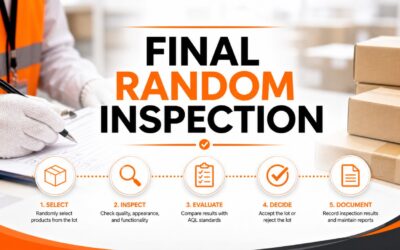
A pre-shipment or final random checklist should be used at the last major checkpoint before goods leave the factory. GoAudits’ 2025 guide describes Final Product Inspection or Pre-Shipment Inspection as the stage typically conducted when production is 100% complete and at least 80% packed. QCADVISOR’s FAQ uses a closely related operational threshold, stating that Pre-Shipment Inspection is done when the order is at least 80% finished and packed.
Because the order is close to shipment, the checklist should focus on final conformity, packed-goods sampling, documentation completeness, and the batch decision. It is often the last chance to stop avoidable nonconformities before the goods leave the factory.
What should a container-loading checklist verify?
A container-loading checklist should verify that the correct goods, in the correct quantity, are loaded into a suitable container under conditions that reduce transit risk. At this stage, you are not re-running the whole product inspection. You are protecting the shipment event itself.
A container-loading checklist commonly checks:
- Quantity and SKU match between the loading list and the goods presented.
- Container condition, including cleanliness, dryness, structural condition, and suitability for loading.
- Carton condition at loading, including visible damage or moisture exposure.
- Stacking and loading method, so the goods remain stable and protected in transit.
- Seal control and loading record, including container number and final closure evidence.
What should a returns inspection checklist include?
A returns inspection checklist should include the fields needed to decide whether a returned item is complete, damaged, repairable, reusable, or rejectable. Returns inspection is different from outgoing inspection because the checklist must capture the condition in which the product came back, not just whether it met the original outbound standard.
Typical returns checkpoints include:
- Returned-product identifiers, reason code, and traceability to the original shipment.
- Packaging condition and whether protective materials or accessories are missing.
- Completeness of components, manuals, labels, or bundled items.
- Visible damage, signs of use, contamination, or tampering.
- Acceptance, repair, refurbishment, or rejection logic linked to the return condition.
What should a release-authorization checklist include?
A release-authorization checklist should include the final conformity, documentation, and approval checkpoints required before shipment is authorized. This stage combines physical inspection results with decision control. A batch that looks acceptable still should not be released if key documents, signatures, or evidence are missing.
A release-readiness section usually checks:
- Final conformity status against the inspection criteria.
- Documentation approval, including required certificates, labels, and report completeness.
- Sign-off authority for the release decision.
- Shipment authorization status and any hold conditions.
- Final release readiness, including whether open issues were closed or formally accepted.
How should you choose and customize a product inspection checklist by product risk and market requirements?
You should choose and customize a product inspection checklist by looking first at the product type, likely failure modes, fragility, destination market, retailer requirements, and your own defect tolerance. Product inspection checklists are not one-size-fits-all. A low-risk household accessory, a regulated electronic item, and a fragile piece of furniture do not need the same checkpoints, the same evidence, or the same decision thresholds.
A practical customization model starts with risk. Ask what can fail, how serious that failure would be, and where the failure is most likely to appear: appearance, dimension, function, packaging, compliance, or transit protection. Then add the market layer. A destination market may require specific warning labels, compliance marks, or documentation that another market does not require. After that, add customer-specific rules such as retailer barcode format, private-label packaging, or brand presentation standards.
When you build the checklist that way, every checkpoint has a reason to exist. The document becomes shorter where the risk is low and stricter where the product, channel, or market creates higher exposure.
What evidence should each checklist checkpoint require?
Each checklist checkpoint should require the type of evidence that best proves the check was actually performed and that the result was recorded correctly. Not every line item needs the same proof. A visual defect may require a photo. A dimension may require a measured value. A barcode may require a scan result. A compliance item may require an attached certificate or label image. Evidence standards make the checklist more auditable and make the inspection report more useful after the site visit.
You can assign evidence by checkpoint type:
- Photo evidence for appearance defects, packaging damage, label position, loading condition, and carton issues.
- Measured values for dimensions, weight, capacity, torque, voltage, or any specification that can be recorded numerically.
- Scan results for barcode or QR-code checkpoints tied to inventory or retailer-system compatibility.
- Attached documents for declarations, certificates, or market-specific compliance records.
- Signatures or named approvals for release status, special concessions, or corrective-action acknowledgement.
When you define evidence standards in advance, the report becomes easier to review, compare, and defend.
What happens if a batch fails the checklist?
If a batch fails the checklist, the usual outcome is rejection, rework, sorting, or escalation for further review. The exact path depends on the type of defect, the number of failures, and whether the issue can be corrected without creating new risk. A failed checklist should not produce a vague conclusion. It should produce a controlled disposition supported by the checklist record, the evidence file, and the defect classification.
In practice, you may reject the batch outright, hold it for rework, separate conforming from nonconforming units, or escalate the case for engineering, commercial, or compliance review. QCADVISOR’s FAQ also notes that failed inspections can lead to corrective action, sorting, or reinspection rather than a single automatic outcome. What matters is that the checklist, the evidence, and the defect logic all support the next decision clearly and traceably. That clarity protects you from releasing a disputed batch on weak reasoning. It also gives the supplier a more concrete path for rework or corrective action.
How are product inspection, product testing, and process control different?
Product inspection, product testing, and process control are different because they answer different quality questions. Product inspection checks sampled goods for conformity during or after production. Product testing evaluates safety, durability, or performance under a defined method. Process control monitors production conditions in real time to prevent defects before they reach finished goods.
Your checklist should keep those roles separate. Inspection verifies conformity. Testing verifies performance or safety. Process control prevents variation.
| Quality activity | Main purpose | Typical timing | Sample logic | Main output | Role in defect prevention |
|---|---|---|---|---|---|
| Product inspection | Verify conformity of sampled goods against specifications | During or after production | Batch sampling, often using AQL | Inspection report, defect log, pass/fail decision | Finds defects already present in the sampled goods |
| Product testing | Evaluate safety, durability, or performance under defined conditions | Before approval, during qualification, or as special verification | Selected units based on test method | Test result, measured performance data, compliance evidence | Validates performance claims or safety requirements |
| Process control | Monitor production parameters to prevent variation and defects | In real time during manufacturing | Continuous or frequent process monitoring | Process records, alerts, corrective actions | Prevents defects before they spread through the batch |
You can run inspection and testing at the same site, and both can inform process control. They are still different tools, and your checklist should keep their roles separate.
What are the main limitations of product inspection?
Although there are advantages, there are certain limitations in product inspection, and the main three are sampling limits, late-stage detection, and dependence on clear specifications. Inspection can tell you a great deal about a batch, but it cannot guarantee that every uninspected unit is defect-free. That limit becomes especially important when the sampling plan is weak or when critical checkpoints are badly defined.
There are 4 main limitations worth keeping in view:
- Miss coverage, because sample inspection does not examine every unit in the batch.
- Detect issues late, because some defects are found only after value has already been added to the order.
- Depend on specification quality, because vague standards produce inconsistent judgments.
- Struggle with hidden failure modes, because some safety, durability, or process problems require testing or process control rather than visual or sampling checks alone.
That is why inspection works best as one control inside a larger quality system. You still need good product specifications, process discipline, and stage-appropriate testing around it.
What are the benefits of digital product inspection checklists?
Digital product inspection checklists offer faster reporting, stronger evidence capture, cleaner calculations, and better record visibility. They are useful when you need inspection data to move quickly from the factory floor to the decision-maker without waiting for a manually rebuilt report. They also make cross-order comparison easier because the same checkpoint structure can be reused and reviewed over time.
There are 5 main digital benefits:
- Capture real-time photo uploads, so visual evidence is attached to the checkpoint while the inspector is still on site.
- Automate calculations, which reduces manual counting errors in sample summaries and defect tallies.
- Share results instantly with buyers, suppliers, or internal quality teams after the inspection.
- Analyze historical trends across suppliers, product types, defect categories, or recurring supplier issues.
- Simplify inspection reporting by turning the checklist record into a clearer, easier-to-review inspection report.
In other words, digital execution does not replace checklist quality. It makes a strong checklist easier to use consistently.
How should a product inspection checklist be maintained and version-controlled?
You should maintain and version-control a product inspection checklist by reviewing it whenever new evidence shows that the current version no longer reflects the real risk or the real requirement set. A checklist should be tested in practice and updated over time as recurring defects, irrelevant checkpoints, or new requirements emerge. That review should not happen informally. It should follow a documented ownership and approval path.
The most common revision triggers are failed inspections, customer complaints, engineering changes, new-market compliance requirements, repeated irrelevant checkpoints, and retailer-format changes. Once a trigger appears, the owner of the checklist should review whether the checkpoint set, pass/fail logic, evidence rule, or sampling instruction needs revision. Good version control also records who approved the change, when it applies, and which orders or suppliers it affects.
That governance matters because the checklist is a shared control document between buyer, supplier, and inspector. If no one owns the revision history, confusion returns.
What common mistakes weaken a product inspection checklist?
The common mistakes that weaken a product inspection checklist are vague wording, missing decision rules, incomplete instructions, weak evidence requirements, outdated specifications, and poor communication before the visit. Most checklist failures are not dramatic. They come from small ambiguities that turn into inconsistent inspection behavior. One unclear tolerance, one missing sample-size note, or one outdated packaging reference can change the final decision materially.
The most damaging mistakes are these:
- Use vague terms such as “good quality” without defining measurable or visible acceptance rules.
- Omit pass/fail logic, so defects are recorded without a clear disposition framework.
- Leave out sample-size instructions, which makes checkpoint coverage inconsistent.
- Skip evidence requirements, which weakens the inspection report and later review.
- Keep outdated specifications or artwork references after engineering or packaging changes.
- Fail to share the checklist with the supplier before inspection, which removes the chance for early self-correction.
Each of those errors weakens a different part of the decision chain. One problem distorts the checkpoint, another distorts the sample, and another distorts the report that management sees afterward.
How much does product inspection cost?
Product inspection cost depends on the scope of work, not only on the fact that an inspection happens. In most cases, the total price is driven by 5 factors: inspector time, travel, testing requirements, sampling intensity, and report or follow-up scope. QCADVISOR’s pricing FAQ states that its standard inspection rate starts at USD 280 per man-day across most of Asia and USD 380 per man-day in Taiwan and South Korea.
The 5 main cost factors are:
- Inspector time: about USD 280-380 per added man-day on QCADVISOR’s current pricing model.
- Travel: about USD 0 extra in mainland China under QCADVISOR’s standard rate, but roughly USD 50-300+ when remote travel or non-China locations add transport cost.
- Testing requirements: roughly USD 50-500+ beyond the base visit when destructive tests, special instruments, or outside verification are added.
- Sampling intensity: often another USD 280-380 if a broader sample pushes the job from one man-day to two.
- Report and follow-up scope: often USD 0 for standard reporting, but about USD 280-380 per added reinspection man-day when a failed batch must be checked again.
How does checklist quality affect inspection cost and reinspection risk?
Checklist quality affects inspection cost and reinspection risk because a clearer checklist reduces ambiguity before the inspector arrives. When the checkpoint wording, sample logic, evidence rules, and pass/fail criteria are precise, the inspection runs faster and the report is easier to defend. That lowers the chance that you will need a repeat visit just to resolve arguments about what the standard was supposed to be.
The cost effect is indirect but real. Weak checklists lead to missed checkpoints, disputed findings, inconsistent supplier expectations, delayed batch decisions, and avoidable reinspection. Better checklist design does not remove all inspection cost, but it does reduce the odds that you will pay twice for the same uncertainty. It also reduces time spent arguing over results after the visit.
When a checklist is weak, people compensate with extra calls, extra evidence requests, and extra review rounds. Those hidden costs do not appear on the initial quote, but they still consume time and budget.
How do customized inspection checklists support QCADVISOR’s product inspection services?
Customized inspection checklists support QCADVISOR’s product inspection services by turning service scope into executable factory-floor checkpoints. On its official site, QCADVISOR says it performs on-site inspections before, during, and after production to verify product quality, packaging, labeling, and compliance with client specifications. The company also says its inspections follow AQL standards and are customized for the product type.
QCADVISOR’s current service pages and product-inspection FAQ describe a stage-based model that includes pre-production qualification, During Production Inspection, Pre-Shipment Inspection, container loading supervision, reinspection, and product sorting. That service structure matters because each stage needs a different checklist emphasis.
For you, the checklist is the link between what you want verified and what the inspector can document consistently. In a service model like this, customized inspection checklists define the actual product requirements, the stage-specific checks, the evidence expectations, and the shipment-readiness decision path without turning the article into a sales message.
FAQs
How often should product inspections be conducted?
Product inspections should be conducted as often as supplier risk, production volume, defect history, and shipment criticality require. A new supplier, a complex product, or a shipment with a tight retail deadline usually justifies more frequent checks than a stable repeat order from a proven factory.
For many programs, frequency changes by stage rather than by calendar. You may inspect once before production, once during production, and once before shipment. Higher-risk suppliers or products may justify extra checks until performance stabilizes.
What are the consequences of poor product inspection?
Poor product inspection leads to later defect discovery, more rework, more returns, lower customer satisfaction, shipment delays, and supply-chain disruption. The damage is not limited to the factory floor. Weak inspection quality can also create false confidence, which is worse than visible uncertainty because the shipment moves forward on a weak decision base.
That is why checklist quality and inspection quality cannot be separated in practice. A weak checklist often produces a weak inspection even when the inspector works carefully.
Can product inspection and product testing happen at the same time and place?
Yes, product inspection and product testing can happen at the same time and place if the product, tools, and method allow it. They still serve different purposes. Inspection checks batch conformity. Testing checks performance, durability, or safety under a defined method.
Your checklist should keep those purposes separate even when the same inspector or site handles both activities. One document can reference both actions, but the acceptance logic should still remain distinct.
Which checkpoints should be sampled, and which should be checked on every unit?
You should sample checkpoints when the defect risk, checkpoint criticality, and practicality support statistical inspection, and you should check every unit or every relevant package when traceability, labeling, or safety risk makes broader verification necessary. The right choice depends on severity, not convenience alone.
That is why labeling, safety, or identity checks often need broader coverage than a destructive or time-intensive test. Critical traceability points often justify wider verification even when most product checks remain sample-based.