Final random inspection (FRI) is a pre-shipment, sample-based quality control check on finished goods, and it matters because it’s often your last realistic chance to stop defects from entering your supply chain. When quality problems slip through, you don’t just pay for rework—you pay for freight, delays, returns, warranty claims, and reputation damage. Industry references on the cost of poor quality regularly place it in the double-digit percent range of sales for many organizations, which is why a “last gate” inspection can be a high-leverage control.
This guide walks you through the full FRI picture: what it is (and how it differs from other inspection types), why it protects your supply chain, and how the process works step by step. You’ll learn which sampling standards and AQL levels are commonly used, when an FRI is valid (production and packing readiness), what gets checked (from workmanship to labeling), and what a good inspection report should contain. We’ll also cover failure triggers, what to do next if a lot fails, typical cost structures (including “Man Day” pricing), and how digital tools are improving inspection services in both consumer goods and industrial inspection.
What is final random inspection (FRI)?
Final random inspection (FRI) is an acceptance-sampling quality inspection that verifies finished products against defined quality requirements before shipping. It differs from earlier controls because it evaluates the shipment as it will be delivered, using random inspection methods to select cartons and units from a completed lot. You use FRI when you want an objective “go/no-go” decision tied to a sampling plan, not a full 100% check of every unit.
In practice, FRI sits near the end of your inspection cycle—after pre-production alignment and during-production monitoring—so you can confirm product quality, packaging, labeling, and shipment quantity before goods leave the factory.
Why is FRI critical in quality control and supply chains?
FRI is critical because it catches late-stage defects, confirms compliance, and helps you control shipment release without relying on factory assurances. It fits your supply chain as the final inspection gate—close enough to shipping to reflect reality, but early enough to still block a bad lot.
Below are 7 advantages you get from final random inspections:
- Prevent defective goods from reaching customers by stopping shipments that don’t meet AQL or key specifications.
- Confirm order accuracy by verifying quantity, assortment, and packout against the purchase order and packing list.
- Reduce dispute risk by creating objective evidence (photos, measurements, defect counts) in a clear inspection report.
- Standardize decisions using sampling standards, defect classification (critical/major/minor), and consistent checklists.
- Improve supplier performance over time by making shipment approval dependent on measurable outcomes.
- Protect cash flow by timing shipment release and (where applicable) final payment to inspection results.
- Support high-risk categories with targeted tests (safety, labeling, documentation) when failures are costly or regulated.
How does FRI ensure specification and regulatory compliance?
FRI ensures specification and regulatory compliance by checking the shipped lot against your defined requirements and required market rules before it leaves the factory. You start with a checklist tied to drawings, approved samples, tolerances, labeling rules, and packaging specs, then verify actual units pulled from random cartons. That structure prevents “best unit” demonstrations, because the inspected items come from the lot that will be shipped.
On compliance, the inspection focuses on what regulators and import channels actually enforce: correct product labeling, mandatory markings, safety warnings, manuals, and packaging statements. For regulated products, you can also verify key documentation and traceability elements so the shipment matches the compliance file you expect, not an improvised substitute.
How does FRI reduce costly rework and delays?
FRI reduces costly rework and delays by finding nonconformities while goods are still at the factory, where fixes are fastest and logistics are still flexible. When defects are discovered after shipment, you’re dealing with freight costs, warehouse handling, customer service time, and often a tighter deadline to replace stock. An FRI puts the problem back where it can be corrected: at the production source.
It also prevents schedule surprises caused by packaging errors, missing accessories, incorrect labeling, or short-shipments. Those issues can turn into port holds or rejected deliveries. A well-run FRI flags them before containers are sealed, so you can rework, re-pack, or re-inspect without derailing your downstream commitments.
How does FRI protect brand reputation?
FRI protects brand reputation by reducing the chance that customers receive visibly defective or nonfunctional products. Many brand-damaging issues are simple: scratches, poor finishing, missing parts, wrong colors, weak packaging, or labeling mistakes. Because FRI checks both product quality and packing quality, it helps prevent those “first impression” failures that lead to negative reviews and returns.
It also supports consistency across repeat orders. When you apply the same acceptance criteria—same defect definitions, same AQL logic, same functional checks—you create a repeatable quality level customers recognize. Over time, that stability becomes part of your brand promise: fewer surprises, fewer excuses, and fewer emergency replacements.
How does FRI lower legal and safety liability?
FRI lowers legal and safety liability by verifying safety-critical attributes and required warnings before shipment approval. If your category requires safety tests or mandatory labeling, missing them can create direct legal exposure, not just quality complaints. An FRI can include targeted checks such as sharp-edge screening, basic electrical safety checks, or verification that safety instructions and warning labels match the destination market.
Just as important, the inspection report creates evidence of due diligence. If a claim occurs, you can show what was checked, what standards were applied, what defects were found, and what decisions were made. That record doesn’t replace compliance testing, but it strengthens process control and accountability.
Why is FRI especially critical in oil, gas, and energy supply chains?
FRI is especially critical in oil, gas, and energy supply chains because late-stage quality problems can stop commissioning, delay shutdown turnarounds, or create safety hazards in high-consequence environments. Industrial products often have strict contractual requirements, traceability demands, and documentation expectations. If the shipment arrives with dimensional deviations, coating defects, missing certificates, or incorrect marking, the cost impact can be far larger than in typical consumer goods.
In these projects, FRI is often tied to an inspection and test plan (ITP) and focuses on export readiness, identification marking, surface condition, dimensional verification with calibrated tools, and documentation checks. Common nonconformities include coating and weld finish issues, labeling errors, missing accessories, and traceability gaps—all of which can block acceptance on site.
How does final random inspection work?
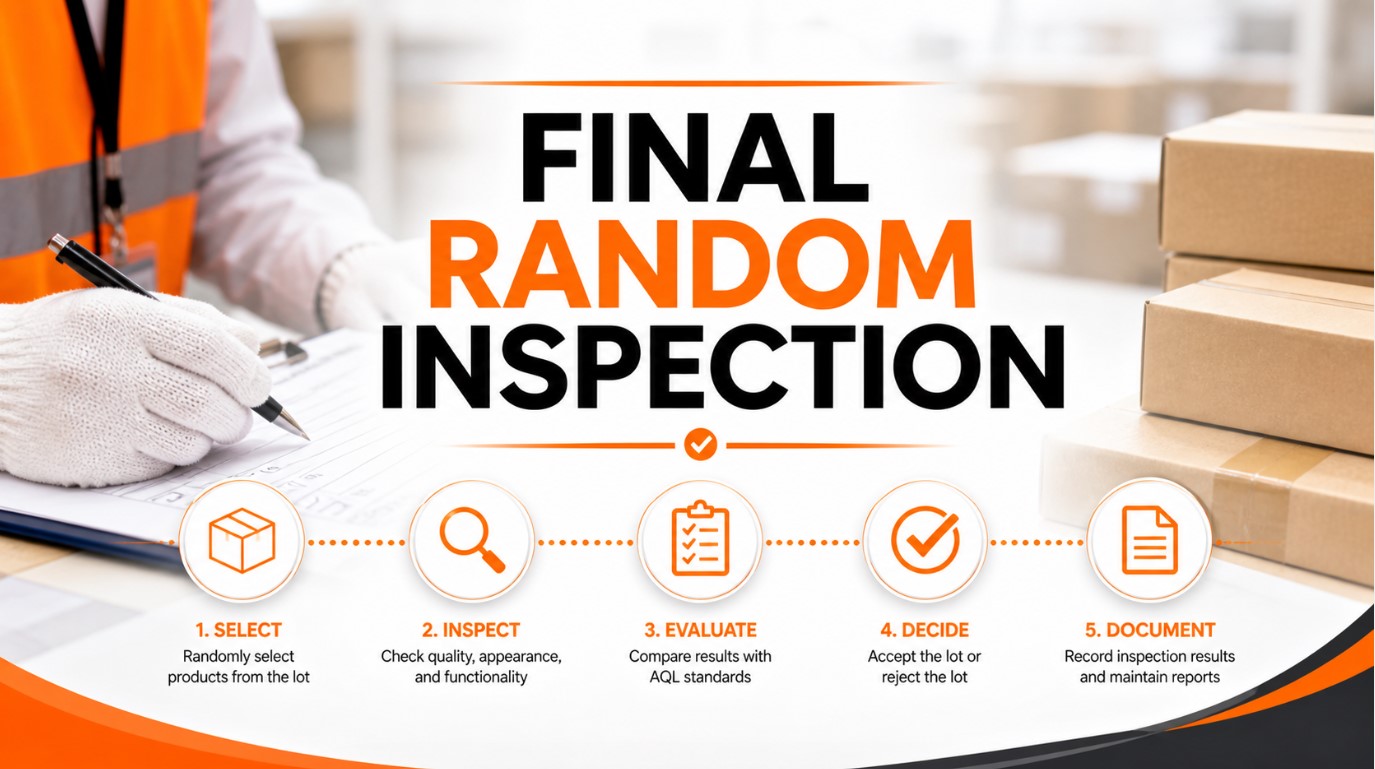
FRI works by selecting a statistically defined number of units from a finished lot, checking them against a checklist, and issuing a pass/fail (or hold) decision based on defects and compliance results. It is more technical than a simple “look-over” because it relies on sampling rules, defect classification, and clear acceptance criteria tied to your purchase order.
A typical FRI process includes these stages:
- Prepare requirements: Confirm product specs, golden sample references, tolerances, and destination labeling rules.
- Verify readiness: Confirm the lot size, finished status, and packing status so sampling reflects the shipment.
- Select random cartons: Choose cartons across the lot to prevent cherry-picking.
- Pull inspection samples: Select units per the sampling plan (often AQL-based).
- Run checks and tests: Inspect workmanship, dimensions, function, packaging, markings, and any special checkpoints.
- Record defects and evidence: Classify defects (critical/major/minor) and capture photos, measurements, and notes.
- Close out and report: Provide a clear verdict and actionable findings so you can approve shipment or trigger rework.
Who should perform an FRI, and what qualifications are required?
FRI should be performed by an independent and competent inspector (often a third party) who can apply sampling standards, interpret specifications, and document evidence clearly. Independence matters because the inspection is a shipment release gate; you want objective judgment rather than production pressure.
Qualifications are practical, not abstract. The inspector needs experience with your product category, the ability to read specifications and tolerances, and familiarity with defect classification and AQL sampling. They also need discipline in random selection (to avoid biased sampling) and strong reporting habits—clear photos, traceable carton counts, and consistent pass/fail logic. For regulated products, you want someone who understands labeling rules, basic safety checks, and what documentation must match the shipment.
Which sampling standards and AQL levels are used in FRI?
FRI typically uses acceptance sampling standards (inspection by attributes) with AQL levels to determine sample size and acceptance limits for defects. The core idea is simple: you don’t inspect every unit, but you inspect enough units—selected randomly—to make a controlled decision about the lot.
Commonly used references include:
- ANSI/ASQ Z1.4: Widely used acceptance sampling tables for inspection by attributes.
- ISO 2859-1: The international equivalent family used for attribute sampling in many supply chains.
- AQL logic: Sets different acceptance limits for critical, major, and minor defects based on risk and market expectations.
- Switching rules (where used): Some programs apply tightened or reduced inspection based on supplier performance history.
How does AQL sampling work in final random inspection?
AQL sampling works in FRI by linking your lot size to a sample size and defining the maximum allowable defects before the lot fails. You start by confirming the shipment quantity (the lot), then choose an inspection level and AQL values. The sampling table tells you how many units to inspect, and the acceptance/rejection numbers tell you when the lot passes or fails.
During inspection, the inspector classifies findings into critical, major, and minor defects. The lot can fail if defect counts exceed the allowed limit for any category. This structure makes the decision repeatable: two inspectors using the same plan should reach the same verdict, assuming they classify defects consistently and sample randomly from the packed cartons.
What is MIL-STD-105E?
MIL-STD-105E is a legacy attribute-sampling standard that influenced many modern acceptance sampling approaches used in product inspection. In the context of final random inspection, you’ll often hear it referenced because it popularized structured sampling tables and decision rules that align closely with AQL thinking.
Even when your inspection provider references newer standards, the “105E” label still appears in supply chain conversations as shorthand for attribute sampling. The practical takeaway is not the document name—it’s the method: select a defined sample, classify defects, and accept or reject the lot based on predetermined limits.
Which AQL levels are most commonly applied?
The most commonly applied AQL levels depend on risk, but in many inspection programs you’ll see stricter rules for critical defects and more tolerance for minor defects. Critical defects often target “no acceptance,” because safety or legal risk is not something you want to average out across a lot.
In day-to-day use, many buyers apply separate AQL thresholds by defect severity and adjust them based on product maturity, supplier history, and destination market. If you sell premium goods, your “major” threshold will usually be tighter. If you are launching a new product or using a new supplier, tightened inspection and stricter AQL values are common until process stability improves.
When should a final random inspection be conducted?
A final random inspection should be conducted after production is complete and when the shipment is largely packed, but before goods ship and before you lose leverage to enforce corrections. If you inspect too early, you risk checking a “nice” subset that isn’t the final lot. If you inspect too late, fixes become expensive and schedules are harder to recover.
The most reliable timing is when the supplier can present final packed quantities, carton counts, and export packaging—so the inspector can sample from real shipping cartons. If you need stronger protection against product switching or short-shipping, you can pair FRI with loading supervision so the inspected goods are the ones that actually enter the container.
At what product completion and packing percentages is FRI valid?
FRI is valid when production is 100% completed and the order is mostly packed—often around 80% packed or more. “100% completed” means the units exist and match the final bill of materials and finishing process. “Mostly packed” means cartons are available for counting and random selection across the lot, not staged in loose piles that allow bias.
That packing readiness is a practical control. It limits the chance that a factory shows you only the best cartons while hiding problems elsewhere. It also allows meaningful checks on shipping marks, packaging integrity, assortment packing, and accessory completeness—issues you can’t verify reliably when goods are still on worktables.
What is checked during a final random inspection?
A final random inspection checks whether the shipped lot matches your purchase order, product specifications, and packaging/labeling requirements within the acceptance limits set by your sampling plan. The focus is broad on purpose: FRI validates the product and the shipment presentation at the same time.
Typical checkpoints include:
- Quantity and assortment: Carton count, packed quantities, and mix accuracy versus documents.
- Workmanship and appearance: Visual defects, finishing quality, and overall consistency.
- Dimensions and measurements: Key dimensions, weight, and tolerance-based checks.
- Function and performance: Basic operation, fit, and common failure modes for your category.
- Packaging integrity: Carton strength, inner packing, protection, and presentation quality.
- Labeling and marking: Barcodes, shipping marks, warnings, manuals, and destination compliance items.
- Safety-related checks (as applicable): Basic safety screening or verification that required tests/labels are present.
How should an FRI inspection checklist be built?
Build an FRI checklist by defining requirements, translating them into measurable checkpoints, and linking each checkpoint to clear accept/reject rules and evidence expectations. You can do it in 6 steps, and the result should read like a tool an inspector can execute without guessing.
- Lock the reference standard: Use approved samples, drawings, and PO specs as the “source of truth.”
- Define defect language: Write what counts as critical, major, and minor for your product quality.
- List measurable checkpoints: Convert specs into measurements, functional tests, and packaging checks.
- Add compliance items: Include destination labeling, warnings, manuals, and required markings.
- Set sampling and AQL rules: State the sampling standard, sample size logic, and acceptance limits.
- Specify evidence: Require photos, measurements, carton IDs, and clear defect descriptions in the report.
Why are golden samples essential for FRI?
Golden samples are essential for FRI because they give you an agreed physical reference that removes ambiguity from “quality” discussions. Specs on paper help, but physical products often involve texture, color tone, finishing, and assembly feel that are hard to capture in words. A golden sample turns subjective arguments into direct comparisons.
In practice, golden samples speed up defect classification and reduce disputes. The inspector can compare a random unit to the approved benchmark and document the differences with photos and measurements. They also protect you when production drifts over time. If a supplier “improvises” a material swap or finishing shortcut, the golden sample makes the deviation obvious and defensible.
What information should an FRI report contain?
An FRI report should contain enough detail for you to approve shipment, demand corrective action, or trigger re-inspection without relying on verbal summaries. The report is your decision document, so it must be specific and evidence-based.
At minimum, it should include the inspection scope (PO, product, lot size, location, date), the sampling method and sample size, and a clear overall verdict such as pass/fail/hold. You also want structured results for each checkpoint: measurements taken, functional test outcomes, packaging and labeling findings, and quantity verification. Defects should be listed with severity classification and supported by photos. If the inspector held a closing discussion with the factory, the report should note agreed corrective actions and whether rework or re-inspection is required.
What causes an FRI to fail, and what happens next?
An FRI fails when the inspected sample shows unacceptable defect levels, serious spec deviations, or compliance and safety gaps that make the lot unshippable under your acceptance criteria. A failure is not just “bad quality”—it’s a controlled decision based on the agreed sampling plan and checklist.
Common failure causes include:
- Defects exceeding acceptance limits: Major or minor defects surpass the allowed count in the AQL plan.
- Critical defects present: Safety hazards or severe nonconformities appear in the sample.
- Specification mismatches: Dimensions, materials, performance, or workmanship fall outside requirements.
- Regulatory noncompliance: Missing or incorrect market labels, markings, or documentation triggers risk.
- Failed on-site tests: Drop, rub, function, or other agreed tests show unacceptable performance.
- Packaging/labeling breakdowns: Wrong barcodes, shipping marks, or insufficient protection creates shipping risk.
Does exceeding AQL acceptance levels cause failure?
Yes—exceeding AQL acceptance levels causes failure because AQL defines the maximum defects you agreed to tolerate in the sample before rejecting the lot. Once the inspector counts defects above the acceptance number for a defect category, the decision becomes mechanical: the lot fails under that plan.
This is why defect classification discipline matters. If a supplier argues that a major defect is “only minor,” your program can collapse into opinion. You should define defect examples in advance and link them to customer impact. When classification and sampling are stable, AQL gives you a repeatable pass/fail gate that scales across many SKUs and suppliers.
Can non-compliance with local regulations trigger failure?
Yes—non-compliance with local regulations can trigger failure because a shipment that cannot legally enter the market is functionally defective, even if it looks fine. Regulatory problems often show up as labeling errors, missing warnings, wrong language requirements, incorrect markings, or documentation gaps tied to the destination country.
Your checklist should make these requirements explicit so the inspector can verify them during pre shipment checks. If compliance items are vague, you risk approving a shipment that gets blocked in customs, rejected by a distributor, or recalled after sale. Treat market compliance as a first-class checkpoint, not an afterthought.
Do missing or failed safety tests cause failure?
Yes—missing or failed safety tests can cause failure because safety risk is usually treated as “critical,” not something you average out across a batch. For electrical and electronic goods, many programs verify that required safety checks were done and may include basic on-site verification such as grounding continuity or insulation checks, depending on scope.
Even outside electronics, safety failures can include sharp edges, choking hazards, overheating risks, or missing warnings. If you rely only on lab certificates, you may miss assembly errors or missing components that change the safety profile. A focused FRI safety section helps you catch those practical risks before shipping.
Will major quality nonconformities fail an FRI?
Yes—major quality nonconformities can fail an FRI because major defects typically indicate functional impact, customer dissatisfaction, or significant spec deviation, and they are counted against strict acceptance limits. A few major defects in a sample can be enough to reject the lot, depending on your AQL level and sample size.
In industrial inspection, “major” can also mean contractual nonconformance: wrong marking, missing traceability, or dimensional deviation outside tolerance. In consumer goods, it often means poor function, obvious cosmetic damage, or missing components. Your program should define “major” in terms of user impact and acceptance risk, not factory convenience.
What are the immediate next steps after an FRI failure?
The immediate next steps after an FRI failure are to freeze shipment release, demand a corrective action plan, and decide whether rework plus re-inspection is required. Start by reviewing the defect list and photos, then classify issues into “must fix before shipping” versus “acceptable with concession” (if you allow concessions at all).
Next, agree on containment: segregate defective cartons, lock rework areas, and prevent mixing reworked units back into unknown inventory. If the root cause suggests systemic problems, consider expanding checks or switching to 100% inspection for a limited time. After rework, run a re-inspection under the same sampling logic or a tightened plan, so the final approval is still evidence-based.
What is the business impact of an FRI failure?
The business impact of an FRI failure is that you trade a controlled delay at origin for avoiding uncontrolled costs at destination. A failed inspection can push shipping dates, disrupt promotions, or require air freight if you choose to recover time. That hurts margins, but it is often cheaper than mass returns, chargebacks, and inventory write-offs.
FRI failure also affects supplier management. It creates a documented performance record you can use for corrective actions, supplier scorecards, and future sourcing decisions. If failures repeat, you may need to change specifications, tighten incoming materials control, add during-production checks, or shift production. The key is to treat failure data as operational input, not just a one-off problem.
How much does a final random inspection cost?
Final random inspection cost is usually priced per inspector per day, with common market rates often falling around $200–$350 per Man Day in major sourcing regions, plus travel or special testing charges. Think of a Man Day as one full day of focused work on your order: preparation, supplier coordination, and the on-site inspection itself.
Here are 7 factors that most affect the final price:
- Location and travel distance: Remote factories can add mileage, lodging, or extra travel fees.
- Lot size and SKU complexity: More models, variants, or large lots increase sampling and checks.
- Testing requirements: Functional, safety, or on-site performance tests can extend inspection time.
- Reporting depth: More photos, measurements, and traceability details take longer to document.
- Urgency: Short-notice bookings can cost more when staffing must be rearranged.
- Industry requirements: Industrial inspection often adds calibration, documentation, and stricter checkpoints.
- Team size: You can use one inspector over two days or two inspectors in one day to fit your timeline.
If you need a quote tied to your product and destination requirements, contact us with your PO, carton count, and checklist scope.
How does FRI compare to other inspection types?
FRI is the best “shipment release gate” among common inspection types, while other inspections cover earlier risk (design readiness, process stability) or later risk (loading integrity). You get the strongest results when you treat inspections as a system, not a one-time event.
Here’s how the main inspection types compare at a high level:
| Inspection type | When it happens | Main purpose | Strengths | Limitations |
| Pre-Production Inspection (PPI) | Before mass production | Verify materials, setup, readiness | Stops problems early | Doesn’t confirm final lot quality |
| During Production Check (DUPRO) | Mid-production | Catch process drift | Prevents late rework | Still not the final shipment |
| Final Random Inspection (FRI) | After production, before shipping | Decide pass/fail on finished lot | Reflects shipment reality | Sample-based, not 100% |
| Loading Supervision (LS) | During container loading | Ensure correct loading and no switching | Prevents substitution/short-ship | Doesn’t test product quality deeply |
| 100% Inspection | Any time | Check every unit | Highest defect detection | Higher cost/time; still needs standards |
| Sample Picking Service (SPS) | Any time | Pull samples for lab tests or verification | Supports compliance testing | Not a full shipment decision |
| Virtual Inspection | Remote | Review via video/photos | Fast and low travel cost | Limited control of sampling and evidence |
| Industrial Inspection | Project-defined | Verify contractual/spec compliance | Strong on docs/traceability | Requires specialized expertise |
When should you use each inspection type?
You should use each inspection type based on where the risk sits in your production cycle and what decision you need to make. Use PPI when the biggest risk is materials, tooling, or early process setup. Use DUPRO when you want to catch drift while there is still time to correct without scrapping packed goods. Use FRI when your priority is shipment release on finished products and you need a documented inspection report.
Add loading supervision when you worry about short-shipment or product switching after inspection. Use 100% inspection when defects are high-frequency, safety-critical, or when a new supplier has unstable processes. Use sample picking when you need lab testing evidence. Use virtual inspection when speed is essential and product risk is low, and rely on industrial inspection when documentation, traceability, and contractual compliance drive acceptance.
Who needs final random inspection?
You need final random inspection if you buy finished products from a supplier and you want an objective shipment decision before goods enter your logistics chain. That includes importers, retailers, private label sellers, e-commerce brands, distributors, and OEM/ODM buyers. If you sell under your own brand name, FRI is often your fastest way to reduce returns and support consistent customer experience.
FRI is also valuable when you are onboarding a new supplier, launching a new product, changing materials, or ramping production quickly. In those situations, factory assurances are least reliable because processes are still stabilizing. Even mature supply chains use FRI as a routine control when the cost of a bad shipment is high—seasonal demand spikes, tight delivery windows, regulated products, or high-value industrial components.
How are digital tools and software improving FRI?
Digital tools improve FRI by making inspections more consistent, faster to review, and easier to audit across suppliers and regions. When inspectors use standardized mobile checklists, you reduce “free-form reporting” and get comparable results order to order. You also speed up decision-making because evidence arrives structured: photos tied to checkpoints, measurements captured in fields, and defect counts summarized automatically.
Software also supports better sampling discipline and traceability. QR codes, carton ID scans, and timestamped photos help prove that sampling was random and that defects came from specific cartons. Dashboards let you track supplier trends—recurring defect types, pass/fail rates, and corrective action follow-through—so inspection becomes a management tool, not just a one-time gate.
What best practices improve FRI effectiveness?
FRI effectiveness improves when you treat it as a controlled decision system: clear requirements, unbiased sampling, disciplined defect classification, and fast corrective actions. The goal is not just to “inspect”—it’s to make shipment release predictable.
Key best practices include:
- Define requirements in writing: Use clear specs, tolerances, and photos so inspectors don’t guess.
- Use golden samples: Keep an approved benchmark to prevent subjective debates.
- Control timing: Inspect only when production is complete and packing is ready for true sampling.
- Enforce random selection: Prevent cherry-picking by requiring carton-level randomness across the lot.
- Standardize defect classification: Provide examples so “major vs minor” is consistent.
- Close the loop: Require corrective actions, rework evidence, and re-inspection when needed.
- Combine controls when risk is high: Pair FRI with DUPRO, loading checks, or 100% inspection for unstable suppliers.
What standards and regulations does FRI need to verify?
FRI needs to verify the standards and regulations that determine whether your shipment can be sold, used safely, and accepted by customers and channels. This is not limited to product performance; it includes labeling, documentation, and traceability that can block market entry.
Typical verification targets include:
- Sampling standards: Acceptance sampling references such as ANSI/ASQ Z1.4 or ISO 2859-1.
- Buyer specifications: PO requirements, drawings, tolerances, and packaging instructions.
- Labeling and marking rules: Destination language requirements, warnings, barcodes, and shipping marks.
- Safety expectations: Category-specific safety checks and required safety labels or manuals.
- Documentation and traceability: Certificates, nameplates, batch/serial traceability, and shipment documents.
- Contractual requirements (industrial): ITP checkpoints, inspection records, and acceptance criteria tied to the project.
Does FRI differ for consumer goods versus industrial products?
FRI differs clearly: consumer-goods FRI prioritizes consistency, appearance, packaging, and basic function, while industrial FRI prioritizes specification compliance, traceability, documentation, and project acceptance requirements. Both use random sampling concepts, but industrial programs often add stricter documentation and measurement discipline because acceptance is tied to contracts and codes.
Two quick examples show the difference in practice. A consumer brand may fail an FRI due to cosmetic defects, barcode mistakes, or weak packaging that drives returns. An energy project may fail due to missing certificates, incorrect marking, coating defects, or dimensional deviations that block site acceptance even if the product “works.”
| Factor | Consumer goods FRI | Industrial products FRI |
| Main risk | Returns, reviews, channel rejection | Project delays, safety, contractual rejection |
| Focus checks | Workmanship, function, packaging, labeling | Dimensional compliance, surface condition, marking, documentation |
| Evidence | Photos, defect counts, functional checks | Photos + calibrated measurements + traceability + cert review |
| Typical “major” issue | Nonfunctional unit, obvious cosmetic defect | Out-of-tolerance dimension, missing certs, wrong marking |
| Follow-up | Rework/repack, re-inspection | Corrective actions, document correction, possible hold for ITP acceptance |
Conclusion
Final random inspection is a practical control because it lets you make a shipment decision based on evidence, not hope. When you apply unbiased sampling, clear defect definitions, and a checklist tied to real requirements, you turn “quality control” into a repeatable process. That helps you ship with confidence, reduce delays, and protect your brand.
The next step is to treat FRI as part of a complete cycle. Use earlier inspections when process stability is uncertain, use FRI as your final gate on finished products, and add loading supervision when product switching or short-shipment is a concern. If you want your inspection program to scale, invest in standard checklists, digital reporting, and supplier feedback loops—because the best inspection is the one that prevents the same defect from showing up twice.