Manufacturing defects are one of the most expensive operational realities in global production — and the numbers make that clear. In 2023, US product recalls hit a seven-year high with 3,301 recall events and 759 million units pulled from the market. Samsung’s Galaxy Note 7 battery defect alone cost the company an estimated $5.3 billion.
A 2024 industry survey found that 73% of manufacturers had experienced at least one product recall in the past five years, and 39% reported the cost of a single recall event exceeded $10 million. Critically, 61% of those recalls were traced back to supplier-related quality issues — not manufacturing errors caught internally, but failures that entered the supply chain before anyone was looking closely enough.
This article covers every major category of manufacturing defect — what they are, what causes them, how they’re classified by severity, which industries are most exposed, and what it actually takes to prevent them before they reach your customers.
What is a Manufacturing Defect?
A manufacturing defect is a flaw or deviation in a finished product that occurs during the production process, causing it to differ from its intended design, specification, or intended function. Unlike other product failures, manufacturing defects are unintentional — they arise from errors in materials, processes, equipment, or human execution rather than from a flawed product concept. Because they typically affect individual units or specific production batches rather than the entire product line, they can be particularly hard to detect at scale.
The distinction between the three types of product defects matters commercially, legally, and operationally.
What are Design Defects?
Design defects are inherent flaws in the product’s concept or engineering that exist before production begins. If a product is designed incorrectly, every unit manufactured to that design is defective — even if the factory executes the production perfectly. These defects affect the entire product line rather than specific batches.
What are Marketing and Labeling Defects?
Marketing defects occur when a correctly designed and properly manufactured product carries inadequate warnings, inaccurate instructions, or misleading claims about its capabilities. A physically sound product can be legally “defective” if consumers aren’t given the information they need to use it safely. Undeclared allergens on food packaging — the leading cause of FDA food recalls in 2024 — are a practical example of how labeling failures create product liability without any production error occurring.
How are Manufacturing Defects Classified by Severity?
The quality control industry classifies manufacturing defects into three severity levels, each with different AQL (Acceptable Quality Limit) tolerances and different commercial and safety implications. Establishing these tolerances is the buyer’s responsibility — not the factory’s — and your classification directly determines how many defective units will pass through your inspection gate.
What are Minor Defects?
Minor defects are small, cosmetic imperfections that don’t affect the product’s function, form, or safety. Consumers are unlikely to notice them; even if they do, they’re unlikely to return the product. AQL tolerance for minor defects is typically set at 4.0% — meaning up to four defects per hundred units may be acceptable before the batch fails inspection. Examples include untrimmed threads in garments, small surface scratches on hardline goods, slight color variation within accepted tolerances, and removable surface marks on electronics.
What are Major Defects?
Major defects significantly affect a product’s functionality, usability, or visual appearance. Consumers who receive a product with a major defect will almost certainly return it or refuse to buy it again. AQL tolerance for major defects is typically set at 2.5%. Examples include misaligned seams or broken zippers in apparel, device malfunction or display failures in electronics, faulty door latches or air conditioning failures in automotive, and fabric damage that compromises a garment’s wearability. These defects are the ones that most frequently generate customer complaints, negative reviews, and elevated return rates.
What are Critical Defects?
Critical defects represent an absolute quality threshold — zero tolerance applies, meaning a single critical defect in the inspected sample is sufficient to fail the entire batch. These are defects that create safety hazards, violate regulations, or render the product completely unusable. In practice, critical defects are the ones that trigger product recalls, regulatory action, and legal liability. Examples include needles found in finished garments, exposed or damaged electrical wiring in electronics, airbag or brake system failures in vehicles, bacterial contamination in food products, and hazardous chemical content in children’s products.
What are the Most Common Types of Manufacturing Defects?
Manufacturing defects span eight distinct categories, each arising from different points in the production process and each requiring different detection methods and prevention strategies. In practice, multiple defect types can coexist in a single product — a material defect in incoming components can cascade into assembly, structural, and functional defects downstream.
Surface Defects
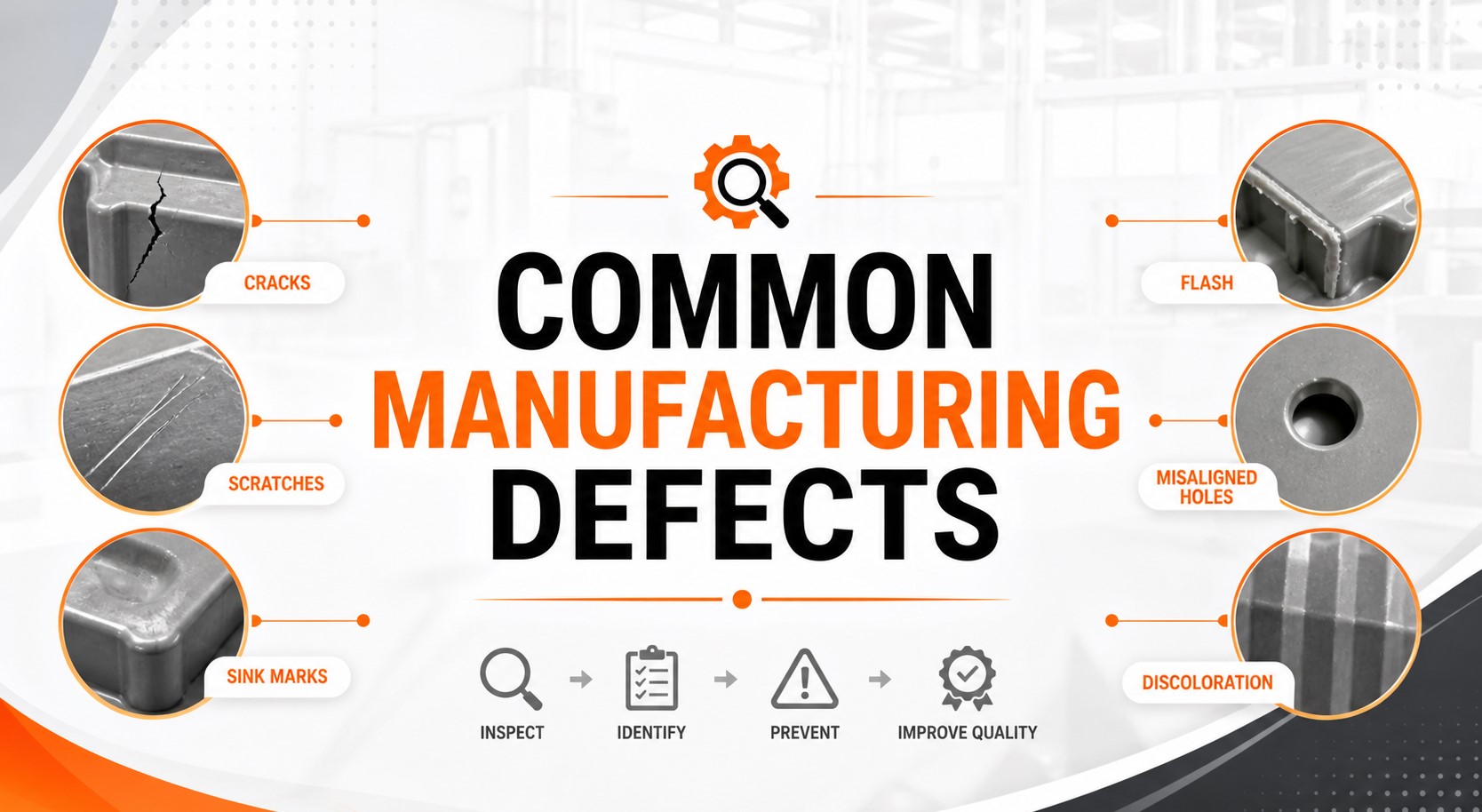
Surface defects are visible imperfections on a product’s exterior that affect its aesthetic quality and consumer perception. They include scratches, dents, tears, discoloration, uneven coating, contamination particles trapped on surfaces, and patterning errors in processes like photolithography for electronics. In categories like automotive finishes, consumer electronics, and premium consumer goods, surface defects directly affect purchasing decisions — a product that looks imperfect is perceived as lower quality regardless of its functional performance. Common causes include rough handling during production, contamination from the manufacturing environment, equipment misalignment, and inadequate material protection between production stages.
Dimensional and Measurement Defects
Dimensional defects occur when a product’s physical measurements — length, width, height, diameter, weight, or geometric tolerances — fall outside the accepted specification range. These can range from minor cosmetic mismatches to critical failures where a structural component doesn’t fit its housing. Causes include tool wear that gradually shifts machined dimensions, incorrect machine calibration, temperature-induced material expansion, and operator error in manual measurement steps. For assembled products, dimensional defects in one component compound: a single out-of-tolerance part can make an entire assembly functionally unusable.
Material Defects
Material defects originate before production begins — when the raw materials or components entering the production process are themselves substandard, contaminated, or incorrectly specified. Chemical contamination alters material properties; physical deformation of incoming materials causes quality inconsistencies in the finished product; size or composition irregularities create variability that no production process can fully compensate for. Given that 61% of recalls are attributed to supplier-related issues, incoming material quality is arguably the highest-leverage defect prevention point in the entire supply chain. Unauthorized material substitution by suppliers — using a cheaper grade of plastic, a different fabric blend, or a generic component in place of a specified brand — is a particularly common source of material defects that’s difficult to detect without systematic incoming inspection.
Assembly Defects
Assembly defects occur when components are incorrectly joined, installed, positioned, or sequenced during the product build process. They arise in both manual and automated assembly, but human-dependent processes are substantially more variable. Missing components, reversed parts, incorrect torque on fasteners, wrong adhesive application, and misaligned sub-assemblies all fall into this category. Faulty fixtures or automated handling equipment can create systematic assembly errors that affect entire production batches before the root cause is identified. Consequences range from cosmetic (a cover panel that doesn’t align properly) to catastrophic (electrical wiring installed with incorrect polarity).
Structural and Integrity Defects
Structural defects are internal weaknesses that may not be visible on the surface but compromise a product’s ability to withstand normal use stresses. Inadequate material bonding, welding defects, voids in composite materials from improper curing, insufficient seam strength in textiles, and delamination in layered packaging materials all fall into this category. These are particularly dangerous because they often pass visual inspection and only manifest as failure after the product has reached the consumer — sometimes under safety-critical conditions. Compression testing, drop testing, tensile testing, and non-destructive evaluation (NDT) are the appropriate detection methods.
Functional and Performance Defects
A product may be visually intact and dimensionally correct but still fail to perform its intended function. Functional defects cover the full range of performance failures: an electronic device that won’t power on, a battery that doesn’t hold charge, a mechanical lock that won’t engage, a pump that doesn’t maintain pressure, or a zipper that fails under normal use tension. These defects can originate from any other defect category — a material defect can cause a functional failure, as can an assembly error or a firmware issue in electronic products. On-site functional testing during product inspection is the primary detection method.
Contamination Defects
Contamination defects involve the introduction of unwanted foreign matter into the product during manufacturing — physical (metal fragments, hair, fibers, dust), chemical (incorrect ingredient, solvent residue), or biological (bacteria, mold). In food manufacturing, contamination by pathogens such as salmonella or listeria triggers mandatory recalls and can cause serious illness. In pharmaceutical production, even trace amounts of incorrect active ingredients can render medicine ineffective or toxic. In electronics, dust on optical or precision components causes functional failures. Environmental controls — clean-room conditions, metal detectors, X-ray inspection systems, proper worker hygiene — are the primary defenses, alongside rigorous sanitation schedules.
Labeling, Packaging, and Documentation Defects
Labeling defects occur when the information on or around a product is incorrect, incomplete, or non-compliant with regulations. Undeclared allergens remain the single most common trigger for FDA food recalls — 47 events in Q3 2024 alone, with nuts and milk as the most frequent undeclared culprits. Other common labeling defects include incorrect country of origin, wrong batch or lot codes, missing regulatory symbols, unreadable barcodes, and care instruction errors on apparel. A product can be physically perfect in every other respect and still be commercially unusable or legally non-compliant if its labeling is wrong. Packaging integrity failures — damaged seals, inadequate cushioning, incorrect packing ratios — also fall here and directly cause product damage during transit.
What are the Root Causes of Manufacturing Defects?
Defects don’t occur randomly — they have specific, identifiable origins. Understanding root causes is what separates defect containment from defect elimination.
The primary root causes are:
- Human error — the most prevalent single cause, responsible for approximately 80% of quality defects. Includes skipped steps, operator fatigue, incorrect assembly sequence, and miscommunication between shifts. The risk increases without documented SOPs, proper training, or adequate supervision.
- Equipment wear and miscalibration — tools and machinery degrade over time. Cutting tools lose precision. Sensors drift. Reflow oven temperatures shift. Without scheduled preventive maintenance and calibration records, equipment-related defects accumulate invisibly until a batch failure makes them visible.
- Substandard or unauthorized raw materials — suppliers substituting cheaper materials without buyer authorization, or incoming materials not inspected against specification. This is the upstream root cause of the 61% of recalls traced to supplier issues.
- Process inconsistency — absence of standardized operating procedures, undocumented process changes, or poorly defined specifications. When workers rely on memory or verbal instruction rather than documented procedures, every shift introduces a different level of variability.
- Environmental factors — temperature, humidity, vibration, and contamination within the production environment. Moisture-sensitive electronic components degrade if stored improperly. Food products contaminate if production areas aren’t cleaned to schedule.
- Inadequate quality management — inspections only at end-of-line rather than at critical process stages, no traceability to isolate root cause when defects are found, and no systematic corrective action process.
- Design-manufacturing gaps — product specifications that exceed what production equipment can reliably achieve, or designs not validated against the actual manufacturing process. When spec and process capability don’t align, defects are inevitable.
What are the Most Common Manufacturing Defects by Industry?
While the defect type taxonomy above applies universally, the specific failures that occur most frequently — and the severity thresholds that matter most — differ significantly by product category.
Garments and Textiles
Garments carry a higher baseline defect risk than most manufactured goods because production is intensely labor-dependent. Human hands sewing and stitching introduce far more variability than injection molding or automated assembly. Minor defects are common: untrimmed threads, slight color variation between fabric rolls (shading), and minor stitching irregularities. Major defects include misaligned seams that affect fit, broken or stuck zippers, fabric damage visible on the finished garment, and measurements outside size chart tolerances. Critical defects in apparel are less frequent but severe: needles or metal fragments left in finished goods, flammability failure in children’s sleepwear, hazardous chemical content like azo dyes or lead, and incorrect sizing in infant products.
Consumer Electronics
Electronics failures are high-consequence because of the combination of complexity and safety risk. Minor defects include surface marks and cosmetic blemishes on housings. Major defects cover the full performance failure category: failure to power on, display malfunctions, connectivity problems, incorrect firmware, and non-functional input/output components. Critical defects center on electrical safety: exposed or damaged wiring (creating fire and electrocution risk), battery cells that overheat or leak — the root cause of the Samsung Note 7 disaster — and electrical shorts. The complexity of electronics means defects can originate at multiple points, from component manufacturing to PCB assembly to final product assembly, making traceability essential for root cause identification.
Automotive
Automotive manufacturing combines high component count with severe safety consequences for functional failures. Paint scratches and minor trim misalignment are cosmetic minor defects. Major defects include faulty door latches, air conditioning failures, electrical system errors, and engine performance issues. Critical defects are those that compromise occupant safety: brake failures, airbag malfunctions (Takata’s defect triggered a recall of over 30 million vehicles in a single NHTSA action in 2023), and steering failures. In 2024, electrical systems became the most common reason for automotive recalls by volume — 2.82 million units impacted in Q3 alone, a 244.9% increase from Q2 — reflecting the complexity of modern vehicle electronics.
Food and Beverage
Food defects carry the most immediate public health consequences of any category. Contamination by pathogens such as salmonella or listeria triggers mandatory recalls across entire production batches. Labeling defects — particularly undeclared allergens — are the most frequent single cause of food recalls in 2024. Composition variations affect safety and efficacy. Packaging seal failures allow contamination and spoilage. Cold-chain defects — temperature excursions during storage or transport — compromise food safety without leaving visible evidence, making them among the hardest to detect and trace.
Pharmaceuticals and Medical Devices
These sectors operate under the most stringent regulatory oversight and carry the most severe defect consequences. Active ingredient concentration errors can make a drug toxic at too-high levels or ineffective at too-low levels. Sterility failures in injectable medications or implantable devices create life-threatening infection risks. The 2024 surge in medical device recalls — up 134.5% year-over-year in the first nine months — reflects both increased regulatory scrutiny and the growing complexity of devices incorporating digital health technologies. Medical device manufacturing defects were the single largest contributor to recall events in Q1 2023.
Why do Defects Cost Exponentially More the Later They are Caught?
This is the quality management principle that most defect-focused content completely omits, and it’s the one that makes the strongest case for upstream quality investment over end-of-line inspection.
The 1:10:100 Rule — known in quality management as the Rule of Ten — establishes a mathematical relationship between defect detection timing and remediation cost:
- Catching a defect at the design stage costs $1 — revising a spec or approving a material substitution is essentially free compared to what comes later
- Catching a defect during production costs $10 — rework, scrap, line stoppage, reinspection
- Catching a defect after delivery to the customer costs $100 — warranty claims, return logistics, replacement production, potential recall management, regulatory response, and brand damage
That 100:1 ratio between post-delivery and design-stage costs explains why relying primarily on final inspection is economically irrational. A defect that could have been prevented at the material qualification stage for $500 can generate $500,000 in recall and remediation costs once it reaches consumers — a 1,000× multiplication.
The ETQ survey data supports this: 39% of manufacturers report that a single recall event costs between $10M and $49.9M.
There is a second dynamic that competitor content rarely addresses: the relationship between buyer price pressure and supplier defect rates. When buyers consistently negotiate below a factory’s sustainable cost level, they create conditions where quality compromise becomes economically rational for the manufacturer.
Material substitution, process shortcuts, reduced inspection frequency — these are the natural adaptations of a factory trying to maintain margin on an under-priced order. The 61% of recalls attributed to supplier issues isn’t random; a significant portion of those failures are the downstream consequence of commercial arrangements that made corner-cutting financially necessary.
How do you Prevent Manufacturing Defects?
Prevention requires action at every stage of the production cycle — not just at final inspection. The most effective programs address root causes systematically rather than applying reactive fixes to individual defect events.
Key prevention practices:
- Standardize all production processes — documented SOPs at every workstation, accessible to operators, updated whenever processes change. Variability is the enemy of quality, and standardization is how you reduce it systematically.
- Invest in operator training — continuous training on process standards, equipment use, and quality criteria; certified sign-off requirements for critical process steps; onboarding programs that go beyond shadowing to documented competency verification.
- Implement incoming material inspection (IQC) — test all incoming raw materials and components against specification before they enter production. A material defect caught at receipt costs a fraction of the same defect caught after it has been processed into finished goods.
- Apply in-process quality checks (IPQC) — establish inspection and testing checkpoints between major production stages. Catching a defect mid-process means reworking a partially completed product, not an entire finished batch.
- Use AQL-based sampling at final inspection — random sampling under ISO 2859 provides statistically valid batch assessment. Define your critical, major, and minor defect tolerances explicitly in your purchase orders and quality documentation before production begins.
- Perform regular equipment maintenance and calibration — scheduled preventive maintenance programs with logged completion; calibration records for all measurement instruments with clearly visible next-calibration dates.
- Conduct supplier audits — verify that your suppliers have the capability, systems, and environment to produce at your quality requirements before you place orders.
- Apply root cause analysis tools — use structured methods (5 Whys, Fishbone/Ishikawa diagram, DMAIC) to identify and address underlying causes rather than applying superficial fixes that allow recurrence.
- Leverage automated inspection technology — machine vision systems achieve 98.5% detection accuracy; automated inspection reduces inspection time by up to 90% and improves defect detection rates by 50% compared to manual methods.
- Maintain traceability — lot tracking and batch codes link finished products to specific material lots, production dates, and process parameters. When a defect is found, traceability determines whether you have a batch-specific problem or a systemic one.
How does a Third-Party Auditor Help Minimize Manufacturing Defects?
Third-party auditors reduce manufacturing defects by addressing their root causes before production begins — not by catching defects after they’ve already been made.
Inspection finds defects in finished goods; auditing identifies the conditions that will produce defects and requires them to be corrected.
- Objective quality system evaluation. Factory management and production teams are under permanent pressure to meet output targets. Third-party auditors operate without that pressure — they assess whether the quality management system, SOPs, inspection procedures, and calibration programs are actually functional, not just documented. A factory whose quality manual claims 100% incoming material inspection but whose storage areas show no IQC records is caught by an auditor; it wouldn’t be caught by a product inspection at end-of-line.
- Equipment and process verification. Auditors physically verify that production equipment is maintained, calibrated, and appropriate for the products being manufactured. They can identify that a reflow oven’s temperature profile isn’t producing consistent solder joints, or that a sewing machine is generating skipped stitches at a rate that will produce major defects — before a full production run has been committed.
- Capacity verification. A factory that takes on more orders than its workforce and equipment can handle will make quality compromises — process shortcuts, reduced inspection frequency, rushed assembly. Auditors calculate whether the factory’s committed production volume is achievable at the required quality level. If it isn’t, they flag the risk before your order becomes part of an overloaded production schedule.
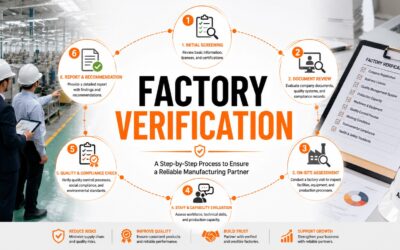
- Supplier qualification before commitment. Before you commit to a factory, a third-party audit gives you verified data on capability, not the factory’s self-assessment. Auditors identify whether quality systems are operational or decorative, whether certifications are current and applicable to your product category, and whether the facility’s working environment supports the quality standards you need.
- Corrective Action Plans and follow-up. After identifying non-conformances, professional auditors issue formal Corrective Action Plans (CAPs) that document each finding, the required corrective action, the responsible person, and a completion deadline. Follow-up audits verify that corrections were actually implemented — creating an enforceable improvement cycle rather than a one-time event.
- Unannounced audits. When audits are conducted without advance notice, they reveal actual operational conditions rather than prepared presentations. A factory that practices adequate quality management when no one is watching produces consistent quality; one that prepares only for planned audits does not.
How does QCAdvisor Help Prevent Manufacturing Defects?
QCAdvisor is a third-party factory audit and product inspection provider with over 1,000 clients globally, trusted by manufacturers and brands including Ikea, Alstom, RATP, Modway, Liewood, Komono, and Izipizi across consumer goods, industrial, and retail categories.
Their approach is built around defect prevention rather than defect catching — captured in their stated mission: “Avoid defects, instead of just catching them.” QCAdvisor’s factory audit service evaluates quality management systems, production capability, equipment maintenance standards, workforce training programs, and compliance with ISO 9001 and applicable regulatory frameworks.
For buyers sourcing from China or across Asia, they can schedule and execute an on-site factory audit within 24 hours of booking — making independent verification practical for both pre-order supplier qualification and reactive investigation when quality anomalies surface.
For importers who need supplier verification without traveling, QCAdvisor offers the QCAdvisor 360 Virtual Tour — an interactive, immersive remote facility walk-through that allows buyers to evaluate the production environment, equipment, and process layout from their office. Their product inspection services cover pre-shipment verification against buyer specifications and applicable regulatory standards, with detailed reports that identify defect type, severity, and required corrective action before goods leave the factory. You can explore their services and request a quote at qcadvisor.com.
Conclusion
Manufacturing defects are not random events — they are the predictable output of specific conditions: undertrained workers, inadequately maintained equipment, substandard materials, insufficient process controls, and quality systems that inspect rather than prevent.
The 1:10:100 cost escalation rule quantifies what experienced quality managers already know: every dollar spent preventing a defect before production outperforms ten dollars of rework spent fixing it mid-process, which outperforms a hundred dollars of recall management after the product has shipped. The most commercially rational quality strategy isn’t finding defects faster — it’s creating the upstream conditions that make defects unlikely in the first place.