Previo en Origen (PEO) is a pre-customs clearance inspection conducted at the country of origin before goods depart for Mexico — verifying physical condition, quantities, and documentary compliance with Mexican customs regulations so that, upon container arrival, your customs broker can initiate a release from SAT within 48 hours.
For anyone moving goods from China, Vietnam, or India into Mexico, understanding PEO is not optional background knowledge; it is the foundation of a compliant and cost-controlled pre-shipment inspection process for Mexico imports.
Mexico’s total merchandise imports reached USD 625.3 billion in 2024 (INEGI), and the country’s seaports processed 2.95 million TEUs in the first four months of 2024 alone — an 18.2% year-over-year increase that puts serious pressure on customs clearance capacity.
US goods and services trade with Mexico totalled USD 935.1 billion in 2024, with Mexico ranking as the top source of US imports — reinforcing the scale of customs compliance stakes.
Key Takeaways
- PEO resolves NOM labeling, HS codes, and documentary compliance at origin — before penalties can apply.
- Mexico’s total merchandise imports reached USD 625.3 billion in 2024 (INEGI). – HS code misclassification carries fines of 250–300% of applicable import duty.
- The 2026 Ley Aduanera reform placed direct legal liability on importers — the customs agent exemption no longer exists.
This guide covers what PEO is and its legal basis, why importers need it and what the financial stakes are, how a PEO inspection works step by step, the ten measurable benefits it delivers, the exact conditions required to achieve the 48-hour release, and how to decide when a PEO inspection is the right call for your shipment.
What Is Previo en Origen?
Previo en Origen (PEO) — translated into English as “Pre-Customs Clearance Inspection” — is a third-party compliance inspection conducted at the country of origin before a shipment departs for Mexico.
Its legal authority comes from Article 42 of Mexico’s Ley Aduanera (Customs Law), officially titled “Examen previo de las mercancías” (Prior Examination of Merchandise), which authorizes pre-arrival physical and documentary review of imported goods.
Article 43 of the same law, which some sources cite in error, governs the automated port-of-entry inspection trigger and does not cover PEO.
Accredited bodies operating under ISO 17020 — the international standard for inspection body competence — conduct the inspection. Their formal output is a certified Previo en Origen inspection report, recognized by SAT (Servicio de Administración Tributaria), Mexico’s customs authority, and transmitted to your customs broker (agente aduanal) to initiate the accelerated clearance process.
PEO is, however, distinct from the other inspection types importers often compare:
- Container Loading Check (CLC): Covers loading observation and container sealing only — no documentary compliance review, no NOM verification, and no 48-hour release eligibility.
- Previo en Origen (PEO): Adds full documentary review — NOM labeling verification, HS code pre-classification, and document cross-checking — to the CLC scope.
- Destination customs inspection: Conducted by SAT after arrival — cannot, in most cases, correct compliance failures before penalties apply.
Why Do Importers Need Previo en Origen for Mexico?
NOM compliance is legally mandatory for every shipment entering Mexico, and PEO is typically the most efficient pathway to complete that compliance before goods leave the factory. The result: customs clearance within 48 hours of arrival and elimination of port-side holding costs.
Since October 1, 2020, all importers must comply with applicable Norma Oficial Mexicana (NOM) labeling standards before Mexican customs clearance. Three pathways exist: accredited Inspection Units using private addresses, accredited General Warehouses, or origin-country inspection via PEO. For exporters shipping from Asia, PEO is typically the only route that achieves compliance before departure.
The financial risks of getting this wrong are severe:
- HS code misclassification carries fines of 250–300% of the applicable import duty.
- Storage and holding fees accumulate daily when shipments are detained at the port.
- Demurrage charges — fees incurred when a container is held beyond the free-time window — are eliminated entirely when PEO has been completed before departure.
- In extreme cases, SAT can order confiscation of the shipment.
The stakes increased sharply with the 2026 Ley Aduanera reform, published in Mexico’s Diario Oficial de la Federación on November 19, 2025, and effective January 1, 2026. That reform eliminated the exemption from liability previously granted to customs agents. Importers and customs brokers now share direct legal responsibility for documentation accuracy and NOM compliance. Technical regulation errors — including any NOM non-compliance — are classified as serious violations, with fines of up to 300% of the goods’ value. The same reform affects approximately 1,463 tariff items with average duty increases of 35% and up to 50% in some product categories; goods qualifying under USMCA/T-MEC preferential treatment are exempt from these increases. If you previously relied on your customs agent to absorb compliance risk, that arrangement no longer holds.
How Does a Previo en Origen Inspection Work?
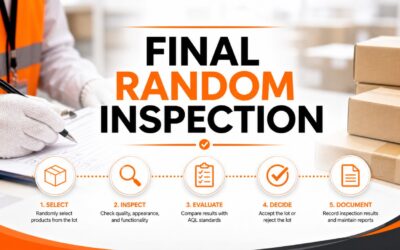
From document review at the origin factory to customs release within 48 hours of container arrival in Mexico, PEO runs through 8 sequential stages. Each builds on the last; a failure at any point can break the 48-hour clearance pathway.
- Service request and supplier coordination — You or your freight forwarder books the inspection with an accredited ISO 17020 inspection body. The inspection body assigns an inspector and dispatches them to the factory.
- Pre-documentation review — Before arriving on-site, the inspector reviews the commercial invoice, packing list, and certificate of origin. For goods shipped under USMCA/T-MEC (Tratado México-Estados Unidos-Canadá) preferential tariff treatment, the certificate of origin must follow the USMCA format. For regulated categories such as food, pharmaceuticals, and chemicals, additional documents may be required — a Quality Inspection Certificate, Health Certificate, or sector-specific regulatory permit — and the inspector estimates applicable import duties and fees at this stage, giving your finance team early cost visibility.
- Physical inspection — Container and packaging condition are checked, external and internal. A 100% quantity count and piece counts are performed against the packing list. Random product sampling verifies goods against the product specifications.
- NOM labeling compliance check — Every applicable Norma Oficial Mexicana standard must be met. Common standards include NOM-050-SCFI (general consumer products), NOM-004-SE (textiles and fiber content), NOM-051-SCFI (food and beverages, requiring front-of-pack warning seals), NOM-024-SCFI (electronics, which also requires ANCE certification from Mexico’s national electrotechnical certification body), and NOM-020-SCFI (footwear and leather goods). The RFC (Registro Federal de Contribuyentes — Mexico’s federal taxpayer number) must appear on product labels and commercial invoices.
- HS code pre-classification — The inspector verifies that the declared Harmonized System tariff code matches the actual product. An incorrect code declaration is one of the five most common PEO failure modes, covered in the inspector’s note below.
- Loading supervision and photographic documentation — The inspector supervises container loading and sealing. Photographic documentation of cargo condition is produced as pre-departure visual evidence, useful in any subsequent dispute resolution.
- Certified report preparation and transmission — The inspector prepares the certified Previo en Origen report and transmits it to your customs broker.
- Customs submission and 48-hour release — Upon container arrival in Mexico, your customs broker submits the PEO report and the Pedimento (Mexico’s official customs declaration) to SAT, initiating the 48-hour release process.
Throughout the process, the inspector cross-verifies the packing list, commercial invoice, and customs declaration against each other. Any discrepancy between those three documents can prevent the 48-hour release — a point covered in detail in the next section.
The five most common PEO failures are: incorrect or missing NOM labeling, RFC absent from labels or invoices, HS code mismatch, quantity discrepancy against the packing list, and missing certificates of origin. In my experience, the RFC number missing from a label is the most preventable of these failures — and the one that catches importers off guard most often. Address all five before the inspector arrives.
After the certified report is transmitted, your job is not finished. Stay available to respond to any additional requests from SAT or your customs broker upon container arrival.
What Are the Benefits of Previo en Origen?
PEO delivers 10 measurable advantages for importers. Its primary benefit is customs clearance within 48 hours of container arrival — achievable, in most cases, through no other single method for non-USMCA shipments from Asia.
- 48-hour customs clearance — Goods with a completed PEO report are processed by SAT within 48 hours of container arrival at a Mexican port.
- Elimination of shipping delays — Compliance issues are resolved at the factory, not at the port, so there is nothing to hold the shipment at customs.
- Avoidance of customs fines and financial penalties — NOM compliance and HS code accuracy are verified before departure, removing the conditions that trigger fines.
- Elimination of storage and demurrage fees — No customs hold means no accumulating daily storage costs and no demurrage charges for containers held past the free-time window.
- Verification of product quality and quantity — The 100% count and random sampling confirm the shipment matches the purchase order before it leaves the factory.
- NOM labeling corrections made at origin — Non-compliant labels discovered at the factory are fixed there. Without PEO, the same problem discovered at port requires costly and time-consuming remediation from a distance.
- Improved cash flow — Goods cleared within 48 hours can be sold or deployed sooner, reducing the capital tied up in transit inventory.
- Reduced customs examination risk — Consistent, documented compliance builds a positive standing with SAT over time, reducing the likelihood of secondary inspections on future shipments.
- Elimination of post-arrival back-and-forth — All compliance issues are resolved before departure, removing repeated coordination between you, your customs broker, and SAT after the container arrives.
- Reduced product loss risk — Photographic documentation and 100% physical verification before loading create an accountable chain of custody for high-value shipments.
PEO benefits three groups: importers gain compliance assurance and pre-verified documentation; customs brokers gain operational certainty; freight forwarders gain reliable delivery timelines.
Goods arriving without a completed PEO report risk customs holds lasting days or weeks, with storage fees accumulating throughout. Goods arriving with a completed PEO report clear within 48 hours. That contrast is the central financial argument for commissioning PEO on every Mexico-bound shipment.
What Does the 48-Hour Customs Release Actually Require?
The 48-hour customs release is conditional, not automatic. Every element below must be correct for it to apply:
- ISO 17020 accredited inspection body — The inspection must be conducted by a body officially accredited under ISO 17020. Reports from non-accredited inspectors carry no weight with SAT.
- Certified report completed before departure — The certified Previo en Origen report must be finalized and transmitted to your customs broker before the shipment leaves the origin country.
- Pedimento and PEO report submitted upon arrival — Your customs broker must submit the Pedimento and the PEO report to SAT immediately upon container arrival. Any delay in submission delays the 48-hour clock.
- Full NOM labeling compliance — Every applicable NOM standard must be met in full. Partial compliance is treated as non-compliance.
- HS code match — The declared Harmonized System tariff code must match the actual product inspected. A single code mismatch is sufficient to trigger secondary inspection.
- Valid certificate of origin — The certificate of origin must be valid, correctly formatted, and in the USMCA format if preferential tariff treatment is claimed.
A single missing element — even the RFC number absent from one product label — breaks the 48-hour pathway entirely. Treating these six conditions as a pre-departure checklist removes uncertainty from the 48-hour promise and gives you a concrete standard to manage your supplier and inspection provider against.
When Should You Commission a Previo en Origen Inspection?
A Previo en Origen (PEO) inspection is a pre-departure compliance mechanism that becomes both urgent and financially justified based on three importer-specific variables. Three variables determine both urgency and financial justification: your product category, the shipment value relative to potential penalties, and your position under the post-2026 liability regime.
- Product category and NOM exposure — NOM standards are product-specific. Electronics require ANCE certification under NOM-024-SCFI. Food and beverages require front-of-pack warning seals under NOM-051-SCFI. Textiles require fiber content labeling under NOM-004-SE. Cosmetics require COFEPRIS (Comisión Federal para la Protección contra Riesgos Sanitarios) registration under NOM-141-SSA1. Higher-risk categories carry greater penalty exposure and benefit most from PEO.
- Shipment value and penalty mathematics — For any non-trivial shipment, the combined risk of NOM fines, HS code misclassification penalties with significant duty penalty exposure, daily storage fees, demurrage charges, and potential confiscation substantially exceeds the cost of commissioning a PEO inspection. The cost-benefit case is strongest for first-time shipments to Mexico or new product categories, where you have no established compliance track record with SAT.
- The 2026 liability reform — As covered above, the November 2025 reform eliminated the customs agent liability exemption and placed direct legal responsibility on you as the importer. Treat every Mexico-bound shipment under this framework as a compliance event, not a logistics event.
- Scheduling lead time — Plan a minimum of 21 days before your shipment loading date. The recommended milestones: book the inspection 21 days out, submit documentation 14 days out, complete pre-inspection document review 7 days out, and conduct the physical inspection 3–5 days before loading.
- Regulated product permits — Some categories require permits beyond NOM compliance. The Secretaría de Economía issues sector-specific import permits for chemicals, dual-use goods, and certain industrial equipment. SEMARNAT (Secretaría de Medio Ambiente y Recursos Naturales) issues permits for products with environmental considerations. Confirm all permit requirements before booking the inspection.
From my experience, PEO is advisable for all shipments to Mexico from non-USMCA countries, and essential for regulated product categories, first-time Mexico shipments, and any shipment operating under the post-2026 liability framework. Treating PEO as a standard step — rather than a precaution reserved for high-risk shipments — is the most straightforward way to keep your Mexico import operations predictable.
How Does QC Advisor Cover Pre-Shipment Inspections for Mexico Imports?
QC Advisor covers pre-shipment inspection processes across product categories and sourcing markets. Previo en Origen sits within the broader landscape of pre-shipment inspection for Mexico imports — a specialized compliance inspection with Mexico-specific regulatory requirements, distinct from a standard pre-shipment inspection (PSI).
QC Advisor coverage includes: – Standard PSI: AQL (Acceptable Quality Level) sampling, quality verification, defect classification, and supplier audits across product categories. – Compliance-focused inspections: PEO and equivalent market-specific inspections covering NOM labeling, HS code pre-classification, and Pedimento documentation. – QC documentation: Inspection reports, audit findings, and corrective action tracking for ongoing supplier relationships.
Nearshoring companies relocating manufacturing to Mexico to supply North American markets are among the primary users of PEO. Mexico attracted approximately USD 41 billion in foreign direct investment in 2025, with manufacturing accounting for 37% of total FDI. No inspection service is sold or recommended here; this is editorial guidance only.
What Should Importers Take Away From This Guide to Previo en Origen?
Previo en Origen is the most practical compliance route for Mexico-bound shipments because it resolves NOM labeling, HS code classification, and documentary accuracy at the factory — the only point in the supply chain where corrections can be made before penalties apply. The 2026 Ley Aduanera reform placed direct legal responsibility for NOM compliance on you as the importer. Treating PEO as a standard step — not a precaution reserved for complex shipments — keeps your Mexico imports predictable.
Two actions before your next Mexico-bound shipment: – Confirm which NOM standards apply to your product category and verify that compliance is achievable at the factory before your inspection date. – Book your PEO inspection at least 21 days before your loading date — submit documents 14 days out, and schedule the physical inspection 3–5 days before loading.
Are you currently commissioning a PEO inspection on every Mexico-bound shipment, or are you still relying on destination-side compliance checks to catch issues after the container has sailed?