Factory verification is the process of independently confirming that a potential supplier is a legitimate, registered business with the manufacturing capability, quality systems, and financial stability to fulfil your orders — conducted before any purchase order is placed.
The reactive pattern is common — you only discover you needed it after your first costly mistake.
One documented case involved a client losing $75,000 to a trading company that presented itself as a factory throughout the entire sourcing process. That kind of loss is avoidable, and that is exactly the problem this guide addresses.
Key Takeaways
- Factory verification confirms a supplier’s legal registration, physical premises, and manufacturing capability before any order is placed.
- An estimated 30% of B2B platform suppliers are trading companies, not factories.
- Third-party verification takes 5–7 business days; the on-site visit is 0.5–1 day, from $249/man-day.
- Verification is a screening gate — a verified supplier can still miss deadlines or subcontract without disclosure.
- Re-verify suppliers annually for lightweight checks; commission a full factory audit every two years.
The stakes extend beyond individual sourcing errors. Third-party failures are cited by 43.6% of organisations as the primary cause of supply chain disruptions globally, according to the BCI Supply Chain Resilience Report 2024.
Nearly 80% of those surveyed experienced a disruption in the previous twelve months, with most problems originating in the first two supplier tiers.
Four risk categories are directly addressed by factory verification: fake or misrepresented manufacturers, inconsistent production capability, fraudulent or invalid certifications, and quality and compliance failures.
The factory verification process is most valuable when selecting a new supplier, placing a high-value order, changing manufacturers, scaling production, or responding to warning signs such as inconsistent communication or unclear documentation.
A proper verification follows a structured sequence: defining the scope, collecting supplier information, conducting on-site or remote checks, reviewing evidence, and interpreting the final report.
However, factory verification does not guarantee perfect production quality, future compliance, or complete protection from supplier risk. It helps buyers identify red flags, compare supplier claims against real operating conditions, and understand how verification differs from factory audits, inspections, factory acceptance Testing, process verification, and broader supplier management.
What Is Factory Verification?
Factory verification is a pre-order due diligence process that confirms a supplier’s legal registration, physical existence, manufacturing capability, and quality systems before any purchase order is issued.
It answers one specific question: “Should we consider working with this supplier?” — not “How do we manage this supplier once we are engaged?”.
That distinction matters, and it shapes the entire scope of the activity. Factory verification is a critical component of supplier qualification — conducted before purchase orders are issued, it establishes the baseline that determines whether further qualification steps are warranted.
Seven attributes are assessed under factory legitimacy verification: legal registration status, physical operations and premises, production equipment, quality control procedures, operational consistency, verifiable certifications, and product manufacturing capability. These seven attributes define what “legitimacy” means in practice — confirming that a supplier is both real and capable.
The industry uses several terms interchangeably for this process. You will encounter “supplier verification,” “factory legitimacy verification,” and “factory vetting” all referring to the same pre-order due diligence activity.
This article uses “factory verification” specifically to refer to the check conducted on manufacturers — as opposed to trading companies or distributors — because confirming physical manufacturing premises and production capability is central to the check. Factory legitimacy — the core concept being confirmed — means the manufacturer is a genuine, operational, and legally registered business capable of producing products to agreed specifications.
What Does Factory Verification Actually Check?
Six categories of checks make up the scope of factory verification: legal and business registration, manufacturing capability, quality management systems, financial health and stability, social and environmental compliance, and export and trade references.
Each category targets a distinct failure mode — a supplier can pass five and still carry serious risk in the sixth. The six checks below define the full scope of a standard factory verification:
- Legal and business registration — confirms the supplier is a legally incorporated entity with a valid business licence, registered address, and authorised business scope.
- Manufacturing capability — verifies the factory has the equipment, workforce, and monthly production capacity to meet your order requirements.
- Quality management systems — reviews quality control systems (covered in detail in Step 4 below).
- Financial health and stability — assesses whether the supplier is financially solvent and unlikely to fail mid-order.
- Social and environmental compliance — checks whether the factory meets applicable labour, health, safety, and environmental standards.
- Export and trade references — reviews shipping history, existing client references, and trade fair participation to confirm operational activity.
A complete factory verification checklist covers nine areas: business registration, factory existence, production capability, quality systems, certifications, product samples, factory audit findings, production inspection, and pre-shipment inspection readiness.
The first six areas are addressed within the five-step process described in this article while the final three represent the broader quality control workflow that follows a successful verification.
One point worth knowing: B2B platform “verification badges” — such as those displayed on Alibaba — only confirm that an identity check was performed on the seller. They do not confirm manufacturing quality or production capability. A badge is not a substitute for a proper verification.
When Should You Commission a Factory Verification?
Five specific conditions trigger factory verification: consideration of a new supplier, an imminent deposit or first order, sharing of sensitive IP, a supplier switch, and material changes to a supplier’s circumstances.
Getting the timing right matters because verification conducted too late — after a deposit is paid or specifications are shared — leaves you without the leverage to walk away cleanly if the supplier fails the check.
A supplier that has already received your product drawings and payment terms holds negotiating power you cannot recover. Here are the five trigger events that justify commissioning a factory verification:
- Before approving a new supplier — any supplier you have not previously worked with should be verified before you advance the relationship.
- Before paying a deposit or placing a first order — the financial commitment of a deposit makes this the minimum acceptable threshold for completing verification.
- Before sharing sensitive technical drawings, specifications, or IP — once you share proprietary information, you lose leverage. Verify the supplier is who they say they are first. In China sourcing contexts, a Non-Disclosure, Non-Use, Non-Circumvention (NNN) agreement provides IP protection after verification — bilingual contracts are recommended for enforceability in Chinese courts.
- Before switching from one supplier to another — a change in supplier carries the same risks as a new sourcing decision; treat it accordingly.
- When a supplier’s circumstances have materially changed — ownership transfers, management changes, reported capacity reductions, and financial difficulties all warrant re-verification.
Verification has a shelf life — re-verification timing depends on supplier risk and relationship stage.
Once a supplier passes verification, a manufacturing agreement should follow — covering pricing and payment terms (typically a 30% deposit and 70% on completion), minimum order quantities, delivery timelines, quality standards, and maximum acceptable defect rates.
Factory verification comes before production capability assessment, specification agreement, and the purchasing contract — it is the earliest supplier-facing step. A complete factory vetting process, from requirements definition through ongoing management, takes approximately 4–6 weeks.
How Is Factory Verification Conducted?
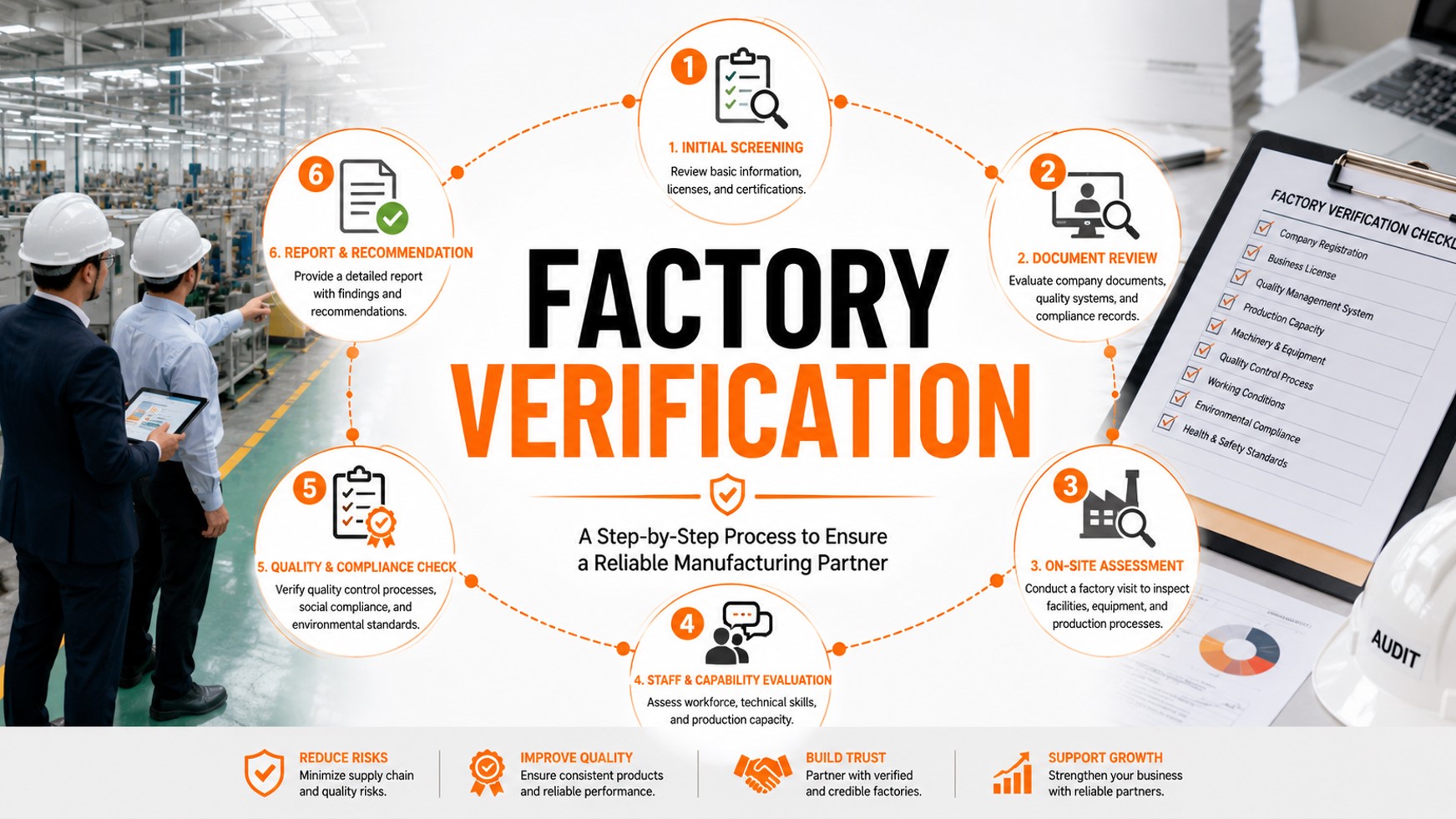
Factory verification works in 5 stages: desk-based registration checks, physical factory confirmation, production capability assessment, quality control system review, and certification verification. The full process takes 5–7 business days including remote research and report compilation; the on-site component takes 0.5–1 day. The on-site visit itself follows seven steps: arrival and company identity check, facility walkthrough and capacity assessment, quality control system review, production sample review, document verification, worker and management interviews, and verification report compilation. Third-party factory verification starts from approximately $249 per inspector-day, with 2025 market rates confirmed at $268–$298/man-day across major providers including V-Trust and Sofeast.
Step 1 — Verify Business Registration and Legal Status
This step confirms the supplier is a legally registered entity with an authorised business scope that matches what they claim to produce. Seven attributes need verification: registered company name, registration number, registered address, legal representative, incorporation date, business scope, and tax registration status.
The verification approach differs across four key manufacturing countries:
- China — verify via the National Enterprise Credit Information Publicity System (NECIPS), the government database for confirming company legitimacy.
- Vietnam — verify via the General Department of Taxation database. Many Vietnamese factories are majority-owned by Korean, Taiwanese, or Chinese investors, which affects the structure of the company you are evaluating.
- India — check GST registration, DUNS number, and Import-Export Code (IEC) issued by the Directorate General of Foreign Trade (DGFT). Confirm the factory’s physical location against its registered office address.
- Mexico — verify through the SAT (Servicio de Administración Tributaria) taxpayer database.
Three documents to request at this stage: business licence, tax registration certificate, and export licence.
Step 2 — Confirm Physical Factory Existence
This step catches the most damaging category of fraud: trading companies posing as manufacturers. An estimated 30% of suppliers listed on major B2B platforms are trading companies, not factories. Confirming that a factory physically exists and operates as claimed is the step most importers skip — and the one that most directly prevents this problem.
Two tiers of confirmation are available:
Remote methods (desk research): – Google Maps street view and satellite imagery of the factory address – Factory website review and video walkthroughs – Trade directory listings and trade fair participation records – Import and customs data via ImportYeti or Panjiva — a factory that has actively shipped goods leaves a customs trail, providing indirect proof of operational activity
On-site confirmation: – Verify the location is in an industrial zone, not a residential building or office – Bureau Veritas, V-Trust, or SGS can conduct the visit on your behalf
Remote verification is insufficient on its own. A Harvard Business School study of nearly 35,000 compliance audits conducted between 2019 and 2021 found that remote audits detected 25% fewer violations than in-person audits overall — and 59% fewer violations in observation-dependent areas. For document-review-based checks, the gap narrowed to 21% fewer violations.
Step 3 — Evaluate Production Capability
This step confirms the factory can actually produce what it claims — at the volume, specification, and quality level your order requires. Three areas are assessed:
- Production equipment — type, age, and maintenance condition of machinery on the floor
- Workforce and labour capacity — headcount and relevant technical skills
- Monthly production capacity — claimed output volume versus observable floor activity
During an on-site or third-party visit, verifiers count machines on the floor, observe worker numbers, identify QC checkpoints in the production line, inspect raw material storage, and check equipment maintenance records. On the question of announced versus unannounced visits: announced visits show the factory at its best; unannounced visits reveal day-to-day operational reality. The gap between the two presentations indicates the true baseline condition of the facility.
Product samples are evaluated across five criteria: workmanship quality, functional performance, material composition, packaging standards, and alignment with agreed specifications. A 2–3 week sample turnaround is the industry benchmark for assessing supplier responsiveness — how quickly and accurately a factory revises samples in response to feedback reveals its capacity to handle specification changes during production.
Step 4 — Review Quality Control Systems
A factory’s quality control system is what turns incoming raw materials into conforming finished products — and what prevents defect-rate surprises after the order ships. Six attributes of the QC system are assessed during verification:
- Incoming material inspection procedures
- In-process quality controls
- Final inspection procedures
- Defect management processes
- Corrective action protocols
- QC documentation practices
Going significantly deeper than basic verification requires a factory audit, which covers nine areas including layout and facility cleanliness, non-conforming materials handling, and complaint handling. That nine-area checklist reflects audit scope — not factory verification scope. The distinction between the two is developed in the comparison section below.
Step 5 — Verify Certifications and Compliance Documents
Accepting a certificate at face value is a specific, well-documented risk. Suppliers can and do forge or alter compliance documents. Common certifications to verify include: ISO 9001 (quality management), ISO 14001 (environmental management), BSCI (social compliance), Sedex/SMETA (ethical trade), SA8000 (labour standards), FSC (chain of custody for forestry products), WRAP (responsible manufacturing), and product-specific testing reports.
Every certificate requires a four-dimension check:
- Validity — is the certificate current and not expired?
- Issuing organisation — is the certifying body accredited?
- Scope of certification — does the scope cover the relevant product category?
- Facility matching — does the certificate name this specific factory, not a parent company or holding entity?
At this stage, complete your document request by adding: ISO certification, product-specific certifications, third-party test results, and any available compliance audit documentation (F038 — documentation stage items). Verify each certificate directly with the issuing body before accepting the file.
What Does Factory Verification Not Cover?
Factory verification has 6 known performance limitations. Its primary limitation is scope: it confirms whether a supplier is genuine and capable at a point in time — it does not guarantee future order performance. Its main caveat is temporal: verification becomes outdated, and a supplier’s circumstances can change materially after the check is completed.
A verified supplier may still fail in 6 specific ways:
- Miss production deadlines
- Misunderstand or misinterpret your specifications
- Change materials without notifying you or seeking approval
- Communicate poorly or inconsistently
- Subcontract production without disclosure
- Fail agreed quality standards on a specific batch
From my experience reviewing sourcing problems, most China sourcing failures occur post-verification — they are supplier management failures, not factory verification failures. If the supplier is real but unreliable, you need better management systems, not a more detailed verification. Factory verification is the entry gate; supplier management runs everything after it.
The regulatory landscape is also shifting the bar. The EU Corporate Sustainability Due Diligence Directive (CSDDD, Directive (EU) 2025/794) applies to companies with 1,000+ employees and EUR 450 million+ net worldwide turnover, with phased application from July 2028. It explicitly states that contractual assurances alone are insufficient — companies must implement genuine verification measures and ongoing monitoring. In the US, the Uyghur Forced Labor Prevention Act (UFLPA) drove US Customs and Border Protection to detain an average of 428 shipments per month in 2024 — a 25% increase from 2023 — with 48% of detained shipments denied entry. For in-scope companies on either side of the Atlantic, a one-time verification approach is increasingly legally inadequate.
Factory verification sits at step 2 of a 10-step supplier control process. Supplier management — covering communication, contracts, production monitoring, inspections, and performance reviews — runs from step 6 through step 10.
What Red Flags Does Factory Verification Uncover?
Two categories of red flags surface through factory verification: signs that a supplier may be illegitimate, and signs that a supplier is unsuitable for your specific requirements. Across both categories, 15 warning signs are the most significant.
Eight legitimacy red flags signal a supplier may not be who they claim:
- No factory address provided, or refusal to permit site visits
- Business licence inconsistencies — name, scope, or address mismatches between documents
- Exaggerated capacity claims that do not match observable floor activity
- No dedicated QC department
- Resistance to third-party inspection
- Unusually low pricing relative to market rate for the product category
- Newly registered company with no traceable trading history
- Offering multiple unrelated product categories — a reliable indicator of a trading company, not a manufacturer
Six operational and financial red flags deserve equal attention:
- Payment account names that do not match the registered company name
- Suspicious or unusual payment requirements
- No evidence of actual production activity — no photos, no video, no visible line activity
- Poor or evasive communication
- Expired certifications
- Limited transparency about production processes
Four communication red flags during initial contact reveal intent early:
- Use of free email domains (Gmail, Yahoo) for business correspondence
- Offering zero minimum order quantities on custom products
- Demanding full upfront payment before any samples are provided
- Claiming the ability to manufacture any product across entirely unrelated categories
I remember one case where a supplier checked every box on paper, but their business email was a Gmail account, they claimed to produce electronics and textiles simultaneously, and they asked for a 100% deposit before samples. Three separate red flags — and the buyer nearly paid.
How Do You Interpret a Factory Verification Report?
A factory verification report is the deliverable produced by the verification process. It contains a pass/fail assessment and a risk rating — and the risk rating is the decision input you act on, not just the pass/fail label. Contrast this briefly with a factory audit report, which contains scoring against criteria, improvement plans, and corrective action tracking — a factory verification report is a screening tool, not a management roadmap.
A standard factory verification report contains 5 sections:
- Company profile verification — confirms legal name, registration number, registered address, business scope, and incorporation date match the documents provided and the government database.
- Facility assessment — summarises physical existence findings: location type (industrial vs residential), floor space, estimated headcount, and production equipment observed.
- Quality system evaluation — rates the observable QC controls against the six system attributes checked in Step 4.
- Risk rating (Low / Medium / High) — the overall supplier risk assessment. A Low rating means proceed with standard commercial due diligence. A Medium rating means a factory audit on this supplier is recommended before placing an order. A High rating means the supplier failed one or more legitimacy checks — do not proceed.
- Recommendations — specific actions the importer should take based on findings, including any documents that require further verification, follow-up questions, or re-verification triggers.
When I review a factory verification report, the first thing I check is the risk rating, then the recommendations section. The body sections tell you why the rating was assigned. Use factory verification to narrow your supplier shortlist; then commission a factory audit only on the finalists. Running a full audit on every candidate is unnecessary and expensive — verification does the screening work first.
An estimated 48% of initial sourcing projects encounter quality complications due to unverified suppliers. A structured report gives you the decision basis to avoid being part of that figure.
How Does QC Advisor Cover Factory Verification and Supplier Due Diligence?
QC Advisor is an independent quality control advisory resource for B2B importers and sourcing professionals. It covers the full spectrum of supplier due diligence and quality control: factory verification as the entry point, factory audits for qualified suppliers, pre-shipment inspection (PSI) and During Production Inspection (DUPRO) for production-stage quality monitoring, AQL (Acceptance Quality Limit) sampling for batch-level conformance assessment, and defect classification for corrective action workflows. The global Third Party Quality Inspection Service market was valued at USD 9.73 billion in 2024 and is projected to reach USD 15 billion by 2035, growing at a CAGR of 4.0% (WiseGuy Reports, LR010). The broader Testing, Inspection and Certification (TIC) market was valued at USD 265.6 billion in 2025, with manufacturing at 28% of end-use share and Asia-Pacific as the fastest-growing region (GM Insights, LR011).
Factory verification is where the importer due diligence process begins — but it is one stage in a broader QC practice. QC Advisor’s coverage spans importers sourcing from China, Vietnam, India, and other major manufacturing regions. The articles cover both the procedural and the conceptual: how to run a process, and why each element of the process matters for your specific sourcing context. The register throughout is practitioner-facing, not vendor-facing — QC Advisor provides importer-side guidance without a service provider’s commercial agenda.
How Does Factory Verification Compare to Related QC Concepts?
Factory verification sits within a broader vocabulary of supplier quality processes. It is frequently confused with supplier verification, factory audit, factory inspection, Factory Acceptance Testing, process verification, and supplier management. Each concept is distinct. The confusion is understandable — all six terms appear in quality control and sourcing literature, sometimes interchangeably — but commissioning the wrong service or misunderstanding the deliverable leads to misaligned expectations and gaps in your supplier due diligence.
Factory Verification vs Supplier Verification
Supplier verification differs from factory verification in scope: supplier verification applies to any supplier type — factory, trading company, or distributor — while factory verification applies specifically to manufacturers, where the check additionally confirms physical manufacturing premises and production capability. Both are pre-order due diligence activities that check legitimacy and registration, and both are event-based. The key difference is that factory verification requires confirming physical manufacturing premises and production capability — attributes irrelevant when verifying a distributor or trading company.
Supplier verification confirms a supplier exists and is genuine. Supplier qualification goes further by confirming the supplier meets specific technical, quality, and regulatory requirements for a particular product or programme. Verification is a prerequisite for qualification, not a substitute for it.
Factory Verification vs Factory Audit
Factory verification differs from a factory audit primarily in scope and depth: verification is an overview check confirming legitimacy and basic capability; a factory audit is a comprehensive evaluation of quality management frameworks, systems, procedures, and personnel, examining workplace conditions and capabilities in detail.
The six-dimension comparison:
- Purpose — verification confirms legitimacy and basic capability; a factory audit evaluates quality management systems comprehensively
- Timing — verification is pre-order or pre-engagement; audits are pre-production or periodic
- Scope — verification covers registration, physical existence, and capability overview; audits cover procedures, controls, and personnel interviews in detail
- Duration — verification takes 0.5–1 day on-site; audits take 1–3 days
- Investment — verification starts from $249/man-day; audits range from $300–$1,000 depending on type
- Deliverable — verification produces a pass/fail assessment with a risk rating; audits produce a scored report with improvement plans
Both occur at or near the supplier’s facility, both are pre-production tools for supplier qualification, and both can be conducted by third-party firms such as Bureau Veritas, V-Trust, or SGS. Factory audits exist in five types: capability, quality (ISO 9001), security/C-TPAT, social compliance (SA8000), and environmental. A factory audit serves two contexts: final step in new supplier qualification, and periodic reassessment in ongoing management. ecqa.com treats the audit as the on-site stage of verification; this article follows the structurally distinct framing used by tetrainspection.com and insight-quality.com.
Factory Verification vs Factory Inspection
Factory verification differs from factory inspection in focus level: verification is supplier-level — it confirms whether the factory is legitimate and capable. Factory inspection (also called quality inspection or product inspection) is product-level — it checks whether a specific batch of finished goods meets agreed specifications.
Three key differences:
- Time horizon — verification is pre-order; inspections occur during and after production
- Scope — verification assesses the quality management system; inspections assess product conformance on a specific batch
- Coverage — inspections do not cover regulatory compliance (health, environmental, safety standards)
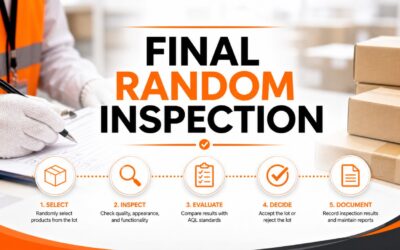
Both can be conducted by third-party inspection firms, and both produce reports. Quality inspections are conducted at multiple stages: pre-production, during production (DUPRO, when 20–80% of production is complete), and pre-shipment when goods are ready to ship. Factory audits are a preventive tool — they evaluate whether a supplier can consistently meet your expectations before the relationship begins. Quality inspections are a reactive tool — they verify that a specific batch of finished goods meets specification before shipment. AQL (Acceptance Quality Limit) sampling is the statistical methodology applied during inspections to determine whether a batch meets the agreed quality standard. Used together, factory audits and quality inspections form a proactive quality assurance system that prevents costly errors and secures your supply chain investment.
Factory Verification vs Factory Acceptance Testing (FAT)
Factory verification differs from Factory Acceptance Testing (FAT) primarily in domain: factory verification is a supplier qualification process for importers selecting a manufacturing partner; FAT is a sign-off procedure for a purchased machine or system. SGS defines FAT as a test that determines whether equipment or plant operates as intended and meets all contractual specifications — conducted at the supplier’s facility before delivery or final installation. FAT is formally governed by IEC 62381:2024, which covers automation systems in the process industry and was updated in July 2024 to incorporate current technology and replace forms with detailed checklists.
Four key differences between FAT and factory verification:
- Subject — FAT verifies a machine or system; factory verification verifies a supplier’s legitimacy and capability
- Domain — FAT is used in equipment procurement across aerospace, automotive, food and beverage, healthcare, and pharmaceutical sectors; factory verification is used in product sourcing and importer due diligence
- Standard — FAT is governed by IEC 62381:2024; factory verification has no single governing standard
- Deliverable — FAT produces a pass/fail sign-off for a specific machine; factory verification produces a supplier risk-rating report
What they share: both occur at the supplier’s or manufacturer’s facility; both use pre-agreed pass/fail criteria; both involve the buyer or their authorised representative witnessing key steps. FAT does not assess factory legitimacy, business registration, or manufacturing capability for future orders.
Factory Verification vs Process Verification
Factory verification differs from process verification primarily in context: process verification is an internal quality assurance activity conducted by a manufacturer on its own processes; factory verification is an external due diligence activity conducted by a buyer on a supplier.
The FDA defines process verification as “confirmation by examination and provision of objective evidence that specified requirements have been fulfilled” (21 CFR Part 820). ISO 9000:2005 defines verification as “confirmation, through the provision of objective evidence, that specified requirements have been fulfilled” (Clause 3.8.4). Process verification answers “Are we building the product right?”. Factory verification answers “Is this factory who it claims to be?”
Three key differences:
- Context — process verification is internal; factory verification is external
- Regulatory framework — process verification is mandated in GMP-regulated sectors under FDA 21 CFR Part 820.75 and ISO 13485; under the FDA QMSR effective February 2, 2026, which incorporates ISO 13485:2016 by reference, supplier audit records are subject to FDA inspection; factory verification has no universal regulatory mandate, though it is increasingly referenced by supply chain compliance frameworks including UFLPA and CSDDD
- Deliverable — process verification produces objective evidence of process conformance; factory verification produces a supplier risk-rating report
Both produce documented evidence. Both use objective measurement. The terminology overlap — “verification” in both names — causes frequent confusion in regulated manufacturing contexts.
Factory Verification vs Supplier Management
Factory verification differs from supplier management primarily in type: factory verification is an event-based check; supplier management is a continuous performance system.
The seven-dimension comparison:
- Purpose — verification checks whether the supplier is genuine and suitable; management controls supplier performance over time
- Timing — verification is event-based, typically before an order; management is ongoing throughout the relationship
- Main question — verification asks “Is this supplier who they say they are?”; management asks “Is this supplier performing properly?”
- Type — verification is a point-in-time check; management is a continuous process
- Scope — verification addresses red flags, credibility, and identity; management covers communication, contracts, quality, delivery, and inspections
- Best used when — verification is for new or higher-risk transactions; management is for repeat orders
- Limitation — verification does not guarantee future performance; management requires consistent discipline to deliver results
As TCI China frames it precisely: “Verification is a check. Management is a system”. The $4.2 billion in estimated annual global losses from supplier fraud and the 48% of sourcing projects that face quality complications from unverified suppliers represent the verification gap. The post-verification failures — missed deadlines, specification deviations, unauthorised subcontracting — represent the management gap. Both require their own tools.
Summary Comparison Table
| Concept | vs Factory Verification | What They Share |
|---|---|---|
| Supplier Verification | Broader scope — covers factories, traders, distributors; FV adds physical premises + capability check | Both are pre-order, event-based due diligence; both check legitimacy and registration |
| Factory Audit | Deeper scope — comprehensive QMS evaluation; 1–3 days vs 0.5–1 day; scored report vs pass/fail | Both occur at supplier facility; both are pre-production tools; same third-party providers |
| Factory Inspection | Product-level (batch conformance) vs supplier-level (legitimacy and capability); production-stage vs pre-order | Both produce reports; both can use third-party firms; both are quality assurance tools |
| Factory Acceptance Testing (FAT) | Equipment/system sign-off (IEC 62381:2024) vs supplier qualification; used in equipment procurement vs importer sourcing | Both occur at supplier premises; both use pre-agreed pass/fail criteria; both involve buyer witnessing |
| Process Verification | Internal QA by manufacturer (FDA 21 CFR 820) vs external check by buyer; answers “building product right?” vs “is supplier legitimate?” | Both produce objective documented evidence; both use measurable criteria; both sit in quality management contexts |
| Supplier Management | Continuous performance system vs event-based check; ongoing vs one-time; asks “performing?” vs “genuine?” | Both are supplier-focused quality tools; both use checklists and records; verification feeds into management |
Conclusion
Factory verification is the entry gate to every supplier relationship — not a guarantee of performance, but
the check that confirms you are dealing with a real, capable, and legitimate manufacturer before any money
or IP changes hands. Used correctly, it eliminates the most costly category of sourcing error: the
supplier who was never who they claimed to be.
The six comparisons in this article exist for one reason: the wrong tool at the wrong moment leaves a gap.
Verification screens. Audits evaluate. Inspections catch defects. Know which one you need, and commission
it at the right point in the process.