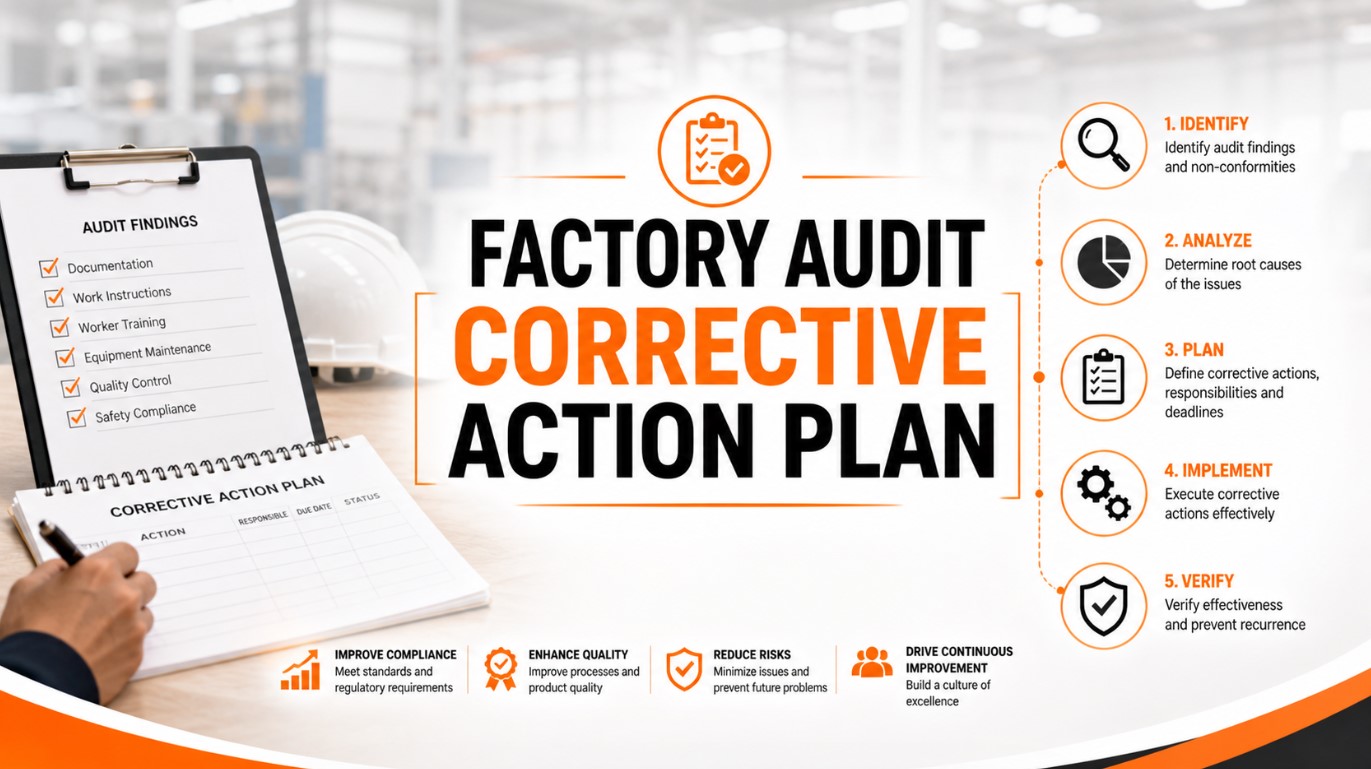
You can build a corrective action plan after a failed factory audit in 6 stages: confirm the finding, contain immediate risk, define each problem clearly, identify the root cause, assign and verify corrective actions, and close or escalate the supplier based on evidence. That sequence matters because a failed factory audit is not just an administrative setback.
It is a signal that your supplier has a control gap in quality, capacity, facility condition, safety, compliance, or process discipline that can damage your next order if you treat the issue casually.
If you work with a factory audit provider, the real value comes after the report as much as during the audit itself, because the report only shows you what failed. The CAP shows you whether the factory can fix it.
This article follows that route in the order you should use it. You will start by defining what a CAP means after a factory audit, then move into a 6-step build process that covers confirmation, containment, problem definition, root cause analysis, action ownership, evidence review, and long-term standardization.
After that, you will see how the CAP should change when the failed finding sits in the quality system, the facility, the equipment base, or the compliance side of the factory.
The second half handles the approval decision. You will see how to verify the CAP before closure, when re-inspection or re-audit is necessary, which mistakes make supplier corrective action weak, and how a factory audit provider can verify remediation without taking ownership of the supplier’s internal fix. The FAQ at the end gives you short answers to the operational questions that come up most often once the failed audit report is already on your desk.
What is a corrective action plan after a failed factory audit?
A corrective action plan after a failed factory audit is a written remediation plan that links each audit finding to a fix, an owner, a deadline, and a verification method. It is not the same as an apology email, a vague promise to improve, or a list of cosmetic changes that make the factory look better for one week. A real CAP connects the audit report to the supplier’s operating system and shows how the problem will be corrected, checked, and prevented from coming back.
A factory audit matters because it usually reviews more than one narrow defect. A manufacturing audit can cover the factory profile, production capacity, facility condition, workflow, organization, and quality assurance systems before it leads into a corrective action plan. That wider scope is why a CAP after a failed factory audit has to do more than clean up one batch. It has to fix the process or condition that made the finding possible in the first place.
The CAP should also cover all audit findings, not only the easiest ones. If the audit showed weak incoming control, poor machine maintenance, missing records, and unclear operator instructions, the plan is incomplete if it addresses only the records. A failed factory audit usually exposes a system problem, not a single loose thread.
How do you build a corrective action plan step by step?
You can build a corrective action plan after a failed factory audit in 6 steps, and each step should close one part of the risk that the audit exposed. The order matters because the early steps protect the next shipment, while the later steps protect the next production cycle. If you mix those goals together, the factory often sends you surface-level actions that look busy but do not change the underlying control weakness.
Most working CAP structures follow the same logic even when the form looks different. One practical sequence uses 8 stages, while other supplier corrective action workflows use D1 through D8 language. The labels change. The logic does not. In practice, you should treat the build process as 6 connected steps:
- Confirm the finding and contain immediate risk.
- Rewrite each finding as a clear problem statement.
- Identify the root cause and the escape point.
- Assign corrective actions, owners, and deadlines.
- Require evidence and verification before closure.
- Implement, monitor, and standardize the fix.
The supplier should usually draft the CAP because ownership improves execution. You should still review it hard, reject weak actions, and approve only the version that matches the failed audit report.
How do you confirm the finding and contain immediate risk?
First confirm that the finding is real, then contain any immediate shipment or production risk before you discuss long-term correction. A failed audit or inspection can sometimes include a measurement, testing, or evaluation mistake, so the first check is factual: did the nonconformity actually occur, and is the evidence sound? That sounds basic, yet it prevents you from escalating the wrong problem while the real one keeps moving through the line.
Once the finding is confirmed, the next question is severity. Widespread nonconformity and partial inconsistency do not demand the same response. If the issue affects the full batch, the whole process, or a safety-critical requirement, you may need to hold shipment, stop production, or freeze affected inventory at once. If the issue affects a limited quantity and rework is realistic, the containment decision can be narrower. Either way, you need to know what is affected, where it is sitting, and whether more product is still being produced under the same broken condition.
One supplier corrective action workflow requires a containment plan within 24 hours for urgent cases. You do not need to force that exact number in every situation, but the benchmark is useful because it separates immediate risk control from slower corrective work. Containment answers one question: how do you stop the damage from spreading right now?
How do you write a clear problem statement for each finding?
Each finding should be rewritten as a clear problem statement that tells you what failed, where it failed, how it was detected, and how much output is affected. A weak CAP often starts with language like “quality issue found” or “operator error observed.” Those phrases are too soft to manage. They do not tell the factory what to investigate, and they do not tell you what proof to request later.
A better problem statement makes the failure concrete. It identifies the requirement, the actual condition, the location or process point, the detection source, and the scope. For example, instead of “inspection problem,” the CAP should state that the in-process control failed to detect a dimensional nonconformity on a named part family during a named operation, and that the audit confirmed the same weakness across a defined quantity or time window.
That level of detail does 2 jobs. It keeps the root-cause analysis honest, and it stops the supplier from solving a narrower problem than the one the audit actually found. If the statement is vague, the action will usually be vague too.
How do you identify the root cause instead of the symptom?
You identify the root cause by explaining both why the problem happened and why the system failed to catch it before the audit. That second part matters as much as the first. A defect can come from the wrong material, a worn tool, a weak work instruction, poor training, or an overloaded line. The escape can come from weak inspection frequency, weak measurement methods, missing checkpoints, poor supervision, or a quality system that never treated the issue as a real risk.
This is where many supplier corrective action plans fail. The supplier names the visible symptom and treats it as the cause. “The operator missed the defect” is not a root cause. It only tells you where the system surfaced. If the operator missed the defect, you still need to ask why the inspection method was weak, why the instruction was unclear, why the gauge was wrong, why the shift was rushed, or why management allowed the process to run without enough control.
One strong CAP sequence breaks the work into 3 parts: define the problem, analyze the cause, then verify the cause with evidence. That structure is useful because it forces the factory to prove the cause instead of guessing at it. You are not looking for a story. You are looking for a cause that can be fixed and then tested.
How do you assign corrective actions, owners, and deadlines?
Assign each corrective action to 1 owner, 1 deadline, and 1 measurable outcome so the plan cannot hide behind vague promises. Department-level responsibility sounds organized, but it creates escape space. A named owner creates accountability, and the action should tell you what will change in the process, not only who will attend a meeting about it.
Most practical CAPs should define 4 control points before the action is approved:
- **One accountable owner:** name the person responsible for completion, not only the department that touches the work.
- **One implementation deadline:** use a date or milestone for each action instead of one broad “ASAP” promise.
- **One measurable result:** tie the action to a checkpoint, KPI, or control change that can be reviewed later.
- **One priority level:** set a faster timeline for high-risk actions than for low-risk administrative fixes.
One SCAR example uses 10 calendar days for high-priority implementation, 20 days for medium-priority work, and 30 days for low-priority items. You should treat those numbers as a reference model, not as a universal rule, because shipment exposure and product risk should drive the final timing. The important point is structure. A stronger CAP uses milestones and implementation logic that survive review.
What evidence and verification methods should you require?
There are 5 evidence and verification checks you should require before closure: document review, photos or videos, record checks, interviews or observation, and a buyer-side approval step. If the supplier sends you only a new form or a single photo, you do not have enough proof to close the CAP. You have evidence that a document or image exists. That is not the same thing as evidence that the failure mechanism is gone.
You should request 5 evidence layers before closure:
- **Updated documents:** revised procedures, instructions, control plans, or training records that show the process standard changed.
- **Visual proof:** photos or videos of the actual fix, especially when equipment condition, layout, labeling, segregation, or safety controls changed.
- **Operational records:** check sheets, inspection logs, maintenance records, or traceability entries that show the new control is being used.
- **Observation or interview evidence:** direct review of how operators, supervisors, or QA staff now perform the work.
- **Independent approval:** a separate approver, buyer, or audit reviewer who decides whether the evidence is strong enough to close the action.
Qarma’s workflow is useful here because it treats evidence as remarks, documents, photos, videos, and real-time app capture instead of as one generic upload box. That idea is sound. Closure should happen only after the evidence type matches the risk type.
How do you implement, monitor, and standardize the fix?
Implementation is complete only when the change is in use, the defect no longer escapes, and similar risk points have been updated as well. A corrective action should change a process, machine, environment, training method, measurement method, or material condition. If the only result is that one person was warned, the CAP is weak because the next person can make the same mistake under the same broken system.
Validation should also prove that the action works. One strong verification model asks whether the defect would return if the broken condition were restored and whether the defect disappears when the corrective action remains in place. You do not always need to recreate failure physically, but you do need evidence that the new control can actually stop the same risk the audit found.
The final step is standardization. If the root cause sits in a shared material, shared process, shared gauge, shared machine family, or shared training gap, the CAP should extend to those related risk points as well. That is how you prevent recurrence instead of relocating it. A closed action on one line means little if the same cause remains active on the next line over.
How should you handle different types of failed factory audit findings?
A failed factory audit does not produce one kind of CAP because quality-system findings, facility findings, and compliance findings fail for different reasons and close with different evidence. That distinction is where many generic CAP articles fall short. They explain the form. They do not explain how the response should change once the type of audit finding changes.
You should judge the CAP against the failed finding’s mechanism. A process-control failure needs proof that the control now detects the defect. A facility failure needs proof that the physical condition changed. A compliance failure needs proof that management behavior, policy, communication, and monitoring changed. If you ask for the wrong evidence, you can close the CAP while the real risk remains open.
That is why a buyer-side review framework should start with finding type before it moves into evidence review.
How do you handle quality-system and process-control findings?
Quality-system and process-control findings usually need updated procedures, revised checkpoints, training, and proof that the new control now catches the defect. If the audit found weak incoming inspection, missing in-process checks, poor recordkeeping, or uncontrolled work instructions, the CAP should show exactly which control changed and where it now sits in the workflow.
The strongest evidence in this category is operational evidence, not only paperwork. You should expect revised documents, training records, real inspection logs, and proof that the revised checkpoint is being used during production. A signed procedure alone is too thin. The question is not whether the supplier can rewrite a document. The question is whether the system now detects the problem before the next shipment.
How do you handle facility, capacity, and equipment findings?
Facility, capacity, and equipment findings usually need a physical change such as maintenance, repair, layout correction, tooling improvement, or added resources. If the audit showed poor machine condition, blocked workflow, overloaded production, inadequate storage, or unsafe facility layout, the CAP should address the physical operating condition rather than hide behind a training-only response.
That means you should expect repair records, maintenance records, replacement proof, layout photos, capacity balancing changes, or evidence that the factory increased the people, space, or machine support needed to run the process correctly. The closure test is straightforward here: can the factory now operate under the expected load without recreating the same breakdown or bottleneck?
How do you handle social, safety, or compliance findings?
Social, safety, or compliance findings usually require management action, worker communication, policy revision, and stronger monitoring because the issue affects people and legal exposure, not only output. The U.S. Department of Labor guidance is useful here because it ties CAP content to responsible parties, verification methods, deadlines, consequences, and communication to affected stakeholders. That is a stronger model than a short list of tasks with no governance around them.
In this category, the CAP should show who was informed, what policy changed, what management training was completed, how workers will see the change in practice, and what follow-up mechanism will prove the issue stays corrected. If the violation could trigger repeated harm, buyer consequences should also be explicit. This is not a category where a photo and one revised form should close the file.
How do you verify the CAP before you close it?
You should close a CAP only when the evidence proves the action was implemented, the verification method shows the risk is controlled, and the supplier has addressed recurrence rather than appearance. That is the buyer-side discipline missing from most weak supplier corrective action plans. Factories tend to submit completion evidence. You need closure evidence.
A useful approval test asks 4 questions in sequence. Did the supplier implement the action it promised? Does the evidence match the type of finding? Has the control been tested in operation rather than only on paper? Did the supplier address the recurrence path, not just the current symptom? If the answer to any of those 4 questions is no, the CAP is not ready to close.
Follow-up matters for the same reason. QIMA’s factory-improvement guidance is blunt on this point: follow-up is the only way to guarantee that the supplier implemented the necessary action and that the change contributes to lasting improvement. That means you should decide in advance whether closure will rely on document review, remote evidence review, re-inspection, or a follow-up audit.
Communication belongs here too. If the failure affected delivery, compliance, or repeated production risk, the supplier should communicate what was found, what changed, and when closure is expected. You do not need polished language. You need a control path that other people can review later without guessing what happened.
When should you re-inspect, re-audit, escalate, or replace the supplier?
The right next step depends on severity, recurrence risk, supplier cooperation, and how much of the problem can be verified without going back on site. If the failed finding is narrow, the evidence is strong, and the correction is easy to verify remotely, document review may be enough. If the failed finding sits in a control system, a facility condition, or repeated operator behavior, remote evidence often is not enough because the risk lives in execution, not only in paperwork.
Re-inspection makes sense when you need to confirm that corrected product or corrected process output now meets the requirement. Re-audit makes more sense when the failed issue is systemic and the closure question is bigger than one batch. Escalation is appropriate when the supplier delays, minimizes, or keeps recycling weak actions without proving real control. Supplier replacement enters the picture when the CAP fails repeatedly or when the business risk of continuing the relationship becomes higher than the switching cost.
The practical decision can be summarized in 4 response paths:
| Situation | Best next step | Why it fits | Closure standard |
| Isolated product issue with strong rework proof | Re-inspection | You need to confirm the corrected batch before shipment | Product passes the agreed check |
| Systemic control weakness in QA, records, training, or supervision | Re-audit or focused follow-up audit | The risk sits in the system, not one lot | The system change is visible and operating |
| Slow response, weak ownership, or vague evidence | Escalation and order hold | The supplier has not earned trust in the closure path | Named actions, dated proof, and buyer approval |
| Repeated failure after prior CAPs | Supplier replacement or suspension | Recurrence shows the factory is not controlling the cause | Risk no longer fits your sourcing tolerance |
The point is not to punish quickly. The point is to protect the next order with the least risky verification method.
What mistakes make a corrective action plan fail?
The most common CAP failures are 6 mistakes: vague problem statements, symptom-level root-cause analysis, missing ownership, soft deadlines, weak evidence, and no follow-up. Those mistakes matter because repeated production issues cost more than a one-time escape. They multiply replacement cost, delay, and trust loss across future orders.
The 6 mistakes show up in predictable ways:
- **Writing a vague finding:** if the CAP cannot tell you what failed, where it failed, and how much is affected, the rest of the plan will drift.
- **Treating the symptom as the cause:** if the action only says “operator attention will improve,” the process is still exposed.
- **Leaving ownership blurred:** if the action belongs to a department instead of a person, closure can be delayed without real accountability.
- **Using soft deadlines:** if the plan says “as soon as possible,” you cannot manage escalation against it.
- **Accepting weak evidence:** if one photo or one revised form closes the CAP, you have closed appearance, not risk.
- **Skipping follow-up:** if nobody checks the fix in operation, the factory can slide back into the old condition during the next busy period.
A stronger CAP stays specific all the way through. It uses explicit timelines, responsibility, root-cause analysis, verification evidence, and follow-up. Vague promises do not survive the next production cycle.
How can a factory audit provider help you verify corrective actions?
A factory audit provider helps most when you need independent verification that the supplier’s corrective action is real, complete, and still effective under operating conditions. That role matters because the supplier owns the remediation, while you own the sourcing risk. An independent reviewer helps you separate those 2 responsibilities instead of letting them blur together.
In practical terms, a factory audit provider can map each corrective action back to the original audit findings, challenge weak root-cause logic, request stronger verification evidence, and verify whether the new control works on site instead of only in documents. That is useful when the finding sits in process discipline, layout, machine condition, traceability, or management behavior. Those issues rarely close well through paperwork alone.
The value is not only technical. It is also decision support. If you need to know whether document review is enough, whether a follow-up inspection will do, or whether a focused re-audit is the safer choice, an independent factory audit provider gives you a cleaner basis for that call. The supplier still has to fix the problem. You just do not have to trust the claim before it is verified.
FAQs
A few short questions come up in nearly every CAP review cycle. The answers below keep the operational logic clear and give you a faster way to judge whether the supplier response is usable.
Who should write the CAP after a failed factory audit?
The supplier should usually draft the CAP, but you should review, challenge, and approve it before implementation starts. That approach keeps ownership with the factory while preventing weak corrective actions from passing unchallenged.
How fast should a supplier respond to a failed factory audit?
Urgent containment can be required within 24 hours, while corrective-action deadlines should be set by priority and shipment risk. The right pace is fast enough to control exposure immediately and structured enough to prove the long-term fix later.
What is the difference between correction and corrective action?
Correction fixes the current problem, while corrective action removes the cause so the problem does not return. Sorting a defective batch is a correction. Changing the broken process that created the batch is corrective action.
When is a re-audit better than document review alone?
A re-audit is better than document review alone when the finding affects systems, facilities, or repeated behavior that cannot be proven with paperwork only. If the issue lives in execution, on-site verification is usually the safer closure method.
Can you keep working with a supplier after a failed factory audit?
Yes, you can keep working with a supplier after a failed factory audit if the CAP is credible, the evidence is strong, and follow-up verification shows the risk is controlled. If the same failure repeats or the supplier cannot prove closure, the relationship should be escalated or replaced.