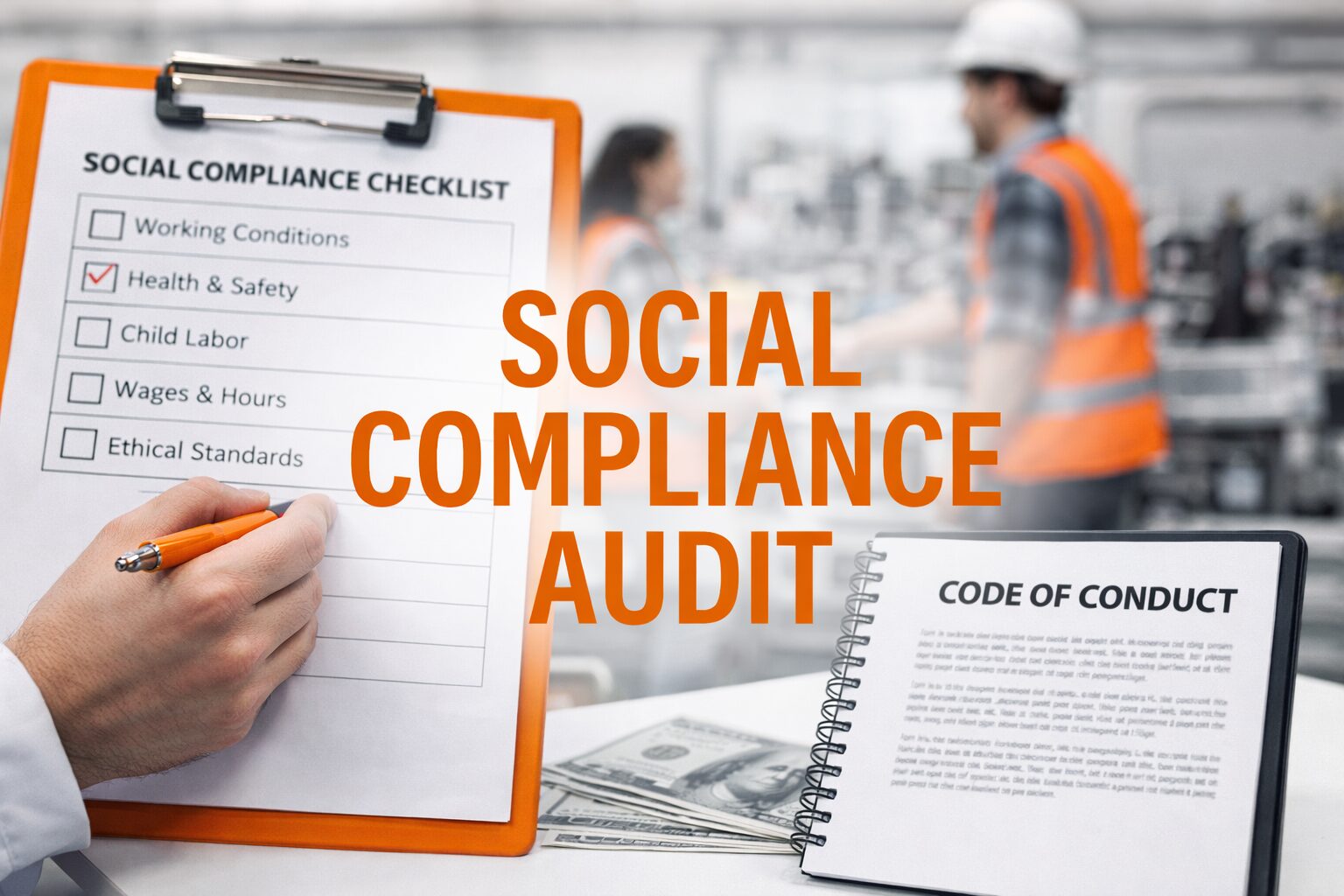
A social compliance audit is your primary tool for checking whether a factory, farm, or packing facility actually respects labor rights, human rights, and basic health and safety standards in practice.
Instead of relying on policy statements or glossy corporate social responsibility reports, a social audit checks actual working conditions against set criteria and labor laws. In manufacturing, it typically sits inside a broader factory audit program and is done by independent third-party compliance auditors, not by the facility.
During a social compliance audit, auditors review management systems, workplace procedures, and daily practices that affect workers’ wages, hours, safety, and treatment. They examine how a site handles freedom of association, non-discrimination, and prohibition of child labor and forced labor, and in many cases also look at environmental impacts and community risks.
These audits are often done on external production sites in high-risk supply chains, such as apparel, electronics, and agriculture.
Because globalization spreads production across Tier 1–3 suppliers in multiple countries, you cannot easily see what happens on the factory floor. Social compliance audits bridge that gap by checking conditions against codes of conduct, ILO conventions, and local regulations.
At-risk countries account for roughly 48% of global apparel production, 53% of apparel exports, and 26% of electronics exports, which is why brands pay close attention to these sectors. Today, mandatory due diligence and modern slavery laws in Europe and North America mean social compliance is no longer just voluntary—it is now a growing legal expectation
A social compliance audit is an independent, evidence-based examination of an organization’s social performance against defined standards and labor laws.
In practice, it is a structured compliance audit where auditors evaluate how a facility meets frameworks such as SA8000, SMETA, amfori BSCI, buyer codes of conduct, ILO conventions, and relevant national regulations.
The focus is on labor rights, working conditions, working hours, wages and benefits, occupational health and safety, non-discrimination, freedom of association, and the prohibition of child labor and forced labor. Many modern audit protocols also include reviews of environmental management and ethical business practices.
You will see these audits used at a company’s own sites and at external facilities in its supply chains, but in sourcing contexts the term usually refers to audits of factories, farms, and packing houses used by brands and retailers.
This definition sets up why the next section looks at their real-world importance for your business.
Social compliance audits are important because they protect workers’ rights, reduce legal and reputational risk, and give you verifiable assurance that supply-chain partners meet minimum social standards. Without structured audits, you depend on self-reporting, which rarely captures the real conditions in distant factories or farms.
Ethical consumerism, ESG investing, and constant news coverage mean your business practices are more visible than ever. Consumers and advocacy groups research how companies treat workers; they look for proof, not slogans.
Independent social audits provide that proof, while simple questionnaires and declarations do not. In manufacturing, this proof often comes through a broader factory audit process, where social compliance checks are combined with on-site review of working conditions, health and safety, and management systems.
Failures in remote facilities—such as forced labor, child labor , or severe safety hazards—can trigger boycotts, lawsuits, import bans, and supply interruptions, even when your company never directly employed those workers.
Risk is higher in specific sourcing regions. According to industry risk analysis, at-risk countries represent around 48% of global apparel production, 53% of apparel exports, and 26% of electronics exports, which is why brands sourcing these depend on audits as part of risk management and due diligence.
Regulatory pressure is also growing. Laws such as the U.K. Modern Slavery Act and similar legislation in North America and Europe require large companies to report on how they prevent slavery and human trafficking in their supply chains.
Social compliance audits, paired with corrective action plans, provide the documented audit process, audit results, and action plan needed to show regulators, investors, and customers that you are meeting those requirements.
This leads directly into the role of social compliance policies, which turn these expectations into daily rules at your sites and suppliers.
Why should organizations care about social compliance policies?
Organizations should care about social compliance policies because these documents turn legal obligations and risk-management goals, and stated corporate values into clear rules that govern everyday decisions at factories and supplier sites. Without written policies aligned with recognized standards, you cannot reasonably expect managers or suppliers to maintain consistent, compliant working conditions.
A strong social compliance policy defines expectations on wages, working hours, child labor, forced labor, non-discrimination, and health and safety. When you clearly set those expectations and tie them to contracts, you help prevent zero-tolerance issues that can instantly fail an audit: underage workers, bonded or trafficked workers, severe safety hazards, physical abuse, or bribery.
High-profile factory disasters in Bangladesh and Pakistan, which killed more than 1,300 workers, show the long-term liability that arises when policies, controls, and enforcement are weak. These incidents still trigger litigation, compensation claims, and brand-image damage years later.
Investors now apply ESG criteria to evaluate companies, and documented social compliance policies plus audit evidence directly influence ESG ratings and access to responsible capital. Clear policies provide internal teams, suppliers, and compliance auditors a common benchmark, often referencing ILO conventions and standards such as SA8000 or the ETI Base Code. They also support training, internal audits, and management accountability across global supply chains.
Even though some research suggests that consumers still often choose cheaper non-certified products, regulators, investors, NGOs, and unions are raising expectations steadily. To maintain long-term resilience in U.S. and global markets, robust social compliance policies are no longer optional; they are the basis for credible, defensible business ethics.
What pressures drive social responsibility commitments?
The main pressures driving social responsibility commitments are regulatory requirements, buyer expectations, NGO and media scrutiny, investor ESG demands, and shifting consumer norms. Together, they form a situation where weak social compliance poses a direct business risk
On the regulatory side, several recent laws push companies to adopt structured due diligence across their supply chains. The Norwegian Transparency Act (effective July 2022) and Germany’s Act on Corporate Due Diligence in Supply Chains (LkSG, in force January 2023) require companies to spot and manage human-rights risks in their operations and suppliers.
The proposed EU Corporate Sustainability Due Diligence Directive (EU CSDDD), adopted at EU level in 2023, will further extend these expectations. Legislators in North America are moving in a similar direction, for example Canada’s Fighting Against Forced Labor and Child Labor Supply Chains Act and revisions to New York’s Fashion Sustainability and Social Accountability Act.
Meanwhile, modern slavery acts and forced-labor import bans, including measures related to Uyghur Forced Labor, allow U.S. authorities to block shipments linked to non-compliant factories. NGOs, unions, and the media routinely publish rankings and exposés focused on labor practices, often drawing directly on social audit data.
Investors and major brands now expect consistent audit results and transparent management systems before they commit to long-term sourcing or financing. As a result, social responsibility has become a mix of hard law and market expectation. For your organization, social compliance is not just about voluntary CSR initiatives; it involves meeting these converging pressures while delivering reliable products to customers.
What are the benefits of social compliance audits?
Social compliance audits deliver multiple benefits for your business, from reduced risk and better brand reputation to more efficient operations and stronger supplier relationships.
The 15 benefits below help you see how audits contribute to value creation as well as risk control:
- Reduce legal and brand risk by detecting child labor, forced labor, and serious safety hazards before they escalate into crises, lawsuits, or import bans.
- Strengthen brand reputation and consumer trust through independently verified social compliance claims instead of untested marketing language.
- Ensure adherence to labor laws and regulations across multiple countries, ensuring compliance with modern slavery acts, due-diligence statutes, and customs rules.
- Improve operational efficiency by linking safer, better-organized production areas to higher productivity, fewer accidents, and less downtime.
- Build long-term, values-aligned supplier relationships built on transparency, continuous improvement, and shared responsibility for workers.
- Support global sustainability goals (SDGs) such as Decent Work (SDG 8) and Responsible Consumption and Production (SDG 12).
- Protect workers’ rights and welfare , improving conditions for employees and surrounding communities in high-risk manufacturing hubs.
- Gain market access and competitive advantage where large retailers or U.S. brands require proof of social compliance to qualify as a vendor..
- Increase supply-chain transparency by mapping sites, understanding subcontracting, and identifying compliance patterns in deeper tiers.
- Drive continuous improvement using audit data trends, corrective action plans, and regular re-audits to track performance over time.
- Boost worker retention and morale as safer, fairer workplaces reduce turnover and recruitment costs.
- Attract ESG-focused investors , as credible audit results indicate stronger management systems and lower social risk.
- Reduce product-quality problems because rushed, unsafe production often correlates with defects and rework.
- Reinforce corporate governance by tying board oversight and policies to measurable social-performance indicators.
- Build a more resilient supply chain that is less vulnerable to labor disputes, sanctions, or sudden reputational shocks linked to non compliance.
Understanding these benefits provides context for the next question: how a social compliance audit is actually conducted in practice.
A social compliance audit is conducted through a structured methodology led by trained, independent auditors who apply recognized standards to your facility or supplier site. Practically, the audit process combines document review, on-site inspection, and confidential worker interviews to evaluate management systems and working conditions against criteria such as SA8000, SMETA, amfori BSCI, ETI Base Code, WRAP, or buyer-specific protocols.
Audits may be announced, semi-announced, or unannounced. For unannounced visits, the facility must start the audit within a short timeframe, sometimes as little as 30 minutes, or the situation is recorded as an audit refusal and treated as a critical issue.
Regardless of format, most audits follow five core procedures: an opening meeting with management, a health and safety-focused facility tour, detailed documentation review, confidential interviews with workers and managers, and a closing meeting where preliminary findings and a corrective action plan (CAP) are discussed.
Some auditing frameworks outline pre-audit preparation and post-audit report generation as extra stages, creating a five-stage or “five key procedure” model that includes preparation and reporting. Throughout the audit, auditors rely on “triangulation”: they cross-check documents, physical observations, and interview testimony to detect falsified records, coaching, or hidden practices such as weekend production that contradicts official schedules. Serious non-compliances can lead to CAPs, follow-up audits, probationary status, or even de-listing of the supplier, depending on your company’s risk management policy.
This staged approach is easier to understand when you break it into distinct phases from preparation through follow-up.
What are the different stages of a social compliance audit?
A social compliance audit typically moves through a sequence of stages that covers preparation, on-site work, reporting, and follow-up, although different standards label these steps slightly differently. This staged process helps you see exactly how auditors progress from initial contact to final audit results and corrective actions .
Here are the eight main stages of a social compliance audit, from start to finish:
- Preparation – review of laws, standards, buyer requirements, and facility profiles; completion of pre-audit questionnaires; risk screening based on country, sector, and previous findings.
- Opening meeting – introduction of auditors, explanation of scope, confirmation of facility layout, workforce profile, and availability of documents.
- Facility tour / health & safety walkthrough – observation of production areas, warehouses, chemical stores, canteens, washrooms, and dormitories where applicable.
- Documentation review – examination of payroll, timecards, contracts, personnel files, age documents, social-insurance records, production records, and permits.
- Worker and management interviews – confidential one-to-one or small-group interviews, including possible off-site or callback interviews.
- Preliminary assessment and closing meeting – presentation of non-conformities, strengths, and required corrective actions, with management input.
- Report generation and CAP – formal report summarizing findings and a CAP detailing responsibilities and timelines.
- Follow-up / re-audit – verification that corrective actions are implemented, often within 3–12 months depending on severity.
Even data-focused schemes such as SLCP or Higg-type modules generally follow this process of preparation, evidence collection, and follow-up. The next subsections look more closely at key on-site stages.
Opening meeting
The opening meeting sets the scope, expectations, and cooperation framework between auditors and facility management and sets the tone for the entire audit. During this meeting, auditors verify they have access to people, production areas, and documentation needed to evaluate social compliance and working conditions.
Typical participants include the factory manager, HR manager, health and safety lead, and any dedicated social compliance or facility management representatives. If these individuals are unavailable, an authorized representative must attend with enough authority to provide information and commit to follow-up actions. In the case of unannounced audits, the opening meeting happens shortly after auditors arrive; if management refuses to begin within the required timeframe, this can be recorded as an audit refusal and treated as a critical non-compliance.
Auditors clarify which standard or framework governs the audit, such as SA8000, SMETA, BSCI, WRAP, or a buyer-specific protocol—along with the time schedule, areas to be visited, confidentiality of worker interviews, and any limitations (for example, structural engineering checks excluded). The opening meeting lets auditors assess management’s attitude toward transparency and accountability, including any resistance, attempts to influence worker selection, or restrictions on photography and site access.
Facility tour (health and safety focus)
The facility tour gives auditors a real-world view of health and safety conditions, going beyond what appears in your policies or records. By walking through the production area, warehouses, maintenance shops, canteens, washrooms, and dormitories, auditors observe how equipment, people, and processes interact during normal operation s.
During the tour, auditors examine key practical elements: whether workers have enough space to move safely around machinery, whether ventilation and lighting are adequate, and whether temperature and noise levels are acceptable. They check that emergency exits are clearly marked, unobstructed, and unlocked, and that evacuation routes, alarms, and fire-fighting equipment are in place and maintained. Chemical storage separated, with no exposed or improvised electrical wiring nearby. Personal protective equipment (PPE) such as gloves, masks, eye and hearing protection must be available and used correctly. In support areas, auditors check that toilets are sanitary, canteens are clean, and drinking water is safe.
Common findings include missing or unused PPE, poor emergency planning, overloaded electrical circuits, unguarded machines, unlabeled chemicals, and visually unsafe buildings or dormitories. Problems in dormitories, such as unsafe wiring, locked exits, overcrowding, or blocked stairways, count as serious health and safety issues even if outside the production floor.
What violations are typically found during walkthroughs?
Walkthroughs most often reveal health and safety and housing-related non-compliances, some of which are severe enough to trigger immediate audit failure or strict corrective action plan requirements. These issues are often visible within minutes once auditors enter the production area or dormitories.
Recurring violations include inadequate PPE, such as missing gloves in cutting operations, lack of hearing protection in noisy workshops, or absence of eye protection near welding or grinding. Machine-guarding issues are common: removed, disabled, or poorly designed guards raise the risk of entanglement and amputation. Locked, blocked, or poorly marked emergency exits and missing evacuation drills are another high-risk pattern. Auditors also find exposed or improvised electrical wiring, overloaded power strips, and unlabelled or improperly stored chemicals without secondary containment. Poor housekeeping leads to obstructed aisles, trip hazards, and blocked access to fire equipment.
In dormitories, typical issues include overcrowding and structurally unsafe buildings, household wiring in wet areas such as bathrooms, and locked exit doors at night. Guidance on machine guarding stresses that guards must prevent contact, be secure, avoid creating new hazards, prevent objects entering moving parts, and allow safe lubrication. When imminent danger to life exists, such as locked exits or unsafe buildings, auditors classify it as a critical violation needing immediate mitigation or production halt.
Documentation review
Documentation review is the moment where auditors test whether the facility’s formal systems and records align with legal requirements and with the reality seen on the shop floor. This part of the audit focuses on contracts, time and attendance, wages, and social benefits—key elements of labor compliance and human rights protections.
Typical documents include employee contracts and personnel files, with proof of age and identity, so auditors can confirm compliance with child labor and young workers rules. Payroll records for at least 6–12 months, including peak and low seasons, show base wages, overtime rates, bonuses, and deductions. Timekeeping records—punch cards, electronic logs, or attendance sheets—provide start and stop times, break patterns, and overtime hours. Social-insurance and statutory-benefit records show that contributions are paid according to law. Production records, such as line output or purchase orders, help auditors cross-check whether the recorded hours and wages make sense for actual production volumes.
Auditors look for consistency over time, not only the most recent month. They compare documentation with worker interviews and observations during the facility tour to reveal coaching, under-recorded overtime, or double book-keeping. Hand-written attendance sheets, missing proof of age, incomplete overtime records, and mismatches between production and hours worked all raise red flags. The quality of documentation reflects management culture and whether the facility treats compliance as a true responsibility or merely a box-ticking exercise.
Why are documentation gaps so common?
Documentation gaps are common because many factories and farms lack robust HR and payroll systems, rely heavily on manual processes, or intentionally manipulate records to conceal non-compliance. Smaller or informal facilities might not fully grasp complex labor laws on overtime, social insurance, or youth employment, which leads to incomplete, irregular, or non-standard records.
In some cases, management uses deliberate practices like double book-keeping, keeping one set of “clean” records for auditors and another reflecting actual operations. Workers may be coached to repeat scripted explanations that align with false documentation. Under-recording overtime is frequent where legal limits are strict but production targets remain high.
Reliance on hand-written attendance sheets makes it almost impossible to verify maximum weekly hours or rest days across several months, especially when archives are missing or illegible. Rapid growth, high worker turnover, and limited HR training further lead to missing contracts, inconsistent wage slips, and poor archiving. Because of these weaknesses, social compliance auditors place strong emphasis on triangulating documents with worker testimony, production data, and direct observations.
Worker interviews
Worker interviews are confidential, voluntary conversations that allow auditors to understand actual working and living conditions without management influence. This is where you gain the clearest insight into whether policies and procedures are truly applied in daily practice.
Auditors usually select workers randomly across departments, genders, age groups, contract types, and shifts. Interviews may be individual or in small groups, and in some cases include off-site or callback conversations to reduce fear of retaliation. Interpreters and local-language proficiency are essential for clarity and trust.
Typical topics include recruitment practices (use of agents, payment of fees, retention of ID documents), working hours, overtime practices, and rest days. Auditors ask how wages are calculated, which deductions appear on pay slips, and how often workers are paid. They explore disciplinary procedures, including physical or verbal abuse, harassment, or humiliating treatment. Questions also cover access to PPE, safety training, the ability to refuse unsafe work, and freedom of association—whether workers can join unions or worker committees and use grievance channels.
Worker interviews often reveal forced labor indicators, such as confiscated passports, recruitment debts, restrictions on leaving dormitories, or overtime that is effectively compulsory. These issues may never show in formal documents. Auditors must therefore manage cultural and language barriers carefully, protect anonymity, and ensure that workers do not face retaliation for speaking openly.
Closing meeting
The closing meeting formally communicates audit findings, clarifies expectations, and launches the corrective action process. It ensures facility management understands non-conformities and improvement opportunities and can respond or provide context.
During this meeting, auditors present a summary of strengths and positive practices observed, followed by each non-conformity classified by severity—for example, minor, major, or critical. For each issue, auditors cite the specific standard clause or law breached, such as labor laws on maximum hours, anti-discrimination requirements, or occupational health and safety regulations.
The team then outlines required corrective actions, responsible persons, and tentative timelines, often drafting or validating a Corrective Action Plan (CAP) that will be finalized with the written report.For critical violations, like child labor, forced labor, bribery, or imminent life-threatening hazards, buyers may suspend orders, place the facility on probation, or demand immediate remediation with tight deadlines and follow-up audits.
The tone of the closing meeting should remain professional and solutions-oriented. The goal is to protect workers and your brand reputation while encouraging continuous improvement instead of purely punitive responses.
The scope of a social compliance audit defines which topics, sites, legal frameworks, standards, and time periods the audit will cover, and this scope can differ widely by industry, buyer, and selected framework. When you commission or undergo an audit, you need clarity on exactly which locations, workforce groups, and business activities are in-scope so that results are meaningful for risk management and due diligence.
Typical scope areas include labor practices, human rights, occupational health and safety, wages and benefits, environmental responsibility, and business ethics, as well as oversight of subcontractors and other supply-chain actors. For example, SA8000 structures scope around eight core elements: child labor, forced labor, health and safety, freedom of association and collective bargaining, discrimination, disciplinary practices, working hours, and remuneration—plus management-system requirements. SMETA, amfori BSCI, and RBA frameworks use comparable clusters, sometimes aggregated into “pillars” such as Labor, Health & Safety, Environment, and Business Ethics.
Scope includes compliance with local law, such as minimum wage, maximum overtime, social security contributions, safety regulations—and alignment with international norms like ILO conventions, UN Guiding Principles on Business and Human Rights, and buyer codes of conduct. Some schemes require environmental aspects and anti-bribery controls to be explicitly in-scope, especially in 4-pillar audits or integrated ESG programmes.
Importantly, scope also specifies which facilities, production processes, and workforce categories are covered, including contract workers, agency staff, migrants, and homeworkers. If higher-risk activities such as subcontracted sewing, farm labor, or home-based finishing are excluded, significant risks can remain invisible despite a “passed” audit.
Knowing the scope of a social compliance audit helps you see which core elements auditors will focus on to assess social performance.
Which core elements are assessed?
Core elements are the main risk areas that any credible social compliance audit must examine to judge overall social performance. These elements appear consistently across different auditing frameworks, even when the detailed wording or number of principles varies.
Key elements include labor practices, covering recruitment, contracts, working hours, overtime, and rest days; human rights and non-discrimination, covering equal opportunity and protection from harassment or abuse; and health and safety, which focuses on occupational risks, emergency preparedness, PPE, and safe housing where dormitories exist. Environmental responsibility is increasingly included, with checks on waste, chemicals, emissions, and resource use. Governance and business ethics cover anti-bribery, conflicts of interest, and whistle-blower mechanisms. Supply-chain and subcontractor management looks at how the organization monitors deeper tiers in its supply chains. Freedom of association and collective bargaining assesses whether workers can organize and negotiate collectively. Wages and benefits evaluate whether employees receive at least the legal minimum wage, correct overtime premiums, and mandated benefits.
Standards like SMETA may bundle these into two pillars (Labor plus Health & Safety) or four pillars (adding Environment and Business Ethics), while SA8000 and WRAP use a list of 8–12 distinct principles. In high-risk sectors like textiles, electronics, and agriculture, auditors focus closely on forced labor indicators, excessive overtime, young and migrant workers, and dormitory conditions, reflecting both global regulations and buyer concerns.
Labor practices
Labor practices cover the full employment relationship from recruitment through termination, including contracts, hours, rest days, and disciplinary measures. In a social compliance audit, this element is central because it directly affects how workers experience daily life on site.
Auditors verify that employment is voluntary, without forced or prison labor and without holding passports or IDs that limit freedom of movement. They check recruitment channels for hidden fees, deceptive contracts, or illegal brokers. Contracts should be written, transparent, and provided in languages workers understand.
Working hours are assessed against local laws and standards, including regular hours, overtime limits, rest days, and paid leave. Global audit data shows that excessive overtime is one of the most common forced-labor indicators, especially in lower tiers of supply chains where orders are volatile and margins tight. Disciplinary practices are reviewed to ensure there is no physical punishment, humiliating treatment, or coercive fines. Employers should follow clear procedures that respect workers’ rights and keep accurate records.
Human rights
Human-rights assessment in a social compliance audit examines whether the facility upholds basic rights to dignity, equality, safety, and freedom from abuse, as articulated in ILO conventions and international human-rights instruments. This dimension overlaps with labor practices but focuses more strongly on how individuals are treated.
Auditors look for non-discrimination in hiring, pay, promotions, and terminations—no bias based on gender, race, religion, age, migrant status, union membership, or other protected characteristics. They investigate harassment and abuse by reviewing disciplinary records, interviewing workers, and assessing whether there are credible grievance mechanisms that allow complaints without retaliation.
In some frameworks, human-rights assessment also touches on community impacts, such as land-use conflicts, pollution affecting nearby residents, or sourcing of conflict minerals. This expands focus from workers in the factory or farm to surrounding communities. Findings in this area can influence not only audit scores but also broader ESG evaluations of the company.
Health and safety
Health and safety in a social compliance audit refers to the facility’s ability to identify, control, and monitor workplace hazards to avoid injuries and illnesses. This element aligns directly with occupational health and safety laws and often references standards such as ISO 45001.
Auditors evaluate the OHS management system: whether risk assessments exist, training is provided, incidents are recorded, and emergency preparedness is tested through drills and maintenance of alarms and extinguishers. They check machinery guards and maintenance, chemical labeling and storage, and proper PPE use.
Specific attention is given to fire safety, structural integrity, electrical safety, ergonomics, and safe operation of high-risk equipment, as well as conditions in dormitories and canteens. Past incidents show poor OHS—crowded factories, blocked exits, unguarded equipment, can cause mass-casualty events, especially in apparel and electronics sectors. For that reason, serious health and safety hazards are often classified as major or critical non-conformities during audits.
Environmental responsibility
Environmental responsibility within social compliance audits concerns how a facility manages waste, emissions, chemicals, water, and energy to reduce environmental impact and surrounding communities. While not every audit scheme includes deep environmental criteria, many modern frameworks treat it as a core or optional pillar.
Auditors may examine waste-disposal methods, including whether hazardous, solid, and liquid wastes are segregated and handled according to law. Wastewater treatment systems and air-emission controls are reviewed for proper permits, operational status, and routine monitoring. Chemical storage and spill-prevention measures—such as bunding, labeling, and emergency procedures—are scrutinized. Facilities may also be asked about resource-efficiency initiatives and sustainability goals related to energy and water.
Environmental violations, such as uncontrolled dumping, untreated discharges into rivers, or visible air pollution can pose serious risks to nearby communities and may lead to audit failure in frameworks where environmental performance is part of the scope. These issues also intersect with health and safety because poor waste or chemical management affects both workers and local residents.
Governance and business ethics (anti-bribery, integrity)
Governance and business ethics in social compliance audits focus on the policies, controls, and culture that ensure decisions are legal and ethical, with zero tolerance for bribery, fraud, and conflicts of interest. This element underpins the reliability of all other audit results.
Auditors examine whether the organization has an anti-bribery policy, a code of conduct, and clear rules about gifts, hospitality, and interactions with officials. They verify the presence of whistle-blower channels and protections, conflict-of-interest declarations, and internal controls designed to prevent record falsification. Any attempt to influence audit outcomes through payments, gifts, or threats is treated as a serious violation.
Credible frameworks such as the RBA Code and 4-pillar SMETA explicitly combine labor, health and safety, environment, and ethics under a unified management-system approach. A facility that manipulates documents or bribes inspectors undermines the purpose of social compliance audits; therefore, bribery and obstruction are often classified as zero-tolerance violations.
Supply chain and subcontractor management
Supply-chain and subcontractor management in a social compliance audit checks how a brand or facility handles social risks beyond its own site. This includes subcontracted production, farms, homeworking, and lower-tier suppliers .
Auditors review approved-supplier lists, due diligence procedures, contracts, and social audit records for subcontractors. They aim to understand whether the primary facility enforces social compliance, tracks performance, and acts on any non-compliance. European due-diligence laws and new North American frameworks require companies to address risks, not only at direct suppliers but also deeper in their supply chains.
Good practice includes risk-based supplier segmentation, targeted audits, capacity-building programs, and clear consequences for non-compliance, rather than one-off inspections. For U.S. and European brands concerned about import bans and modern slavery laws, this broader supply-chain approach is now a central part of risk management strategy.
Freedom of association and collective bargaining
Freedom of association and collective bargaining cover workers’ rights to form or join trade unions, elect representatives, and negotiate collectively with management, as recognized in ILO Conventions 87 and 98. This element supports lasting improvements in working conditions.
In social compliance audits, auditors assess whether unions or worker committees exist, whether management interferes or retaliates, and whether any policies or contracts restrict organizing. They check grievance records, interview workers, and review worker-management meetings. The presence of credible, democratic worker bodies is a strong indicator that workers can raise concerns before they become crises.
Lack of freedom of association is a frequent negative finding, and in some standards open denial of these rights can cause audit failure. In countries where formal unions are restricted, many codes require alternative mechanisms such as independently elected worker councils and documented dialogue processes.
Wages and benefits
Wages and benefits cover the full compensation package workers receive, including base pay, overtime pay, bonuses, social security, and required benefits like paid leave and maternity protection.
Auditors verify that wages meet or exceed the legal minimum wage and that overtime is paid at the correct premium rate. They cross-check pay slips, timecards, and worker testimony to detect underpayment, unauthorized deductions, delayed payments, or non-payment of social insurance. Sometimes, facilities pay the minimum wage on paper but deduct income unfairly for housing, “fines,” or services.
In SA8000-type audits, inadequate wages and benefits—particularly pay below legal minimums or missing mandated benefits—are a common reason for major non-conformities. Some standards encourage progression toward living wages, but most audit criteria initially focus on legal compliance and correct calculation methods. Reliable payroll and benefits systems are therefore essential for a good audit result.
What are the key components and main elements?
The key components of social compliance link labor, health and safety, human rights, environment, and ethics with management-system elements that maintain performance over time. Put simply, it is not enough to have good conditions on the day of the audit; you need systems that maintain and improve those conditions.
Core management components include a documented social-compliance policy and supplier code of conduct, clear roles and responsibilities, and regular risk assessment and internal audits. Manager and worker training, grievance systems, and whistle-blowing channels help spot issues early. Corrective action and continuous improvement processes turn audit findings into practical changes. Supplier and subcontractor monitoring ensures that standards reach deeper into your supply chains.
These components are reflected in frameworks like SA8000, which merges eight social requirements with a management-system clause; WRAP’s 12 principles; amfori BSCI’s 13 performance areas; and broader guidance from RBA or ISO 26000, which emphasizes accountability, transparency, stakeholder engagement, and respect for human rights. Without these system elements, a site might pass a single audit using short-term fixes but then slide back into non-compliance, causing recurring violations and escalating risk classifications in your portfolio.
A social compliance audit often fails if zero-tolerance or “critical” violations occur, or when numerous major findings demonstrate a systemic disregard for workers’ rights, health, safety, or environmental obligations. In such cases, auditors and buyers conclude that the facility is not meeting baseline expectations for responsible business conduct.
Zero-tolerance issues often include underage labor, forced labor, signs of human trafficking, or serious physical or sexual abuse, life-threatening safety conditions such as locked emergency exits or structurally unsafe buildings, and bribery or obstruction of auditors. Systemic non-compliant working conditions—extreme overtime, lack of weekly rest, unsafe housing, and hazardous exposure without PPE—can also lead to failure when they are widespread and unaddressed. Serious wage violations, such as pay below legal minimums or unpaid overtime, and denial of freedom of association frequently appear in failed audits.
Under standards that include environmental scope, illegal dumping of hazardous waste, uncontrolled air or water pollution, or major chemical mismanagement can also cause failure. Many frameworks rate findings as minor, major, or critical and label overall audit results as acceptable, needs improvement, at risk, or non-compliant. Multiple critical or severe findings typically trigger an outright fail.
In some cases, the result is probationary non-compliance: the facility has a defined period and follow-up visits to correct issues. In others—especially where child labor, forced labor, or bribery is proven—the result may be zero-tolerance failure, and business relationships can be suspended or terminated for several years.
Recognizing the issues that can cause an audit to fail naturally leads to a closer look at specific violations, starting with the critical concern of child labor.
Child labor
Child labor is defined in social compliance audits as hiring workers below the legal minimum age or placing young workers in hazardous tasks banned by laws or standards. The definition is anchored in local legislation and in ILO Conventions 138 and 182, which address minimum age and worst forms of child labor.
Auditors check proof-of-age documents such as ID cards, birth certificates, or school records and look closely at recruitment practices in high-risk countries. Workers who seem underage and may ask for added proof or verify information with schools or community sources. False IDs and age misrepresentation are known issues in some regions, so auditors often triangulate records with interviews and observations.
When underage workers are found, modern best practices emphasize remediation rather than simple dismissal. This often includes removing the child from hazardous work, supporting access to education, and supporting family income so the child does not shift to another unsafe job. Because of the seriousness of child labor, its presence often leads to automatic audit failure and strong scrutiny from brands and regulators.
Forced labor
Forced labor in social compliance audits refers to any work or service performed involuntarily under menace of penalty. This includes practices such as passport retention, debt bondage, confinement, deportation threats, or limits on leaving employment. It is closely linked to modern slavery legislation and is treated as one of the most serious forms of non-compliance.
Auditors look for indicators like confiscated ID documents, recruitment fees that create heavy debt, compulsory overtime, and workers’ inability to resign without extreme penalties. Migrant workers recruited via cross-border agents often face higher risk. Social audit datasets show multiple forced-labor indicators in a significant share of audits in high-risk countries, particularly in deeper supply-chain tiers where oversight is weaker.
Documented forced labor is universally treated as a zero-tolerance violation under major standards and many national laws. It can lead to import bans, goods seizure, civil lawsuits, and criminal investigations, especially in the U.S. and European markets. As a result, forced labor findings have immediate and severe consequences for both factories and buyer companies.
Health and safety hazards
Health and safety hazards as a failure category involve serious risks of injury or death arising from working or living conditions that fall far below legal and standard requirements. In social compliance audits, this exceeds minor housekeeping issues to focus on imminent dangers.
Hazards include unprotected machinery with moving parts exposed, locked fire exits, overcrowded production floors, overloaded electrical systems, nonfunctional alarms, and absence of evacuation plans. Structurally unsound buildings or dormitories, storage of flammable materials near ignition sources, and missing fire-fighting equipment are also critical concerns. Past factory disasters in South Asia and other regions, which killed over 1,300 workers, have made regulators, brands, and investors highly alert to these risks.
Auditors classify these hazards as critical findings that need immediate action, which may include partial shutdowns, urgent engineering assessments, and accelerated CAP timelines. Continued operation under these conditions is often unacceptable to major buyers and can lead to immediate suspension of orders.
Physical or verbal abuse and harassment
Physical or verbal abuse and harassment in a social compliance audit refer to any physical punishment, sexual harassment, threatening behavior, or degrading language directed at workers by supervisors, security staff, or others in authority. This covers intimidation tactics that might be locally common but still breach international standards and national labor laws.
Auditors investigate abuse by reviewing disciplinary records, grievance logs, and confidential worker interviews. They listen for patterns of yelling, public humiliation, unwanted physical contact, or sexual comments. They assess if workers can refuse uncomfortable tasks and if complaints are handled seriously without retaliation.
Abuse can also affect housing or dormitory rules, including strict movement control, locked doors, or harsh curfews. These practices often correlate with other serious violations such as forced labor or discrimination. Repeated or severe abuse is typically treated as a major or zero-tolerance non-conformity, requiring immediate corrective action, disciplinary measures against perpetrators, and improvements in management training and oversight.
Bribery and corruption
Bribery and corruption in social compliance audits include attempts to sway audit results or regulatory enforcement using payments, gifts, threats, or false information. This can range from cash offers to auditors to organized consulting schemes that promise guaranteed “pass” results.
Auditors are trained to report and reject bribery attempts. Credible standards require strict anti-corruption protocols and auditor codes of conduct, and many audit firms maintain hotlines to report incidents. Facilities offering bribes or pressuring auditors to alter findings face immediate, severe consequences, including automatic audit failure, long-term exclusion from approved supplier lists, and potential legal action.
Corruption can also involve local authorities accepting payments to ignore labor violations or unsafe conditions. This leads buyers to rely more on independent, third-party audits for accurate information on working conditions. For your organization, strong anti-bribery policies, transparency, and accountability mechanisms are integral to credible social compliance and protecting brand reputation in U.S. and global markets.
Non-compliant working conditions (hours, overtime, rest)
Non-compliant working conditions for hours, overtime, and rest mean repeated violations of legal and standard limits on how long employees work and how much rest they receive, even when wages superficially appear adequate. In audits, this issue is common and strongly tied to forced-labor risk.
Auditors frequently uncover workweeks that exceed legal maxima, such as 60–72 hours or more, insufficient weekly rest days, and overtime that workers feel compelled to accept to keep their jobs or meet production quotas. At some sites, “voluntary’” overtime policies conflict with intense pressure in practice.
Standards require that overtime be voluntary, compensated at premium rates, and kept within specified limits, with guaranteed rest periods. When extreme hours combine with low pay, recruitment debts, or restricted freedom of movement, auditors may classify the situation as a forced-labor indicator. Persistent non-compliant working-hour patterns can therefore elevate a facility’s risk profile and jeopardize relationships with brands that face regulatory and reputational pressure.
Unfair labor practices and discrimination
Unfair labor practices and discrimination refer to unequal or abusive treatment of workers based on characteristics such as gender, age, ethnicity, religion, social origin, migrant status, or union affiliation. Social compliance audits look beyond written policies to evaluate how workers are treated in real workplace decisions
Auditors search for pay gaps between comparable roles, promotion barriers, job segregation by gender or ethnicity, and harsher discipline for certain groups. They review recruitment ads, hiring records, and dismissal patterns for signs of discrimination. Interviews may reveal that pregnant workers, older employees, or union supporters face subtle or overt pressure to resign.
Many standards mirror ILO principles on equal remuneration and non-discrimination, requiring transparent wage structures and credible grievance mechanisms. Significant discrimination findings can contribute to audit failure and may invite regulatory or legal scrutiny, especially in regions with strong anti-discrimination laws or where ESG investors closely monitor workforce diversity and inclusion.
Inadequate wages and benefits
Inadequate wages and benefits mean failing to pay the legal minimum wage, proper overtime, or required benefits, as well as use of abusive deductions, delayed payments, or wage withholding. This category frequently overlaps with other labor and human rights findings.
Auditors cross-check pay slips, timecards, and interviews to confirm that basic pay meets or exceeds legal minimums, that overtime is calculated properly, and social-security contributions are paid to government systems as required. They look for patterns of deductions for items that should be free or optional, such as PPE, recruitment fees, or unreasonable housing charges.
When underpayment or missing benefits is systemic, audits may classify the facility as non-compliant with standards such as SA8000 or WRAP. In certain contexts, workers can file claims with labor courts or government agencies. For brands, supply chains that rely on chronically underpaid workers represent significant legal and reputational risk, especially in markets where regulators focus on wage theft and exploitation.
Restrictions on freedom of association
Restrictions on freedom of association involve any interference, intimidation, dismissal, or retaliation aimed at preventing workers from organizing, joining unions, or bargaining collectively. This is a key human-rights issue and signals how management addresses dissent and grievances.
Auditors examine whether unions or independent worker committees exist, if workers face pressure not to join and if contracts or policies explicitly prohibit organizing. They also look for evidence of union-busting, such as firing worker leaders, using “yellow” committees controlled by management, or promising benefits only to non-union workers.
Denial of freedom of association is explicitly prohibited in ILO conventions and in many company codes of conduct. As a result, serious restrictions in this area are a strong negative signal in social compliance audits and can significantly influence brand decisions on whether to continue or expand sourcing relationships with a site.
Environmental non-compliance
Environmental non-compliance in social audits means breaking environmental laws and basic sustainability rules, including illegal waste disposal, untreated wastewater discharge, or severe air pollution. Although some social audits include only screening-level environmental checks, many 4-pillar frameworks treat this area as a full assessment domain.
Auditors evaluate whether hazardous waste is stored and disposed of safely, whether wastewater systems are functioning and permitted, and whether air emissions meet regulatory standards. They check for spill-prevention measures, emergency plans, and signs of uncontrolled dumping on nearby land or in waterways. Environmental mismanagement can create health and safety risks for workers and surrounding communities, for example through toxic fumes or contaminated water.
When communities are visibly impacted, like polluted rivers or constant smoke, buyers may view environmental non-compliance as a serious reputational risk. Under some standards, serious environmental violations can cause audit failure or require urgent remediation backed by close monitoring and follow-up audits.
Documentation deficiencies (contracts, timecards, payroll)
Documentation deficiencies include missing, incomplete, inconsistent, or falsified records related to employment contracts, timekeeping, and wage payments. While documentation issues may reflect weak admin systems or indicate intentional concealment of non-compliance.
Common patterns include hand-written time sheets that do not match machine output, missing labor contracts or proof-of-age documents, mismatched hours versus payroll, and gaps in social-insurance records. Facilities may provide only a few months of data or refuse to share historical records, citing confidentiality.
Such deficiencies can themselves lead to negative audit outcomes, especially when combined with evidence of underpayment or excessive overtime. Auditors generally require at least 6–12 months of records to assess compliance patterns and seasonality. Refusal or being unable to provide adequate documentation may count as non-cooperation and indicate deeper systemic risk, leading brands to reassess the relationship..
Types of social compliance audits are defined by who conducts them, for what purpose, and under what standard or timing. Understanding these types helps you create a balanced oversight program combining internal accountability with independent verification across your supply chains.
Broadly, audits may be internal, second-party (buyer-to-supplier), third-party (independent), customer-led under proprietary protocols, or certification audits that lead to formal recognition. They can be announced, semi-announced, or unannounced, with each approach weighing operational planning against observing everyday working conditions. Over time, the industry has evolved from simple self-assessment toward collaborative reliance on shared auditing frameworks, allowing a single robust audit to serve multiple customers.
Standards and auditing frameworks such as SA8000, SMETA, BSCI, WRAP, and RBA underpin many of these audit types. Multi-stakeholder initiatives and convergence programs help reduce audit fatigue by letting facilities share credible audit data with multiple brands, increasing efficiency without lowering expectations.
The following subsections explain each main type and how it fits into a comprehensive social compliance strategy.
Internal audits
Internal audits are self-conducted assessments carried out by your company’s own compliance or internal-audit team to test adherence to codes of conduct, labor laws, and internal policies. They form a key part of social compliance management systems.
These audits allow you to identify gaps before external auditors arrive and to monitor sites regularly at lower cost. Effective internal audits go beyond checking documents; they involve walkthroughs, worker interviews, and sampling payroll and time records similar to external audits. When done well, they reveal non-compliance patterns and help you correct issues early.
Internal audits are particularly important under due-diligence laws like the German LkSG or the upcoming EU CSDDD, which expect companies to systematically monitor their own operations and not just rely on supplier audits. For U.S. companies with global supply chains, strong internal auditing shows that social compliance is part of everyday management, not fully outsourced to third parties.
Second-party (supplier) audits
Second-party audits are assessments carried out by buyers—or their designated agents—directly on suppliers’ facilities to verify compliance with buyer codes of conduct and specific requirements. They are widely used in apparel, electronics, agriculture, and consumer goods.
These audits often take place during supplier onboarding, for vendor qualification, and at regular intervals afterward. Because the buyer controls the scope, second-party audits can include requirements stricter than local law, such as bans on certain recruitment practices, stricter overtime limits or specific environmental standards.
Second-party audits also allow buyers to align audit questions with their own social responsibility and ESG priorities, focusing on topics most relevant to risk management and brand reputation. They still rely on skilled compliance auditors and strong audit processes to maintain credibility with regulators and stakeholders.
Third-party audits
Third-party audits are evaluations performed by independent auditing firms or certification bodies that are separate from both the buyer and the supplier. These firms are often accredited or recognized under schemes such as SA8000, SMETA, WRAP, or amfori BSCI.
IIndependence and impartiality give third-party audits credibility with regulators, investors, NGOs, and buyers who rely on consistent standards across regions. Third-party auditors specialize in social compliance, labor laws, and health and safety, and they work with structured audit processes that support comparability across sites and countries.
Companies frequently choose third-party audits when they need certification, public reporting, or cross-recognition among many customers. When you select a provider, you should look for a substantial experience base—many reputable firms in key sourcing regions have 15–20 years of social-audit experience—and clear governance over ethics, conflicts of interest, and data security.
Customer-led audits
Customer-led audits are assessments initiated and specified by brands, retailers, or large buying companies using their proprietary audit tools and scoring systems. These audits may be carried out by in-house teams or by contracted third-party auditors, but the customer controls the design and outcomes .
Such audits are often integrated into vendor-qualification or preferred-supplier programs, where audit scores influence whether a supplier receives orders, improved payment terms, or long-term contracts. “Criteria may combine standard labor and safety requirements with company-specific expectations, such as targeted environmental initiatives or strict rules on conflict minerals.
For suppliers, customer-led audits can feel demanding, but they also offer clarity on exactly what a particular customer expects. For buyers, they provide tailored insight into risk exposure and overall performance, although overreliance on proprietary tools can contribute to audit fatigue if suppliers must undergo multiple different audits for different customers.
Certification audits
Certification audits are formal evaluations against certifiable standards such as SA8000, WRAP, Fair Trade schemes, or certain OHS and environmental standards. They are conducted by accredited certification bodies that follow defined rules for impartiality and quality assurance
For example, SA8000 certification requires a comprehensive assessment of compliance with eight social criteria plus management-system requirements. Certification typically runs on a three-year cycle with surveillance audits to verify ongoing compliance. WRAP certification in apparel and footwear operates with similar logic, focusing on lawfulness, humane treatment, and ethical production practice.
Certification provides publicly recognizable proof of social compliance that you can reference in ESG reports, customer communications, and tenders. Some buyers or markets may require certification as a condition for doing business, particularly in high-risk sectors or for government contracts.
Announced vs unannounced audits
Announced and unannounced audits differ primarily in timing and level of prior notice, which in turn influence realism, readiness, and operational stress. Announced audits are scheduled in advance, while unannounced audits occur without a specific date being communicated to the facility, or within a defined window.
Announced audits let sites prepare: key managers attend, documents are organized, and production areas tidied. This improves efficiency and reduces confusion but increases the risk that atypical “audit-day” practices differ from normal conditions. Unannounced audits provide a more authentic snapshot of working conditions, especially regarding working hours, emergency preparedness, and dormitories, but they may cause operational disruption and face resistance at entry
Some auditing frameworks use semi-announced models, where the audit will take place within a certain period—for example, a month—without specifying the exact day, balancing realism with basic planning needs. Worker interviews, especially about overtime and treatment, may be more candid under unannounced or semi-announced approaches because less time is available for coaching.
A simple comparison is summarized below:
| Parameter | Announced Audit | Unannounced Audit |
| Prior notice | Specific date agreed in advance | No specific date; may be within a window |
| Preparation time | High: documents, staff, and areas prepared | Low: relies on everyday conditions |
| Typical use cases | Initial assessments, certification, complex sites | High-risk sites, suspected non-compliance |
| Main pros | Efficient, complete records, less operational disruption | More realistic view, harder to stage-manage |
| Main cons | Risk of window-dressing, coached workers | Access resistance, logistical challenges |
| Impact on interviews | Workers may feel coached or monitored | More spontaneous, but sometimes more anxious |
Social compliance audits are anchored in industry standards, company codes of conduct, and international labor norms that specify what auditors must check and how to assess compliance. These frameworks bring structure, consistency, and transparency to the audit process, making results more comparable across facilities and countries.
Key global frameworks include SA8000, SMETA (2-pillar and 4-pillar), amfori BSCI, WRAP, and the Responsible Business Alliance (RBA) Code of Conduct. All draw heavily on International Labor Organization (ILO) conventions and international human-rights instruments. The Social & Labor Convergence Program (SLCP) adds a converged assessment framework that standardizes social-data collection across brands, especially in apparel and footwear.
ISO 26000 on Social Responsibility, though not certifiable, provides guidance based on seven principles: accountability, transparency, ethical behavior, respect for stakeholder interests, and respect for the rule of law, respect for international norms of behaviour, and respect for human rights. Multi-stakeholder initiatives and industry councils use these principles to harmonize requirements and promote recognition of equivalent audits, reducing duplication.
In practice, many companies combine one or more global frameworks (such as SA8000 or SMETA) with their own supplier code of conduct and legal requirements to create a customized audit protocol that fits their risk profile and sustainability goals. The next subsections highlight some of the most commonly referenced standards.
With the framework context in mind, you can now look at SA8000 and how it structures measurable areas of social responsibility.
SA8000 (Social Accountability International)
SA8000 is one of the most established global social-certification standards, developed by Social Accountability International in 1997 to set a comprehensive benchmark for decent work. It is widely used in manufacturing and agriculture supply chains that serve international brands.
The standard covers eight measurable areas: child labor, forced labor, health and safety, freedom of association and collective bargaining, discrimination, disciplinary practices, working hours, and remuneration. It also includes detailed management-system requirements covering policies, internal monitoring, corrective actions, and employee participation.
SA8000 certification typically lasts three years, with surveillance audits to confirm continuous compliance. Because it is grounded in ILO conventions and the Universal Declaration of Human Rights, SA8000 is recognized by many global buyers and investors as a credible signal of social responsibility. For U.S. companies sourcing abroad, SA8000-certified facilities often pose lower social risk within broader ESG and due diligence programs.
SMETA (Sedex Members Ethical Trade Audit)
SMETA is a widely used social audit methodology developed by Sedex to evaluate labor, health and safety, and, optionally, environmental and business-ethics performance. It is designed to enable audit results to be shared easily with multiple customers through the Sedex platform.
SMETA offers two configurations: a 2-pillar model that focuses on Labor Standards and Health & Safety, and a 4-pillar model that adds Environment and Business Ethics. The methodology is based on the ETI Base Code and local laws and is commonly used in apparel, food, packaging, and consumer goods supply chains.
Facilities can upload SMETA audit reports and corrective action plans to Sedex, where buyers access the data for supplier assessments and ESG evaluations. This shared approach reduces audit fatigue by allowing one credible social audit to serve multiple brands while maintaining high expectations for labor rights and working conditions.
amfori BSCI (Business Social Compliance Initiative)
amfori BSCI is a business-driven social-compliance system that focuses on continuous improvement rather than certification. It centers on a Code of Conduct covering 13 performance areas, including no child labor, no forced labor, fair remuneration, health and safety, reasonable working hours, environmental protection, and ethical business behavior .
BSCI audits can be full assessments or follow-up visits and may be announced, semi-announced, or unannounced, depending on risk. Audit outcomes are graded, and ratings guiding corrective actions, training, and supplier engagement. Because many brands subscribe to amfori, BSCI provides a unified framework that members can apply across factories and farms in different countries.
nstead of a public “seal,” BSCI emphasizes data sharing within its membership and systematic use of results in sourcing and risk management decisions. For companies focused on European markets and evolving due-diligence laws, BSCI is a common choice.
WRAP Code of Conduct
WRAP (Worldwide Responsible Accredited Production) is an independent certification program mainly used in apparel, footwear, and sewn-products manufacturing. Its Code of Conduct is built on 12 principles addressing compliance with laws and workplace regulations, prohibition of forced and child labor, harassment and abuse, discrimination, health and safety, hours of work, compensation, environmental practices, customs compliance, and security.
Facilities seeking WRAP certification undergo an audit by accredited auditors and must demonstrate adherence to these principles and related best practices. Certification levels (Platinum, Gold, Silver) reflect the extent and consistency of compliance.
WRAP pays particular attention to export-oriented manufacturing where customs integrity and supply-chain security are crucial. WRAP-certified sites reassure brands and retailers that products are made under recognized social and ethical standards.
Responsible Business Alliance (RBA) Code of Conduct
The Responsible Business Alliance (RBA) Code of Conduct is a comprehensive standard designed for electronics, automotive, and other technology-intensive supply chains. It covers labor, health and safety, environment, ethics, and management systems in a single integrated framework.
Labor provisions include freely chosen employment, avoidance of child labor, humane treatment, non-discrimination, and respect for freedom of association. Environmental provisions cover permits, pollution prevention, resource efficiency, and hazardous-substance management. Ethics clauses cover anti-corruption, disclosure of information, intellectual property, and fair business practices.
RBA places strong emphasis on management systems, including risk assessment, corrective action, and responsibility for social compliance across the supply chain. For U.S.-based electronics and tech companies, RBA often serves as a key reference for social compliance audits and ESG reporting.
International Labor Organization (ILO) conventions
International Labor Organization conventions provide the foundational labor standards on which nearly all social-compliance codes and auditing frameworks are built. They provide the foundation for many company policies, codes of conduct, and national labor laws.
Core conventions include freedom of association (No. 87), the right to collective bargaining (No. 98), elimination of forced labor (Nos. 29 and 105), abolition of child labor (Nos. 138 and 182), and elimination of discrimination in employment and occupation (Nos. 100 and 111).
Many corporate codes explicitly commit to respecting ILO principles even when local law is weaker or enforcement is limited. During social compliance audits, auditors use ILO conventions as reference points for evaluating non-compliance in high-risk countries with weak statutory protections.
Social & Labor Convergence Program (SLCP)
The Social & Labor Convergence Program (SLCP) is a multi-stakeholder initiative that created the Converged Assessment Framework (CAF) for social and labor data collection, mainly in apparel, footwear, and textiles. Instead of issuing certificates, SLCP standardizes how information is gathered so that brands and retailers can share verified data.
Under SLCP, facilities complete a detailed self-assessment that is then verified by an accredited body. The result is a dataset that multiple brands can use, cutting repeated social audits and freeing resources for improvement programs. The focus is on transparency and comparability rather than a pass/fail score.
SLCP supports a shift from repeated compliance audits toward more collaborative approaches where stakeholders work on root causes and long-term improvements in working conditions, aligning with broader sustainability goals.
How do you prepare for a social compliance audit?
Preparing for a social compliance audit involves clearly understanding applicable standards, identifying gaps, organizing documentation, training people, and setting up mechanisms that function well long before auditors arrive. You can follow these seven steps to prepare for an audit and integrate social compliance into daily operations
Preparation should cover understanding laws and buyer codes, conducting gap analysis, documenting policies and records, training managers and workers, running mock audits, setting up grievance mechanisms, and organizing audit-day logistics. These steps align with due-diligence expectations under modern regulations and U.S. import controls.
Importantly, preparation should be ongoing, not a last-minute clean-up. When you treat social compliance preparation as ongoing, you improve working conditions and management systems in ways that benefit both workers and business performance. The seven steps below are organized as H3 subsections for clarity.
Understand applicable standards and buyer requirements
The first step in preparing for a social compliance audit is to map all relevant standards and legal obligations affecting your facility and supply chain. You need a clear view of local labor laws, health and safety regulations, ILO-aligned principles, and any buyer-specific codes or auditing frameworks such as SA8000, SMETA, BSCI, RBA, or WRAP.
Some buyers may require specific schemes or favor particular pillars—for example, SMETA 4-pillar with Environment and Business Ethics included. Facilities should review contracts, compliance clauses, and audit protocols to understand which topics, indicators, and evidence types will be assessed.
A useful tool is a compliance matrix showing each requirement (such as maximum weekly hours, minimum wage rates, or recruitment-fee rules) alongside current practice at the site. This gives managers clarity on where policies and procedures already align and where adjustments are needed before the audit.
Conduct a gap analysis and risk assessment
The second step is to conduct a gap analysis and risk assessment, comparing current practices and records against the mapped requirements. This helps you spot non-conformities and high-risk areas.
Effective gap analysis mirrors audit techniques: you review documents, perform walkthroughs, and talk informally with workers and supervisors to understand true working conditions. You should also consider external risks like country, sector, and migrant or agency workers, which affect forced-labor risk and regulatory focus.
Assign risk levels—high, medium, low—based on the severity of potential impact on workers and likelihood of occurrence. Focus prioritization on zero-tolerance areas like child labor, forced labor, extreme safety hazards, and gross wage theft, as these issues can trigger audit failure, import bans, or legal liability
Document policies, procedures, and records
The third step is to record clear policies and procedures governing recruitment working hours, wages, discipline, grievances, health and safety, and environmental management. Written policies create consistency and help auditors see that you take social compliance seriously.
You should make sure 6–12 months of payroll and time records are complete, accurate, and accessible. Personnel files must include contracts, proof of age, and evidence of social-insurance registration or equivalent benefits. Policies and procedures should be available in management and worker languages, with translations as needed.
As laws or buyer requirements change, update documents and communicate changes to relevant teams. During an audit, well-organized, up-to-date documentation signals strong management systems and reduces confusion, delays, and contradictions between records and worker interviews.
Train managers and workers
The fourth step is to train managers and workers so that they understand policies, rights, responsibilities, and everyday practices that support compliance. Training links written rules to actual behavior on the floor.
Topics should include worker rights, anti-harassment expectations, health and safety procedures, emergency drills, proper record-keeping, grievance channels, and anti-bribery policies. Supervisors and HR staff need extra training to apply rules consistently and respond constructively to complaints or audit findings.
Training sessions should be documented with attendance lists, content summaries, and trainer details. Supervisors and HR staff need additional training to apply rules consistently and respond constructively to complaints or audit findings. Well-trained managers and workers are more likely to maintain compliant practices even in periods of production pressure.
Run mock/internal audits and corrective actions
The fifth step is to run mock or internal social audits that simulate actual audit conditions. These practice runs can be carried out by internal teams or external consultants skilled in social compliance and workplace inspections.
A good mock audit includes short-notice walkthroughs, targeted document checks, and confidential interviews with workers. It often uncovers issues like undocumented overtime, informal practices, or gaps in payroll and HR systems that have not surfaced in normal management reviews.
Findings from mock audits must lead to corrective actions with clear owners, deadlines, and follow-up checks. When you treat mock-audit results seriously, you lower the risk of surprises in external audits and show a culture of continuous improvement.
Establish grievance and whistleblowing mechanisms
The sixth step is to establish and maintain effective grievance and whistleblowing mechanisms that allow workers to raise concerns safely. Auditors view these mechanisms as evidence of strong social-compliance management and respect for human rights.
You should provide multiple channels, such as anonymous suggestion boxes, hotlines, worker representatives, and HR offices with open-door policies.There should also be escalation options beyond direct supervisors, such as to senior management or independent contacts, so workers can bypass immediate power imbalances.
Records of complaints, investigations, and resolutions show auditors how management responds to issues. A complete absence of complaints in a large facility may be a red flag, suggesting fear or lack of trust rather than perfect conditions.
Prepare audit-day logistics and communication
The seventh step is to prepare audit-day logistics and communication so that the audit can proceed smoothly and transparently. This allows both management and auditors to focus on key issues.
Plan for access to all production and non-production areas, including warehouses, dormitories, and off-site locations within the audit scope. Ensure that key personnel such as HR, health and safety, and facility management are available, while also respecting the need for private worker interviews free from management presence. Assign an audit coordinator and cross-functional team to support document retrieval and site tours.
Communicate with workers ahead of time about the audit purpose and their right to speak confidentially, free from coaching or pressure. Good communication reduces anxiety and helps ensure that auditors receive accurate, candid information.
Writing a social compliance audit report involves organizing evidence into a clear, structured document outlining what was assessed, the findings, and next steps. In this section, report writing is presented as an eight-step process that covers format, data collection, scope and methodology, non-conformities, other findings, corrective actions, supporting evidence, and finalization.
A strong report remains objective, evidence-based, and consistent across facilities and countries. It enables benchmarking, trend analysis, and informed decisions by brands, investors, and regulators. For U.S.-based companies facing scrutiny from authorities and stakeholders, high-quality reporting is essential to demonstrate due diligence and accountability.
The eight steps below can be used by in-house compliance auditors, third-party firms, or certification bodies to structure social audit reports that are both practical and defensible.
Use a clear and structured format
The first step in writing a social compliance audit report is to adopt a clear, standardized format that makes information easy to navigate. A typical report contains a cover page, executive summary, facility details, audit scope with methodology, detailed findings by topic, a corrective action plan, and annexes.
Using consistent rating scales and terminology, such as minor, major, and critical non-conformities or compliant, needs improvement, and non-compliant, helps readers compare results across sites and audit cycles. Clear headings and tables improve transparency for managers, buyers, and regulators.
A well-structured format ensures that no key elements—such as worker interviews, documentation checks, or health and safety observations—are overlooked. It also improves how data feeds into internal systems for ESG reporting and risk management.
Gather and present relevant information
The second step is to gather and present all relevant background information about the audited site. This includes facility name, location, size, number of workers, product types, and ownership structure, as well as audit dates, audit team members, and standards or codes of conduct used.
Findings should be supported by specific evidence, including document identifiers and interview codes, photos of conditions or equipment (without revealing worker identities), and notes from the facility tour. Each data point should support conclusions about compliance or non-compliance with defined criteria.
Clearly presenting this information helps stakeholders grasp the site context and how robust the audit process was. It also provides a foundation for tracking changes in performance over time as future audits are conducted.
Define audit scope, purpose, and methodology
The third step is to outline the audit scope, purpose, and methodology so readers understand what was assessed and why. Scope should clarify which sites, buildings, and workforce groups were included, and which topics or pillars (labor, health and safety, environment, ethics) were assessed.
Purpose may cover initial supplier approval, periodic monitoring, re-certification, or follow-up on previous non-conformities. Methodology explains how auditors conducted the work—for example, document review, facility tour, payroll and timecard sampling, and confidential worker interviews.
This level of detail is essential for transparency and credibility. It allows brands, regulators, and other stakeholders to judge whether the audit was sufficiently rigorous for the risks involved.
Highlight non-conformities
The fourth step is to highlight non-conformities clearly and systematically. Each non-conformity should state which standard clause or legal requirement was breached, what evidence backs the finding and the issue’s severity.
Common violations include child labor, forced labor indicators, excessive working hours, unpaid or underpaid overtime, unsafe conditions, discrimination, and limits on freedom of association, missing or falsified documentation, environmental breaches, and bribery attempts. For each case, reports should specify the number of workers affected, the root cause where known, and whether the issue is isolated or systemic.
Accurate severity classification (minor, major, or critical) helps prioritize corrective actions and guides decisions on supplier status, remediation, and follow-up audits.
Detail other audit findings
The fifth step is to document other audit findings that may not reach the level of formal non-conformities yet still affect risk and improvement priorities. These include positive practices, observations of emerging issues, and systemic weaknesses that could lead to future non-compliance.
Reports should showcase positive examples like active worker committees and strong safety training, or innovative grievance mechanisms, as well as early-warning signs like inconsistent record-keeping or unclear policies. Using risk ratings and simple root-cause analysis for these observations helps management prioritize preventive actions instead of waiting for issues to escalate.
Develop and include a corrective action plan
The sixth step is to develop a corrective action plan that links directly to each non-conformity and significant observation. For each issue, the CAP should detail the required corrective action, responsible person, needed resources, and a realistic deadline. It should differentiate between immediate containment actions—such as unlocking exits or supplying PPE—and longer-term system fixes such as revising policies, upgrading equipment, or redesigning wage systems.
A good CAP integrates into the facility’s management systems and is tracked through follow-up audits, internal checks, and regular status updates. For buyers and investors, CAP progress can be as important as initial findings in assessing social performance.
Attach supporting evidence and documentation
The seventh step is to include supporting evidence and documentation in annexes. These annexes can include completed checklists, non-identifying workplace photos, and anonymized interview summaries, copies of key policies, sample pay slips, timecards, and any government permits or waivers relevant to labor or environmental practices.
Care should be taken to protect worker identities and sensitive information while still providing enough detail to substantiate findings. Clear referencing between main-text findings and annexed evidence enhances transparency and helps external reviewers—such as brands or regulators—validate conclusions.
Finalize and share the report
The eighth step is to finalize the report through quality review and then share it securely with relevant stakeholders. Internal or external reviewers may check for accuracy, consistency, and compliance with auditing frameworks. After alignment on the CAP, the report is shared with the facility, the commissioning brand or buyer, and when appropriate, investors or regulatory channels
Reports form part of a longitudinal record of social compliance performance. They aid trend analysis, regulatory disclosures, ESG reporting, and demonstrate due diligence to authorities and civil society. Maintaining secure, searchable archives of reports and CAP status is therefore a key component of social compliance management systems.
During a social compliance audit, auditors act as independent investigators and evaluators, collecting, triangulating, and interpreting evidence about working conditions and management systems at a site. Their role is to compare observed practices with defined standards, labor laws, and codes of conduct, and document findings in a structured, defensible format.
Core tasks include audit planning, leading opening and closing meetings, guiding the facility tour, and reviewing documentation, and interviewing workers and management. Auditors classify findings by severity, develop or validate corrective action plans,and prepare detailed audit reports that integrate into companies’ compliance and ESG systems. Throughout the audit process, they must maintain impartiality, confidentiality, and sensitivity to cultural and language differences while still asking probing questions.
Effective auditors possess strong knowledge of labor laws, HR and payroll systems, occupational health and safety, and auditing frameworks like SMETA, SA8000, and BSCI. They also need investigative instincts—for example, noticing production deliveries on weekends despite official Monday–Friday schedules and spotting inconsistencies between documents, observations, and interviews.
The work often involves significant travel, tight reporting deadlines, and, in some contexts, personal risk. Auditors may face pressure, intimidation, or bribery attempts when findings threaten local business interests. For brands and buyers, choosing competent, ethical auditors are therefore essential for obtaining reliable social compliance information.
By reviewing the auditor’s tasks, you can now recognize why APSCA oversight matters for consistent, high-quality audit outcomes.
What is APSCA and why does it matter?
The Association of Professional Social Compliance Auditors (APSCA) is a global organization formed in 2015 to professionalize social auditing and build trust in audit results. It sets competency standards, defines ethics requirements, and provides oversight for its member auditors and firms.
APSCA develops exams and qualification pathways for auditors, covering knowledge of labor laws, human rights standards, auditing procedures, and business ethics. It also enforces a professional code of conduct and can discipline or remove members who break rules, such as accepting bribes or failing to stay independent.
Many brands and retailers now prefer or require that social audits be conducted by APSCA-member auditors, seeing membership as a mark of consistent quality and integrity. For you as a buyer, working with APSCA-affiliated providers lowers the risk of compromised audits and supports your broader due diligence and ESG commitments.
What should you expect from third-party social compliance audit providers?
Third-party social compliance audit providers are firms you rely on to deliver independent, reliable assessments of working conditions throughout your supply chains. You should expect robust professional standards, clear methodologies, and strong safeguards around ethics and data security.
Key criteria include at least 10–15 years of field experience, especially in key sourcing regions in Asia, Latin America, or Eastern Europe. Some established providers have been conducting social audits for over 18 years. Regional presence and language skills are important so auditors can communicate effectively with workers and understand local labor and health and safety regulations.
Providers should have explicit anti-bribery and conflict-of-interest policies, comprehensive auditor training and calibration programs, and secure systems for storing reports and tracking corrective actions. Transparent methodologies aligned with recognized frameworks, like SA8000, SMETA, BSCI, RBA, and WRAP—help ensure that audit results are accepted by multiple brands, investors, and regulators. If you are evaluating a provider like QCadvisor or any other firm, these are the factors you should use to judge service quality and reliability.
Social compliance in practice involves concrete actions that companies take to ensure their products are made under acceptable working conditions and in line with labor laws,human rights standards, and business ethics. These examples help you see how social compliance audits, policies, and corrective actions work together in real supply chains.
One example is a U.S. clothing retailer auditing a foreign garment factory against its code of conduct and local labor laws. The audit may reveal excessive overtime or incomplete wage records. The retailer requires a corrective action plan to reduce hours, improve timekeeping systems, and make sure workers are paid the correct overtime premiums. If the factory refuses or fails to improve, the retailer may terminate the relationship, even if the products are high-quality.
Another example is a manufacturer that adopts a social-compliance code that covers fair wages, non-discrimination, health and safety, environmental practices, and responsible sourcing of conflict minerals. The company then audits its own plants and key suppliers, integrates social performance into purchasing decisions, and reports results in its ESG disclosures.
A third example is a factory that pursues SA8000 or ETI Base Code alignment to attract more international buyers. It eliminates recruitment fees, introduces worker committees, invests in safer machinery, and improves dormitory conditions. Over time, audit scores improve, workers report better treatment, and the facility secures more stable long-term contracts. These real-world actions show that social compliance is not just about passing audits; it is about making measurable improvements in people’s lives.
Social compliance focuses on adherence to laws, standards, and codes of conduct related to labor, human rights, and workplace conditions, verified through audits and ongoing monitoring. It represents the rules-and-evidence aspect of corporate responsibility, where compliance auditors check whether facilities follow defined requirements and whether corrective actions are implemented.
Corporate social responsibility (CSR) is broader. It covers voluntary initiatives, philanthropy, community programs, and environmental projects that exceed legal requirements. CSR activities often highlight a company’s positive social impact, but they do not replace the need for strict compliance with labor laws and human-rights standards.
Business ethics refers to the moral principles guiding decisions about how the company behaves—toward workers, communities, customers, and the environment. Ethical commitments often motivate both CSR initiatives and robust social-compliance programs.
In modern ESG frameworks, social compliance is part of the “S” pillar and forms a foundation for sustainable business. It links directly to risk management, brand reputation, and legal accountability, while CSR and ethics influence the company’s culture and goals.
These real-world examples of social compliance illustrate practical measures that naturally lead into understanding how social compliance fits within the broader context of CSR and business ethics.
Ethics vs. corporate social responsibility
Ethics and corporate social responsibility are related but distinct, and both shape how you manage social compliance. It centers on moral judgments—what individuals and organizations believe is right or wrong. It shapes leadership decisions, everyday behavior, and the tone of policies and procedures.
CSR, by contrast, focuses on institutional commitments and programs that a company adopts to contribute positively to society. This might include community projects, environmental initiatives, or partnerships with NGOs. Leaders motivated by ethics may adopt strong CSR initiatives and social-compliance systems even without legal requirements, because they see value in protecting workers and communities.
Companies driven purely by minimal legal compliance may implement social audits and policies only to the extent required by law or major customers. This may reduce immediate risk but might not gain the deeper trust of employees, consumers, and investors that a genuinely ethical approach provides.
Social psychology explains how group norms, conformity, and fear of exclusion influence both individual behavior and organizational decisions, and these insights help you understand why social compliance gains or loses traction. People and companies often follow rules because they want acceptance from important reference groups—customers, investors, regulators, and peers—not just because of written regulations.
Companies follow social compliance partly to avoid reputational risk, losing customers, investors, or market access if linked to unethical practices, forced labor, child labor, or serious safety incidents. Public rankings, media exposés, and NGO campaigns shape what stakeholders perceive as acceptable business practices, encouraging companies to meet higher standards.
At the same time, social-psychology studies show that many consumers who say they prefer ethical products still choose cheaper options when faced with real purchasing decisions. This gap suggests that regulation, buyer pressure, and investor expectations—not consumer preferences alone—are essential to drive consistent corporate behaviour.
Inside factories, power imbalances and fear of retaliation can discourage workers from speaking up about abuses. Social compliance audits must therefore provide confidential interview settings and safe grievance mechanisms. Workplace culture and peer norms matter: when supervisors treat respect for workers as standard practice, compliance lasts longer.
Building on how social psychology shapes behavior, you can see why implementing social compliance beyond the audit is essential for creating lasting improvements across your organization and supply chains.
Implementing social compliance beyond audits transforms findings into lasting improvements across your organization and supply chains. Rather than treating audits as one-off inspections, you establish a cycle that addresses root causes, engages workers, and integrates social responsibility into business decisions. Think in terms of a 7-step improvement cycle: root-cause analysis, prioritization, worker engagement, training, infrastructure upgrades, monitoring, and policy updates.
First, analyze root causes behind non-conformities—such as unrealistic production planning driving excessive overtime or inadequate HR capacity causing documentation gaps. Second, Prioritize actions by risk to workers and brand reputation, emphasizing critical issues such as safety hazards and forced labor. Third, engage workers and their representatives in solutions, including changes to schedules, dormitory rules, or grievance mechanisms.
Fourth, provide targeted training for managers and employees to reinforce new expectations and correct harmful practices. Fifth, invest in infrastructure where needed—for example, better machine guarding, upgraded dormitories, or digital timekeeping systems. Sixth, monitor progress through internal audits, KPI dashboards, and follow-up visits, tracking changes in incident rates, turnover, and worker feedback.
Finally, update policies, contracts, and supplier requirements to lock improvements into your management systems. When you embed social compliance in procurement, HR, and operational planning, audits act as checkpoints within a broader culture of responsible business, not isolated events.
Once you establish ongoing social compliance processes, the next step is to translate audit findings into specific corrective action plans that address both immediate risks and systemic gaps.
What corrective action plans are required after an audit?
Corrective action plans (CAPs) after a social compliance audit must tackle each non-conformity with clear, time-bound actions addressing immediate issues and underlying system gaps. CAPs turn audit findings into tangible improvements for workers and communities.
For critical issues—such as child labor, forced labor indicators, severe safety hazards, or attempted bribery—the CAP should prioritize immediate containment and remediation.
Examples include removing children from hazardous work while arranging education support, unlocking and redesigning emergency exits, or ending ties with corrupt recruitment agents..
CAPs should then define longer-term measures: revising policies, improving training, upgrading equipment, implementing new HR or payroll systems, and strengthening internal audits. Each action requires a responsible person, a deadline, and clear success criteria. Evidence of implementation—such as updated documents, photos of safety improvements, training records, or new grievance data—must be collected and shared with buyers or auditors as appropriate.
Many standards and buyers mandate follow-up audits or remote verifications to formally close CAP items. A well-managed CAP process, supported by software tools and clear communication, signals to stakeholders that you treat social compliance issues seriously and are committed to continuous improvement.
Understanding the corrective actions needed highlights the value of audits, which naturally raises questions about the typical costs involved in conducting them.
A social compliance audit for a typical factory or farm usually costs from a few thousand to several thousand U.S. dollars per audit, with higher fees for complex, multi-site, or multi-day engagements. Prices vary by region, standard, and provider, but remain small compared with potential costs of non-compliance, like fines, shipment seizures, canceled orders, or reputational damage.
Six key factors drive the cost of a social compliance audit:
- Facility size and complexity – Larger sites with multiple buildings, dormitories, or specialized processes require more auditor time and effort.
- Country and risk level – High-risk countries or remote locations may involve higher travel costs, security arrangements, and more intensive audit work.
- Audit duration and scope – Longer audits with multiple days on-site and 4-pillar coverage (labor, health and safety, environment, ethics) cost more than shorter 2-pillar reviews.
- Standard or certification required – Standard or certification required: Certification audits (e.g., SA8000, WRAP) and APSCA-backed audits may cost more due to accreditation and oversight.
- Number of workers and sites covered – Larger workforces and multi-site audits increase sampling needs for interviews and document checks.
- Need for follow-up audits or specialized expertise – Cases involving structural engineering assessments, environmental specialists, or multiple re-audits add to overall cost.
While social compliance audits represent a tangible expenditure, the cost of ignoring labor and human-rights risks is often far greater over time.
Knowing the investment required for an audit helps you plan the appropriate frequency of audits to maintain ongoing compliance and risk management.
Most buyers and standards expect social compliance audits at least annually, or every two years for higher-risk facilities, with shorter intervals after serious non-compliances. The precise frequency should be risk-based, reflecting the complexity of your supply chain and the sensitivity of products and locations.
Key factors include country risk ratings, sector-specific risks (such as apparel, electronics, or agriculture), previous audit performance, and the presence of vulnerable groups like migrant workers, agency workers, or homeworkers. Facilities with repeated major or critical findings, or signs of forced labor, may need more frequent audits until performance stabilizes.
Due-diligence laws and ESG frameworks increasingly expect ongoing monitoring rather than isolated audits. This means combining external social audits with regular internal audits, grievance-mechanism data, worker surveys, and third-party risk information. For many U.S. and European brands, a mix of annual or bi-annual audits plus continuous internal monitoring offers a balanced approach to social compliance and risk management.
Once you determine how frequently audits should occur, it’s important to understand the time each audit will require to ensure thorough and reliable results.
A typical social compliance audit of a small to medium-sized factory lasts from one to several days on-site, depending on workforce size, number of shifts, and scope.
A simple 2-pillar audit at a small facility can usually finish in one day, while larger sites or multi-site operations may take two to four days or more.
On-site time must cover the opening meeting, full facility tour, document review, worker and management interviews, and closing meeting. Audits including environmental and business-ethics pillars, or complex supply chains, may require extra time..
Auditors also spend time before the visit on preparation—reviewing facility profiles, previous audit results, and applicable standards—and after the visit on analysis and report writing. As a result, total engagement time is longer than on-site time alone. Planning enough time ensures sampling is adequate and results give a reliable view of working conditions, not a quick snapshot.
With a clear sense of audit duration and scope, you can appreciate why social compliance audits are essential tools for protecting workers, managing risk, and strengthening your overall supply chain.
Conclusion
Social compliance audits are now a core element of responsible global sourcing, especially for U.S. companies operating in complex international supply chains. They offer structured, evidence-based insight into labor rights, working conditions, health and safety, and related human-rights and environmental issues impacting workers, communities, and brand reputation. Regulatory changes, investor expectations, and heightened public concern about modern slavery and forced labor mean that social compliance is no longer optional; it is a critical component of risk management and legal due diligence.
Effective social compliance programs pair credible standards and auditing frameworks with skilled auditors, strong internal systems, and meaningful worker voice. Quality software tools and data analytics help you track audit results, corrective actions, and trends. Ultimately, the goal is not just to pass audits but to maintain workplaces where workers are safe, treated fairly, and able to exercise their rights. When you align social compliance with business ethics, ESG priorities, and long-term strategy, you build more resilient supply chains and contribute to safer, fairer, and more sustainable global production.