Sourcing from Asia without visiting your suppliers used to be considered a calculated risk. Now it’s standard practice for thousands of global buyers. Remote factory audits have made it possible to verify a supplier’s legitimacy, production capacity, and quality systems from a desk in New York, London, or Berlin — no flights required.
This guide explains exactly what a remote factory audit is, how the process works step by step, what auditors can and cannot verify remotely, and how to choose the right approach for your sourcing situation. You may also find our factory audit checklist useful alongside this guide.
Key Takeaways
- Remote factory audits rose from 2% of all audits before 2019 to 79% remote or hybrid by 2021 (industry data via IIA)
- Remote audits detect roughly 25% fewer violations than in-person inspections, particularly for physical safety conditions (HBS, 2025)
- Costs typically range from $229 to $399 for remote audits in Asia — significantly less than on-site alternatives
- Remote audits work well for supplier screening, follow-up checks, and budget-constrained buyers
- Physical conditions and factory staging remain the most significant limitations to manage
What Is a Remote Factory Audit?
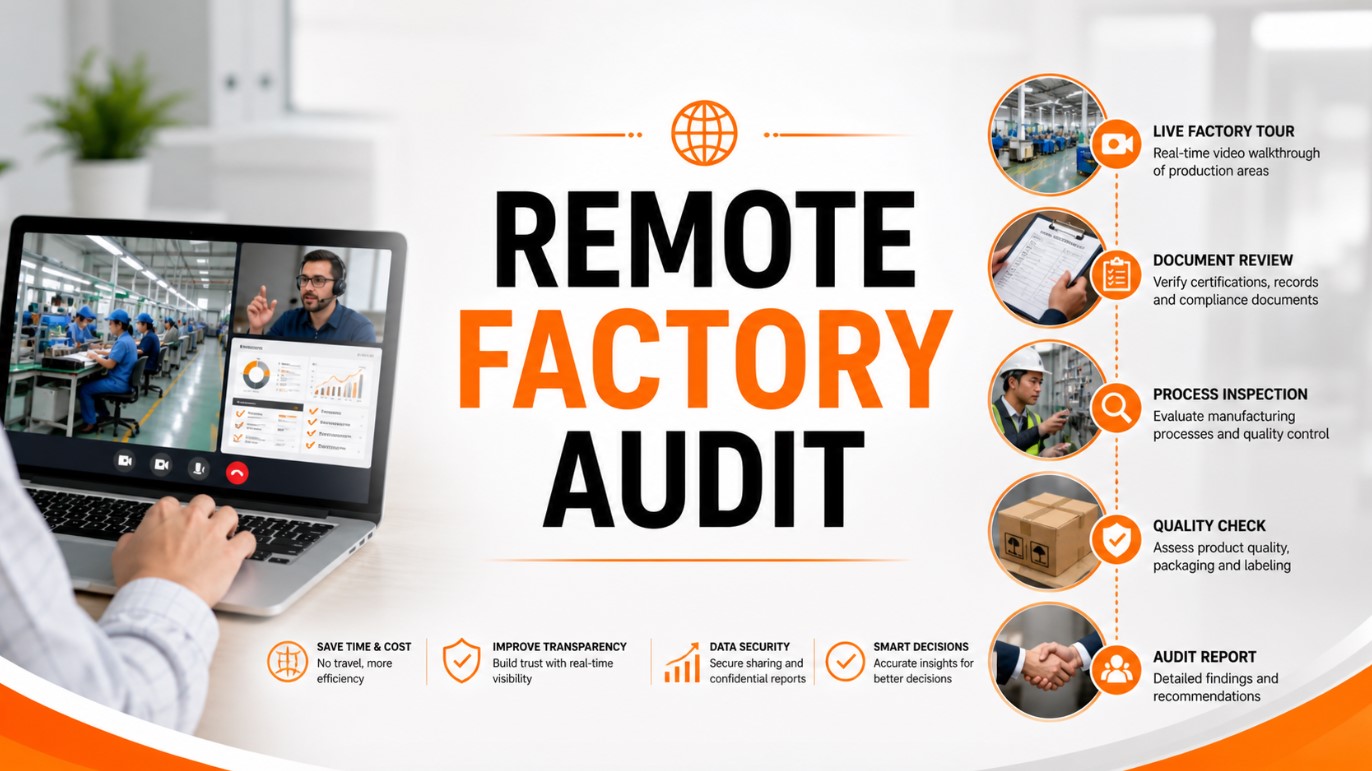
A remote factory audit is a structured assessment of a manufacturing facility conducted without the auditor physically attending the site. Using live video, document sharing, and real-time communication tools, a qualified auditor evaluates the supplier’s legal standing, production capabilities, quality management systems, and working conditions — all from a remote location.
The concept existed before 2020, but COVID-19 turned it from a niche option into an industry standard. Industry data via the IIA shows remote audits rose from just 2% of all audits before 2019 to 38% in 2020, then to 79% remote or hybrid by 2021. That shift didn’t reverse. Buyers discovered that remote audits delivered genuine intelligence — faster, cheaper, and without the logistical burden of international travel.
Remote audits are not a single product. They range from lightweight document reviews to full live video walkthroughs with multi-department inspections. The right format depends on your risk level, the supplier relationship stage, and the product category involved.
Products like QCADVISOR 360 Virtual Tours represent the more advanced end of remote auditing, combining structured audit frameworks with live virtual factory walkthroughs for buyers who need genuine visibility without travel.
How Does a Remote Factory Audit Work? A Step-by-Step Breakdown
Remote factory audits follow a structured sequence designed to replicate the key elements of an on-site visit. The process typically runs to completion within one business day, compared to two to three days for on-site audits when travel is factored in.
Step 1: Pre-Audit Document Submission
The factory submits a document package before the audit date. This includes business licenses, export certifications, ISO certificates, quality management manuals, and any relevant test reports. Auditors review these in advance to identify gaps or inconsistencies before the live session begins.
Step 2: Scheduling and Technology Setup
The audit team and factory agree on a time slot, typically within 24 hours of booking for faster providers. Technology requirements are confirmed: stable internet connection, video conferencing platform, and camera-capable devices for the factory walkthrough. In China, WeChat is often the preferred video platform — Zoom and Microsoft Teams can face connectivity restrictions due to the Great Firewall. In Vietnam and Bangladesh, Teams and WhatsApp video are common alternatives.
Step 3: Live Video Walkthrough
The factory representative carries a smartphone or tablet through the facility in real time, guided by the auditor’s instructions. This is not a pre-recorded tour. The auditor directs which areas to visit, in which order, and can request the camera to pan, zoom, or stop at specific points. Smart glasses are used by some advanced audit providers to deliver a hands-free, first-person perspective.
Step 4: Production Line Review
Auditors assess machinery condition, production capacity, workflow layout, inventory levels, and output quality during the live walk. They look for evidence that the factory’s stated capacity matches what’s physically visible — equipment counts, shift structures, and raw material stockpiles are all part of this check.
Step 5: Worker Interviews
Auditors can request to speak directly with production workers, either via the factory representative holding the phone to a worker or through a separate video call. This matters for social compliance checks. In China and Vietnam specifically, the auditor should speak the local language or be supported by an independent interpreter — not one provided by the factory.
Step 6: Documentation Review — Live
Any documents not submitted in advance are reviewed live during the call via screen share. Auditors can request to see original documents on camera to check for tampering, missing stamps, or date inconsistencies that wouldn’t show in a scan.
Step 7: Q&A and Clarification
The auditor poses direct questions to factory management covering quality procedures, rejection rates, corrective action history, and customer complaint handling. Responses are recorded and cross-referenced against the documents.
Step 8: Audit Report Delivery
A written report summarising findings, scores, photographs, and recommendations is delivered — ideally the same day. Reports from reputable providers include photographic evidence, checklist scores by category, and a clear pass/conditional/fail verdict.
What Does a Remote Factory Audit Cover?
Remote factory audits cover the same four core categories as on-site audits, though the depth of assessment varies by category. According to a Harvard Business School study of nearly 35,000 audits (Toffel et al., 2025), remote audits detected 25% fewer violations overall compared to in-person audits — with the gap widest for physical conditions and narrowest for document-based checks.
Legal and Registration Documents
- ☑ Business licence and registration validity
- ☑ Export licence and trading rights
- ☑ ISO 9001 or other management system certifications
- ☑ Product-specific certifications (CE, RoHS, BSCI, SA8000, etc.)
- ☑ Bank account and ownership verification documents
Production Capabilities and Capacity
- ☑ Factory floor area and layout confirmation
- ☑ Key machinery and equipment condition
- ☑ Production line staffing levels
- ☑ Monthly output capacity vs. stated capacity
- ☑ Raw material sourcing and inventory management
Quality Management Systems (QMS)
- ☑ Incoming material inspection procedures
- ☑ In-process quality control checkpoints
- ☑ Final inspection and sampling protocols
- ☑ Non-conformance and corrective action records
- ☑ Customer complaint handling processes
Social Compliance and Working Conditions
- ☑ Working hours records and overtime policies
- ☑ Wage records and payslip verification
- ☑ Child and forced labour policy documentation
- ☑ Emergency exits and evacuation procedures (visual confirmation)
- ☑ PPE availability and usage (visual confirmation — note: remote audits detect 59% fewer observation-based violations per HBS 2025)
The HBS finding is important to understand clearly. For clauses requiring physical observation — PPE usage, fire safety, air quality — remote audits found 59% fewer violations than in-person. For document-based clauses, the gap narrowed to 21% fewer violations. This doesn’t make remote audits unreliable. It means you need to understand what each format is genuinely good at detecting.
Review our factory audit checklist to see how these categories map to individual checklist items.
Remote vs. On-Site Factory Audit: Key Differences
| Factor | Remote Factory Audit | On-Site Factory Audit |
| Cost | ~$229–$399 (Asia, typical range) | $400–$800+ (excluding travel) |
| Time to Complete | 1 day (booking to report) | 2–3 days including travel logistics |
| Travel Required | None | International travel to factory location |
| Violation Detection Rate | ~75% of on-site rate (HBS 2025) | Baseline (100%) |
| Best For | New supplier screening, follow-up audits, budget-constrained buyers | First-order critical audits, high-risk product categories |
| Key Limitations | Physical conditions harder to verify; factory staging risk | Resource-intensive; slower to arrange |
When Should You Use a Remote Factory Audit?
The choice between remote and on-site isn’t always clear. The right answer depends on the supplier relationship stage, product risk level, and what you already know about the factory. Here’s a practical decision framework.
Use a Remote Audit When…
You’re screening a new supplier before committing to a first order. A remote audit lets you verify the basics — legal registration, stated capacity, and quality procedures — at low cost and fast turnaround. It’s also the right tool for follow-up audits on previously approved suppliers where you want to check corrective actions have been implemented.
Budget constraints are a real factor for smaller importers. Remote audits cost roughly half (or less) of equivalent on-site audits, making regular monitoring financially viable for companies that couldn’t otherwise afford quarterly supplier checks.
Supply chain switching is another trigger. McKinsey data from 2025 shows 82% of companies report their supply chains were affected by new tariff structures. Buyers rapidly onboarding alternative suppliers in Vietnam, India, or Bangladesh to reduce China dependency need to verify new factories quickly — remote audits are built for this speed.
Choose an On-Site Audit When…
You’re placing a first order in a high-risk product category: electronics, medical devices, children’s products, or anything with significant regulatory requirements. Physical verification of safety conditions is not optional in these categories. The 59% detection gap for observation-based violations found in the HBS study is most consequential here.
High-value, high-complexity manufacturing also warrants in-person assessment. A factory producing precision components for aerospace or automotive applications requires hands-on verification that no camera walkthrough can fully replicate.
You’ve identified red flags in a previous remote audit. If something looked wrong — or was deliberately kept off camera — an on-site visit is the appropriate escalation.
Consider a Hybrid Approach When…
You have an ongoing supplier relationship but want to re-verify periodically. A hybrid model combines an annual on-site audit with quarterly remote follow-ups. This balances thoroughness with cost. Many quality professionals consider this the optimal structure for mid-to-large importers managing multiple Asian suppliers simultaneously.
In practice, buyers who combine an initial on-site audit with bi-annual remote follow-ups catch corrective action backsliding significantly earlier than those relying on annual on-site visits alone.
Remote Factory Audits by Country: China, Vietnam, Bangladesh, and India
Regional conditions matter enormously in remote auditing. Technology access, language complexity, infrastructure reliability, and local compliance culture differ significantly across Asia’s major manufacturing hubs.
China
China accounts for 30.2% of global manufacturing output (China Briefing / China Customs, 2024) and generated USD 3.57 trillion in exports in 2024 (Council on Foreign Relations). For most global buyers, it remains the primary sourcing market — and the primary audit target.
Remote audits in China face two distinct challenges. First, document translation: most factory records are in Mandarin, and relying on factory-provided translations creates an obvious verification gap. Auditors who read Chinese, or who have access to independent translators, are non-negotiable.
Second, platform restrictions. Zoom and Google Meet often experience connectivity issues inside Chinese factories due to internet filtering. WeChat Video or local equivalents work more reliably for live walkthroughs. Confirm platform compatibility before booking.
Factory staging is a well-documented risk in China. Some facilities maintain a “showroom” presentation for auditors — clean floors, visible PPE, orderly records — that doesn’t reflect normal operating conditions. US and EU buyer inspection demand in China rose 21% year-over-year in Q3 2024 (QIMA Q4 2024 Barometer), partly in response to increased tariff-driven scrutiny and the need to verify newly onboarded suppliers.
Vietnam
Vietnam has absorbed significant manufacturing investment as buyers diversified from China. Its remote audit landscape comes with infrastructure challenges, particularly in northern industrial provinces. Rural factory locations may have unreliable internet connections that affect live video quality.
Language adds complexity. Vietnamese factory management often speaks limited English, and Mandarin is not a reliable bridge language in Vietnam as it sometimes is across the border. Auditors with Vietnamese language capability, or verified local interpreters, are essential.
Infrastructure aside, Vietnam’s factories generally present well in audits when buyers work with experienced local audit teams who understand regional norms.
Bangladesh
Bangladesh is the world’s second-largest garment exporter, and its audit data warrants close attention. QIMA’s Q4 2024 Barometer found that 37% of audited factories in Bangladesh recorded critical violations related to working hours and wages between January and September 2024. Compliance scores dropped 26% year-over-year in the same period.
These numbers make a strong case for regular, unannounced-element audits rather than infrequent scheduled reviews. Remote audits with randomised walkthrough requests are particularly valuable in the Bangladeshi context, where buyers cannot easily make surprise on-site visits.
Connectivity varies significantly by factory location. Pre-test video connections at least 48 hours before the audit date.
India
India’s manufacturing sector spans textiles, pharmaceuticals, automotive components, chemicals, and consumer goods. Each sector carries different audit priorities. Pharma factories sourcing to regulated markets (US FDA, EMA) require document-heavy audits with a strong focus on GMP compliance — an area where remote formats perform well.
Textile and garment factories in India face similar social compliance concerns as Bangladesh, though QIMA data suggests slightly better aggregate compliance scores. Automotive component suppliers, increasingly relevant as global OEMs diversify, require capacity and technical competency assessments where physical inspection adds meaningful value.
What Are the Limitations of Remote Factory Audits — And How Do You Work Around Them?
Remote audits are a genuinely useful tool. They are not a perfect substitute for in-person inspection. The Harvard Business School study (Toffel et al., 2025) — analysing nearly 35,000 audits conducted between 2019 and 2021 — found remote audits detected 25% fewer violations overall than in-person assessments. Knowing where the gaps are lets you mitigate them.
- Physical conditions are harder to verify
PPE usage, fire exit accessibility, air quality, and equipment safety guards are observation-dependent. Remote audits found 59% fewer violations in these clauses than on-site auditors (HBS 2025). Mitigation: use remote for screening, schedule an on-site audit for high-risk categories before placing large orders. Consider hybrid scheduling for ongoing monitoring.
- Factory staging
Factories know the audit is coming. They can prepare. Clean floors, visible signage, and staff briefed on what to say are all possible. Mitigation: during the live walkthrough, make unscripted requests — ask to see a specific storage area not mentioned in advance, ask to speak to a worker chosen at random, or request a different area than the planned route.
- Document authenticity
Certifications can be forged. A clean-looking ISO certificate on screen is not the same as a verified one. Mitigation: cross-verify key certifications directly with the issuing body’s public database. ISO, BSCI, and SA8000 all maintain searchable online registries.
- Connectivity and infrastructure issues
Dropped video calls are a real problem in rural Vietnam and parts of Bangladesh. A factory that “loses connection” at a critical moment creates an audit gap. Mitigation: pre-test the factory’s connection 24–48 hours before the audit. Agree on a backup protocol — phone video, WhatsApp, or a local photo-upload workflow — before the session begins.
- Language barriers
An auditor who cannot communicate directly in the factory’s language depends on factory-provided translation. That’s a conflict of interest built into the process. Mitigation: work with audit providers who employ auditors fluent in the factory’s working language. QC Advisor deploys local auditors who speak the language of the factories they assess across China, Vietnam, India, and Bangladesh.
In practice, the language limitation is the one that catches buyers off guard most often. Auditors relying on factory staff to translate worker interviews are not conducting independent assessments — they’re conducting managed ones.
Red Flags to Watch for During a Remote Factory Audit
This is where experienced remote auditing differs from a video call. Knowing what to watch for turns a passive viewing experience into genuine intelligence gathering.
- A heavily scripted walkthrough
If the factory representative moves through the facility at a practiced pace without hesitation, always arriving at tidy, well-lit areas, treat this as a yellow flag. Real factories in production are organised chaos. Pristine conditions during working hours warrant a specific question about current production status.
- Reluctance to pan the camera to specific areas
Any request to see a specific area — a storage room, a secondary production floor, a chemical storage zone — should be met with compliance, not a detour. Repeated deflections or camera drops when moving toward unscheduled areas are a serious concern.
- Documents provided in advance only — not live
If a factory offers to email documents before the call but resists showing originals on camera, that limits your ability to check for recent print dates, missing official stamps, or signs of alteration. Always request original documents on screen during the live session.
- Auditors not allowed to speak directly with workers
The factory representative should be willing to hand the phone to a production worker for a brief direct interview. Refusal, or persistent insistence on “translating” all worker responses themselves, limits the value of the social compliance portion of the audit significantly.
- The factory looks too clean or too empty
A factory running production orders at stated capacity should show signs of activity: materials on the floor, workers at stations, finished goods in process. An unusually clean, quiet, or empty facility during claimed working hours raises questions about actual capacity or whether production has been staged for the visit.
- Internet drops at specific moments
One connectivity issue is understandable. Repeated drops specifically when the camera approaches particular areas — a dormitory, a subcontractor section, a chemical storage area — are a pattern worth noting in your audit report. Ask for the session to be restarted and the area revisited.
- Certifications from unfamiliar bodies with recent issue dates
A certification issued in the past 30 days from a certification body you cannot find online is a document authenticity concern. Legitimate bodies are searchable. If you can’t verify the issuing organisation within 10 minutes of searching, escalate to document verification before placing an order.
- Management answers differ from documents
If a factory manager states a monthly capacity figure in conversation that doesn’t match the machinery count visible on screen, or a staffing level inconsistent with the shift records provided, document the discrepancy. Inconsistencies between verbal statements and written records are among the most reliable indicators of supplier misrepresentation.
Most red flags in remote audits are not dramatic. They’re small mismatches — a date that doesn’t add up, a room that never gets shown, a worker interview that gets redirected. Experienced auditors look for the accumulation of small inconsistencies rather than a single definitive finding.
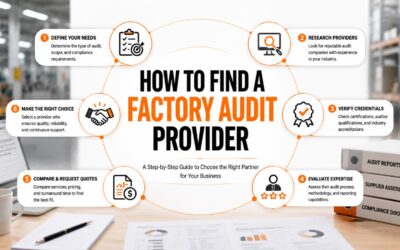
How to Choose a Remote Factory Audit Provider in Asia
Not all audit providers offer the same quality of remote service. The difference between a reliable audit and a checkbox exercise often comes down to a small number of provider characteristics.
- ISO 9001-certified auditors
The auditor’s own quality management processes should meet the same standard they assess in factories. ISO 9001 certification for the audit firm signals a structured, documented, repeatable methodology. Ask for the certificate, not just the claim.
- Local auditors who speak the factory’s language
This single factor has more impact on audit quality than almost any other. An auditor who reads Mandarin, speaks Vietnamese, or understands Bengali can access source documents directly, conduct independent worker interviews, and identify staged scenarios that would slip past an interpreter-dependent review.
- Same-day or fast-turnaround reporting
Your decisions depend on your audit results. A provider that takes five to seven days to deliver a report introduces operational delays that compound across a sourcing cycle. Look for same-day or 24-hour reporting as a stated service standard, not an exception.
- Digital audit platform with photo evidence
Written reports alone are not enough. A credible remote audit report includes timestamped photographs taken during the live session, covering each major inspection area. A digital platform that stores this evidence and makes it accessible for future comparison audits adds long-term value.
- Track record in your product category
An audit firm experienced in garment social compliance may have limited depth in electronics technical audits. Ask specifically about their auditor pool in your product category — not just geographic coverage.
- References from recognisable brands
Ask for references, or look for publicly stated clients. Audit firms trusted by IKEA, Walmart, Sephora, Amazon, and Coca-Cola have been evaluated by supply chain teams that run rigorous supplier qualification processes. QC Advisor audits more than 1,250 factories monthly across Asia and counts those brands among its clients — a useful benchmark when assessing provider credibility.
Start Your Remote Factory Audit — Verify Suppliers Without Travelling
Remote factory audits have matured into a reliable, cost-effective tool for buyers who need genuine supplier visibility without the expense and delay of international travel. When applied to the right scenarios — supplier screening, follow-up verification, rapid onboarding of alternative suppliers — they deliver actionable intelligence that protects sourcing decisions.
QC Advisor’s factory audit services, including the QCADVISOR 360 Virtual Tours product, are designed for exactly this purpose: professional, same-day remote and on-site audits conducted by local, ISO 9001-certified auditors across China, Vietnam, Bangladesh, India, and the wider Asia region.
If you’re ready to verify your suppliers, explore your options at QC Advisor’s remote factory audit services. Audits can be booked and completed within 24 hours.
FAQs
Can a remote factory audit replace an on-site audit?
For most supplier screening and follow-up scenarios, a remote factory audit provides sufficient intelligence. It cannot fully replace on-site audits for high-risk product categories — electronics, medical devices, children’s products — where physical condition verification is critical. A hybrid model (initial on-site, then remote follow-ups) gives most buyers the right balance of depth and cost.
How much does a remote factory audit cost?
Remote factory audits in Asia typically range from $229 to $399 for a standard one-day audit, based on published market rates (Sofeast). On-site audits run $400 to $800 or more, excluding international travel. Pricing varies by scope, country, and provider. Always confirm what’s included — report format, photo evidence, certification checks.
How long does a remote factory audit take?
The live session typically runs three to five hours. From booking to final report delivery, reputable providers complete the process within 24 hours. Some providers offer same-day reporting when audits are booked the morning of the audit date. Compare this to two to three days for on-site audits when travel logistics are included.
What technology is used in a remote factory audit?
Standard tools include video conferencing platforms (WeChat in China, Teams or WhatsApp in Southeast Asia), smartphone or tablet cameras for live walkthroughs, screen sharing for document review, and real-time photo upload for evidence capture. Some advanced providers use smart glasses for hands-free first-person walkthrough footage. Backup protocols should be agreed in advance in case of connectivity issues.
Is a remote factory audit enough for a new supplier?
A remote audit is a strong first step for new supplier screening. It verifies legal registration, stated capacity, and basic quality systems quickly and affordably. For first orders in high-risk or high-value categories, follow up with an on-site audit before committing to volume production. The Harvard Business School study (2025) found remote audits miss roughly 25% of what on-site audits detect, making on-site verification the right standard for high-stakes categories.
How do remote audits handle language barriers in China or Vietnam?
The best approach is auditors who are native or fluent speakers of the factory’s working language. This allows direct document reading, independent worker interviews, and real-time identification of inconsistencies. Where an interpreter is used, they should be independent of the factory — not a staff member translating on behalf of management. Always confirm auditor language capability before booking.