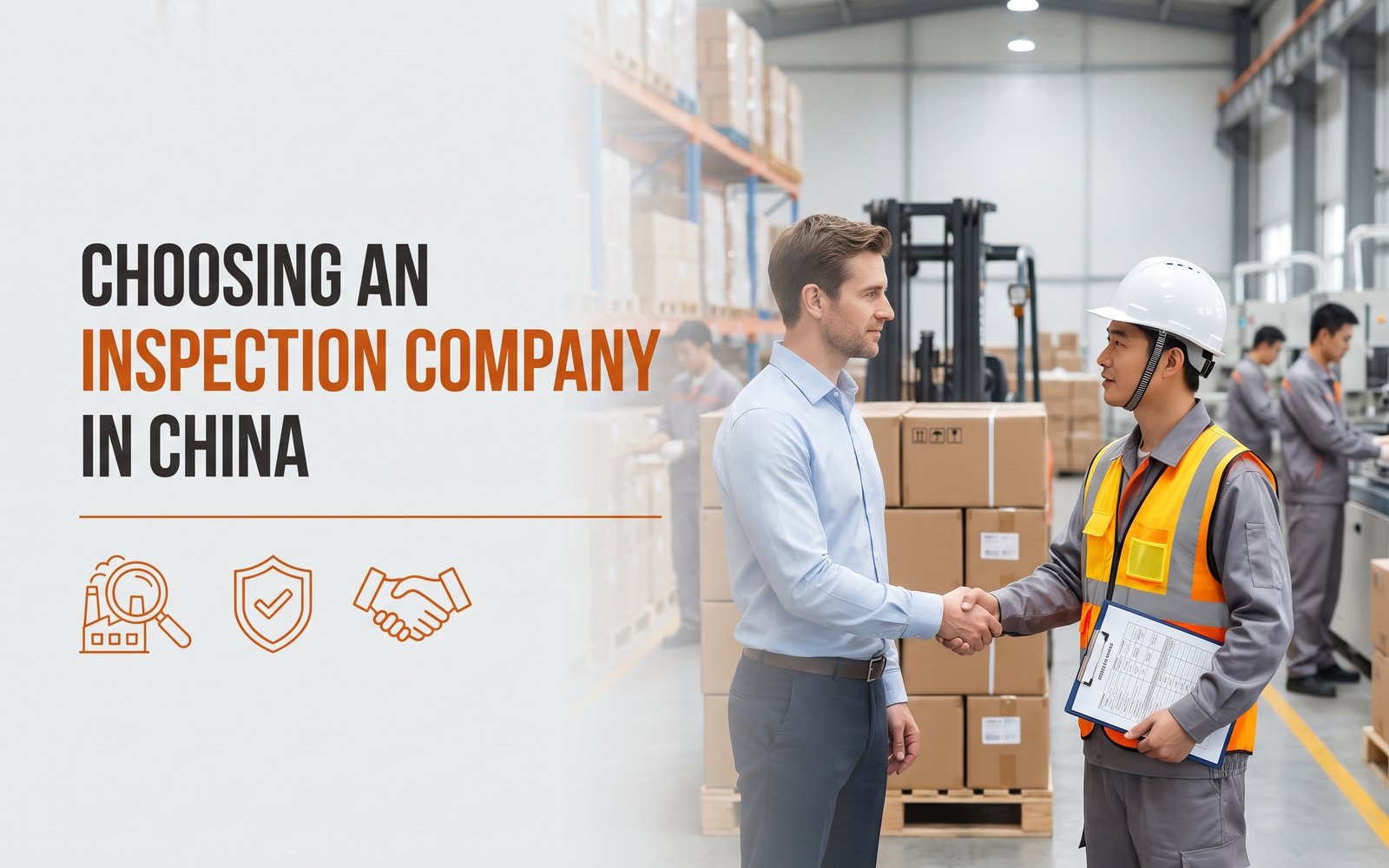
To choose a third-party inspection company in China, check five things first: who pays the inspector, whether the company legally exists, what its accreditation actually covers, who will stand in your factory, and how it stops bribery. Those five checks remove most bad options before you compare prices.
Hundreds of firms sell quality control and inspection services in China. Their websites look alike. Their inspectors don’t.
We’re QCADVISOR, an independent quality control agency headquartered in Hong Kong, with in-house inspection teams in China, Vietnam and India. This guide starts with the three types of provider, then covers the 12 factors we’d check before booking any of them, including us.
Global Group, Independent Specialist or Freelancer: Which Type Fits Your Order?
Third-party inspection providers in China fall into three groups: global testing, inspection and certification (TIC) groups, independent specialists and freelance inspectors. Your product risk and your customer’s requirements decide which type fits.
| Global TIC groups | Independent specialists | Freelance inspectors | |
|---|---|---|---|
| Examples | SGS, Bureau Veritas, Intertek, TÜV Rheinland | Focused QC agencies | Individual inspectors |
| Strengths | Accreditation, in-house labs, retailer recognition | Flexible scope, direct access to senior staff, fast changes | Lowest price |
| Weak points | Standardized scope, higher price, slower to adapt | Usually not accredited, no in-house labs, smaller teams in peak season | No supervision, no backup, no one accountable |
| Best for | Retailer-mandated programs, certification, lab testing | Importers, brands and Amazon FBA sellers who want a responsive team | Low-risk orders with an inspector you already know |
“If you don’t know your manufacturer, hire a big name” is common forum advice, and the big names do bring accreditation and labs. For most consumer-goods orders, though, you’re paying for the inspector on site and the speed of the report. The 12 factors below compare exactly that.
The 12 Factors at a Glance
Factors 1 to 5 are pass/fail filters. A company that fails one is out, whatever its price. Factors 6 to 12 compare the companies that pass.
| Factor | Question to ask | Red flag |
|---|---|---|
| 1. Independence | Who pays you, and do you earn anything from factories? | Your supplier recommends or books the inspector |
| 2. Legal registration | What is your registered entity and its number? | No legal entity, only a trading name |
| 3. Accreditation | What does your ISO/IEC 17020 scope cover? | “ISO certified” with no certificate or scope |
| 4. Inspector expertise | Who inspects my product category? | Any inspector goes to any product |
| 5. Integrity controls | How do you prevent bribery? | “Our people are honest,” with no procedure |
| 6. Methodology | Which sampling plan and AQL will you use? | No sample size in the quote |
| 7. Service range | Which production stages can you cover? | Final inspections only |
| 8. Reporting | Can I see a sample report? | A pass stamp without measurements or photos |
| 9. Coverage | Where is your nearest inspector? | Travel surcharges for main manufacturing hubs |
| 10. Lead time | How far ahead do I book, and how do I reschedule? | No written rescheduling policy |
| 11. Pricing | What does the man-day rate include? | A quote that won’t list man-days, rate and travel separately |
| 12. Accountability | What happens if you miss something? | No answer in writing |
1. Independence: Who Pays the Inspector, and Who Picked Them?
Independence comes first because every other factor depends on it. A third-party inspection company must work only for the buyer. If your supplier recommends the inspector, pays the fee or arranges the visit, the inspector’s real client is the factory, and the report will reflect that.
Three setups break independence quietly:
- Factory-recommended inspectors. “The QC company we always use” is someone your supplier already has a relationship with.
- Sourcing agents with an in-house inspection team. The agent earns a commission on the order, so its inspector judges goods the agent’s income depends on.
- Referral fees. Some inspection firms pay or receive commissions from agents and factories. Ask directly.
Logistics matter too. An inspector the factory collects and takes to lunch spends the day as its guest. Ask whether the company accepts factory-arranged transport. The right answer is no.
Ask: “Do you earn anything from the factories, agents or shipments you inspect?” Worry if the answer is vague, or your supplier offers to book the inspection for you.
2. Legal Registration: Is the Inspection Company a Real, Active Business?
A legitimate inspection company can give you its registered name and registration number in seconds. For a mainland Chinese entity, that number is the 18-character Unified Social Credit Code. You can check it free on the National Enterprise Credit Information Publicity System (GSXT), run by the State Administration for Market Regulation (SAMR).
Match the name, legal representative and registered address against what the company told you. Then check the status, because a business license only proves a company was registered once. The GSXT record shows whether it still operates (存续 or 在营) or has been deregistered or revoked (注销 or 吊销).
Hong Kong-registered firms appear on the Companies Registry’s e-Services Portal, where a basic name search is free.
Older guides still tell buyers to check whether an inspection firm is approved by AQSIQ. That agency no longer exists. China merged its functions into SAMR and the General Administration of Customs in 2018, so an “AQSIQ-approved” badge today signals stale marketing.
Ask: “What is your registered entity, and what is its registration number?” Worry if you only get a trading name, a WeChat ID and a personal bank account.
3. Accreditation: What Does ISO/IEC 17020 Prove, and When Do You Need It?
ISO/IEC 17020 is the international standard for the competence and impartiality of inspection bodies. Its current edition, ISO/IEC 17020:2026, replaced the 2012 version in March 2026. In China, CNAS (China National Accreditation Service for Conformity Assessment) accredits inspection bodies against it. Accreditation proves a documented, audited system. It doesn’t prove that the person in your factory knows your product.
Three details matter more than the logo:
- Scope. Accreditation covers named inspection fields. A CNAS ISO/IEC 17020 certificate can cover boiler and pressure-vessel inspection and say nothing about garments or electronics. Ask for the certificate and read the scope.
- Type. The 2026 edition sorts inspection bodies into Type A, fully independent of the goods and parties they inspect, and Type non-A, which have some link to what they inspect. Certificates issued under the 2012 edition stay recognized until March 2029 and still use Types A, B and C. For buyer-side inspection, look for Type A under either edition.
- ISO 9001. This certifies a general quality management system. It is common among inspection firms and says little about inspection competence.
You need an accredited inspection body when a retailer, a government program or your contract requires one. Otherwise, weigh accreditation alongside the field factors below, not above them.
Ask: “Can I see your accreditation certificate and its scope?” Worry if you hear “ISO certified” with no standard number, no certificate and no scope.
4. Inspector Expertise: Who Will Actually Stand in Your Factory?
The inspector, not the brand on the report, decides what gets caught. An apparel inspector checking a Bluetooth speaker can count cartons correctly and still miss a loose battery contact. Ask who will inspect your goods, which product categories that person covers, and whether the same inspector can return for repeat orders.
Many buyer guides treat full-time inspectors as the only safe option. The better question is category fit plus supervision. A full-time generalist who moves between toys, furniture and garments every week can be less useful than a part-time senior engineer who only inspects electrical appliances and gets reviewed after every job.
Part-time work raises one more question. Ask what a part-time inspector does the rest of the week. One who also works for a factory or a sourcing agent brings the independence problem from Factor 1 straight back in.
Ask about the inspector’s track record, how inspectors are tested and reviewed, and what happens to one whose results don’t hold up.
Ask: “Who inspects my category, and how many inspections like mine has that person done?” Worry if any available inspector gets sent to any product.
5. Integrity Controls: How Does the Company Stop Bribery?
Bribery is the open secret of inspection in China, and every provider says its people are honest. Procedure is what separates them. Ask what the company does to make a bought result hard to deliver and easy to detect.
Controls worth hearing about:
- background checks through industry networks before hiring
- supervisor review of every report before release
- spot checks, and an investigation whenever an inspector’s reports look inconsistent
- inspectors assigned from other regions when local relationships could create a conflict
- inspector pay above the market rate, so a factory’s envelope is less tempting
- immediate dismissal for confirmed violations
One more control protects you after the visit. When the supplier’s representative signs the findings before the inspector leaves, the factory can’t dispute them later.
Ask: “Walk me through your anti-bribery controls, step by step.” Worry if the answer is about trust and culture instead of checks and consequences.
Want an inspector who works only for you? QCADVISOR does no sourcing and never accepts factory-arranged transport. A supervisor checks every report before you see it, and the supplier signs our findings on site. Product inspections and factory audits across China start at USD 280 per man-day, with travel included in mainland China. Request a quote on our booking platform.
6. Methodology: How Will They Sample and Judge Your Goods?
A professional inspection company states its sampling plan before the inspection, not after. Most use AQL sampling under ANSI/ASQ Z1.4 or its equivalent, ISO 2859-1, at General Inspection Level II, with separate limits for critical, major and minor defects. Your quote should show the sample size.
AQL (Acceptance Quality Limit) is the worst average defect rate you will accept. Here is how the defect classes usually work:
| Defect class | What it means | Typical AQL |
|---|---|---|
| Critical | Could injure a user or break a legal requirement | 1.0 or lower, often set at zero |
| Major | Likely to cause a return or complaint | 2.5 |
| Minor | Cosmetic, unlikely to cause a return | 4.0 |
A worked example: an order of 1,200 units inspected at Level II gives a sample of 80 units. At AQL 2.5, the lot passes with up to 5 major defects and fails at 6.
A good provider builds the checklist from your purchase order, product specifications, golden sample (the approved reference unit) and past defects, then adds category checks such as EN 71 or ASTM F963 points for toys.
Ask: “What sampling plan and AQL will you use, and will you inspect against my checklist?” Worry if the quote has no sample size or uses one generic checklist for every product.
7. Service Range: Can They Cover Every Stage of Production?
Choose a company that covers the stages your risk calls for, not only the final check. A complete provider can audit the factory before you order, inspect during production, run a pre-shipment inspection before you pay the balance, and supervise loading at dispatch.
| Service | When it happens | What it catches |
|---|---|---|
| Factory audit: factory verification audit (FVA) or factory technical audit (FTA) | Before the first order | Trading companies posing as factories, subcontracting, capacity gaps |
| Pre-production inspection or qualification (PPI / PPQ) | Before production starts | Wrong raw materials, components or packaging |
| During production inspection (DPI / DUPRO) | When 20–50% of the order is produced | Systematic defects while they can still be fixed |
| Pre-shipment inspection, also called final random inspection (PSI / FRI) | When at least 80% is finished and packed | Quality, quantity, labeling and packaging problems |
| Container loading supervision (CLS) | During loading | Short-shipping, wrong cartons, poor stacking, damaged containers |
Container loading supervision is also called container loading inspection (CLI).
Inspection isn’t lab testing. Product testing for CE, FCC or REACH is laboratory work, and most CE marks rest on the manufacturer’s own declaration of conformity. An inspection company checks certificates, markings and documents on site.
Ask: “Which of these services do you run in-house?” Worry if the company only sells final inspections and can’t help before production.
8. Reporting: What Should a Sample Inspection Report Show?
Ask for a sample report before you book. A useful report measures your product against your specification, classifies every defect as critical, major or minor, and shows photos of each finding. Opinions and a pass stamp give you nothing to act on.
A complete inspection report includes:
- the result: pass, fail or pending your decision
- sample size, AQL limits and the defects found in each class
- measured dimensions, weights and colors against your specification
- function and on-site test results
- packaging, labeling, barcode and shipping-mark checks
- photos of products and every defect, plus video for functional or noise problems
- the supplier representative’s signature on the findings
Turnaround matters too. A report that arrives three days late can land after the container is booked, so ask for same-day delivery and confirm the report language.
Ask: “Can I see a real, anonymized report for a product like mine?” Worry if the sample report reads like a brochure.
9. Geographic Coverage: Do They Have Inspectors Near Your Factory?
Coverage decides cost and speed. A company with inspectors based near your supplier books faster and avoids travel surcharges. Ask where its nearest inspector is based and whether travel is included, especially outside the main manufacturing hubs.
Most export manufacturing in China clusters in Guangdong’s Pearl River Delta around Shenzhen, Dongguan and Guangzhou, in Zhejiang around Ningbo and Yiwu, and in Jiangsu, Fujian and Shandong. Check that your provider has inspectors in the province where your factory is, not only in Shenzhen.
Ask: “Where is your closest inspector to this factory address?” Worry if the company quotes a long-distance travel fee for a factory in a main hub.
10. Lead Time and Scheduling: How Fast Can They Book?
In the main manufacturing hubs, a well-staffed inspection company can usually schedule an inspection two to three days ahead. The rescheduling policy matters just as much, because factories miss production dates. Ask about cut-off times, postponement fees and weekend work.
Inspection demand spikes before the Lunar New Year shutdown and the October Golden Week holiday, when factories rush orders out. Book as soon as your production date is confirmed.
Ask: “What’s your cut-off for postponing, and what does a late change cost?” Worry if there’s no written policy and every change becomes a negotiation.
11. Pricing: What Does the Man-Day Rate Actually Include?
Third-party inspection in China is priced per man-day, which means one inspector for one working day on site. Published rates on China inspection websites run from under USD 200 to over USD 300. The headline rate matters less than what it includes. Extra costs usually sit in travel, re-inspections, weekends, urgent bookings and postponements. Many independent firms now include travel and weekend work in the rate for China’s main hubs, so add up any extras before you compare.
Put these questions in writing before you compare quotes:
- Is travel included, or charged per trip?
- Is a re-inspection charged at the same rate as the first inspection?
- Do weekends, holidays or urgent bookings cost extra?
- What is the postponement fee, and when does it apply?
- How many man-days does this inspection scope need, and why?
Cheap inspections cut something, usually the sample size, the time on site or the inspector’s experience. One man-day at around USD 300 on a USD 30,000 order costs about 1% of the order value.
Ask: “Can you send an itemized quote with man-days, rate and travel?” Worry if the company won’t itemize the quote, or can’t say in writing what a re-inspection, weekend or late change costs.
12. Accountability: What Happens If the Inspector Misses Something?
No inspection company catches every defect, because AQL sampling checks a sample. A serious provider still has a clear, written position on its own errors and a named person who answers.
Seller forums repeat one warning: if a third-party inspector misses something, you’ll have no recourse. A big name doesn’t change that by itself. SGS’s published General Conditions of Service, for example, cap its liability at 10 times the fee for the service or USD 20,000, whichever is lower. Read the terms of every provider on your shortlist, and ask how a claim is handled before you need to make one.
Ask who your day-to-day contact is, whether they work in your time zone, and whether you can reach a supervisor during the inspection.
Ask: “What’s your written policy when your inspector gets it wrong?” Worry if the answer starts and ends with “inspections are based on sampling.”
How Does QCADVISOR Measure Up Against These 12 Factors?
We built QCADVISOR around the questions above, and we’d rather you test us against them than take our word for it. Habib Rkha, who has spent 17 years in quality control in China and across Asia, founded the company in 2018. Our leadership team has visited more than 4,000 factories across Asia.
Why importers use QCADVISOR in China:
- We only do quality control. No sourcing, no supplier matchmaking, no factory-arranged transport.
- Your product goes to an engineer who inspects that category, not whoever is free that day.
- From USD 280 per man-day in mainland China, with travel and weekends included and re-inspections at the same rate.
- Same-day reports, checked by a supervisor before they reach you.
Here’s how we answer each of the 12 factors:
| Factor | How QCADVISOR handles it |
|---|---|
| 1. Independence | No sourcing and no supplier matchmaking, by design. No commissions from factories or agents. No factory-arranged transport. |
| 2. Registration | Headquartered in Hong Kong (Cheung Sha Wan, Kowloon), with an office in Shenzhen (Futian District). |
| 3. Accreditation | Not ISO/IEC 17020-accredited or ISO 9001-certified, by choice. |
| 4. Expertise | Category specialists matched to your product, many of them part-time senior engineers who inspect a single category. |
| 5. Integrity | Background checks through our industry network, supervisor review of every report, spot checks, inspectors from other regions where local ties could create a conflict, above-market inspector pay, and immediate dismissal for any confirmed bribe. |
| 6. Methodology | ANSI/ASQ Z1.4 (ISO 2859-1), Level II by default. Checklists for more than 540 product types, adapted to your specifications and past defects. |
| 7. Service range | Factory verification and technical audits, sample qualification, PPI/PPQ, DPI, PSI, container loading supervision, re-inspection and sorting. |
| 8. Reporting | Photo and video reports in English, the same day, or by noon the next day for remote sites or long findings lists. Sample reports on request. |
| 9. Coverage | In-house team in China with supervisors in . Travel included in mainland China. |
| 10. Lead time | On site within 24 to 48 hours in most of China once the goods are ready. Book two to three days ahead to lock the date, four to five days elsewhere in Asia. Rescheduling is free if the factory tells us by 6 PM China time one working day before. Later changes cost about USD 100. |
| 11. Pricing | From USD 280 per man-day across most of Asia, USD 380 in Taiwan and South Korea. Travel included in mainland China, and any cost for a very remote site is shown in the quote before you book. No extra charge for weekends, holidays or urgent requests. Re-inspections at the same rate. |
| 12. Accountability | A dedicated supervisor, an Account Manager in European or US hours, and 24/7 support by chat, WhatsApp and email. If a problem traces back to our error, we take responsibility and agree fair compensation in proportion to it. |
On accreditation, we’ll be direct. If your retailer or contract requires an accredited inspection body, choose one. If it doesn’t, judge us on the field factors, starting with a sample report for a product like yours.
What Does a QCADVISOR Pre-Shipment Inspection in China Look Like?
A pre-shipment inspection is your last check before the balance payment, and it is the service most buyers book first. It is one of five stages our quality control and inspection services in China cover, from the factory audit before your first order to loading supervision at dispatch. Here’s how a pre-shipment inspection runs:
- Booking. You create a project for your order on our booking platform and request a date. We send a quote. Once you approve it, we confirm the date, address and readiness with your supplier directly. You book and pay, so the supplier never chooses or pays the inspector.
- Preparation. Two days before, we finalize the scope, checklist and sampling plan from your specifications, golden sample and past issues.
- Inspection day. With the goods at least 80% finished and packed, the inspector checks quantity, workmanship, measurements, function, packaging, labeling and shipping marks. The supplier’s representative signs the findings before the inspector leaves.
- Report. You get the photo and video report the same day, or by noon the next day for remote sites or long findings lists.
- If it fails. We review the findings with you and the supplier, agree on rework, replacement or sorting, and re-inspect at the same rate.
Most inspections take one man-day, travel included in mainland China. Payment is in advance, and enterprise clients can move to monthly invoicing. Ask us for a sample pre-shipment inspection report before you book your first one.
We also tell you what we don’t do. We don’t run lab testing or social compliance audits, and we refer clients to specialist partners for both.
Frequently Asked Questions
Should I use the inspection company my supplier recommends?
No. A supplier-recommended inspector has a relationship with the factory before your inspection starts, and that relationship shapes what gets reported. Choose and pay the inspection company yourself, give it your specification directly, and make sure it arranges its own transport to the factory.
How much does a third-party inspection in China cost?
Most providers charge per man-day, one inspector for one day on site. Published rates run from under USD 200 to over USD 300, and a standard pre-shipment inspection usually takes one man-day. Compare what each rate includes, such as travel, re-inspections and weekend work, not only the headline number.
Who pays for a re-inspection after a failed inspection?
The buyer books and pays for it, at the rate in the inspection company’s quote. Many importers write a clause into the purchase order that makes the supplier reimburse re-inspection costs after a failed result. Agree on it before production starts, while you still hold the balance payment.
Should I inspect the goods myself?
You can, and nobody knows your product better. The cost is a flight, several days on site and a hotel for every order, and the factory will treat you as a guest, not an inspector. Many importers check the first order in person, then hand repeat orders to an independent inspector working from their checklist.
So, Which Third-Party Inspection Company Should You Choose?
Choose the company that can prove it works only for you before you pay it a cent. In practice, the shortlist comes down to five steps. The first three apply the five filters, and the last two compare the companies that pass:
- Rule out any inspector your supplier or sourcing agent suggested.
- Check the legal entity, and check the accreditation scope if your customer or contract requires one.
- Ask who will inspect your product category and how the company controls bribery.
- Compare sampling plans, sample reports, coverage, lead times and itemized quotes, not headline rates.
- Get the company’s position on its own errors in writing.
Then test the winner on one real order. A pre-shipment inspection on a small shipment shows how the company communicates, how its report reads and whether its findings match what arrives in your warehouse. That single comparison tells you more than any sales call.
Keep expectations honest. Third-party quality control and inspection won’t turn a weak supplier into a good one. It gives you verified facts while the goods are still at the factory and the balance is still in your account. That is your last moment of real bargaining power, and the person on site should answer to you.
If you’re shipping from China, QCADVISOR can be that person. Create an account on our booking platform to book your first inspection. We’ll send a quote before anything is confirmed.