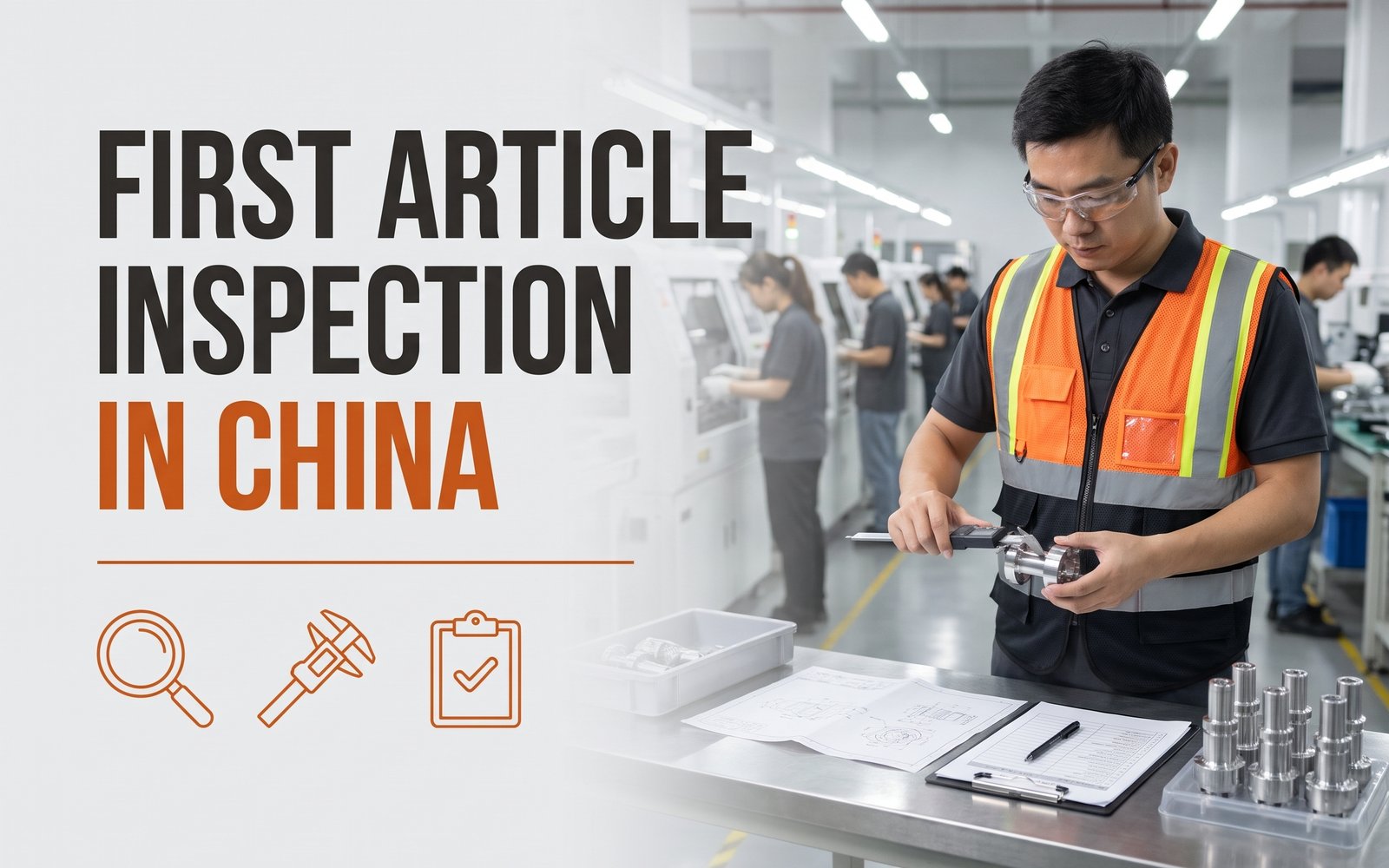
A first article inspection (FAI) in China is an independent check of the first units your supplier makes with its mass-production tooling, materials and workers, done before the rest of your order is produced. It answers one question: can this factory repeat the sample you approved, at volume? A pass gives you a documented baseline for every inspection that follows. A fail costs you a day, not a container.
Most quality problems in Chinese manufacturing start in the gap between the sample room and the production line. Your golden sample was made slowly, by the factory’s best technician, with hand-picked materials. Your 5,000 units will be made by a shift of operators working to a daily quota, using whatever resin, fabric or steel the purchasing department bought that week.
First article inspection is the quality control step built to close that gap. This guide covers where FAI sits among the other factory inspections in China, what it checks, when to book it, what it costs, and how it feeds every later inspection.
What Is Factory Inspection in China?
Factory inspection in China is any on-site quality control check carried out at your supplier’s facility by someone who does not work for the factory. It splits into two families. Factory audits tell you whether a supplier can make your product. Product inspections tell you whether they did.
An audit looks at the factory itself: business licence, production lines, equipment, workforce, quality management system and whether parts of production are subcontracted. Product inspections look at your goods at fixed points in the production timeline. In China, those points follow a standard sequence.
| Inspection | When it happens | The question it answers |
| Factory audit (FVA or FTA) | Before you place the order | Is this a real factory, and can it make my product? |
| Pre-production inspection (PPI/PPQ) | Before production starts | Are the raw materials, components and setup right? |
| First article inspection (FAI) | First units off mass-production tooling | Can the line repeat my approved sample? |
| During production inspection (DPI or DUPRO) | 20 to 50% of the order produced | Is quality holding as volume builds? |
| Pre-shipment inspection (PSI) | At least 80% finished and packed | Does the finished lot meet my acceptance criteria? |
| Container loading inspection (CLI) | During loading | Are the right goods, in the right quantity, going into a sound container? |
Every factory in China also runs its own quality control. Good ones perform a “first piece inspection” (首件检验, shǒujiàn jiǎnyàn) at the start of each shift or after each mold change. That check is useful, but it works for the factory. The QC team usually reports to the same production manager who is measured on output and on-time delivery.
The person checking your goods should not be paid by the person who made them. That is why independent inspection exists. First article inspection is the first independent check on mass-production output, linking the audit (can they make it?) to the in-line and final inspections (did they make it right?).
What Is First Article Inspection, and How Is It Different From Sample Approval?
First article inspection is a structured inspection of a small number of production-representative units, checked characteristic by characteristic against your drawings, specifications and approved sample. “Production-representative” is the part that matters. The units must come off the real line, made with the real tooling, real materials and real operators.
Sample approval and FAI answer different quality control questions:
- A pre-production or golden sample proves the factory understood your design. It is often built in a sample room, sometimes with materials that will never be bought again.
- A first article proves the production process can make that design. It is pulled from the line after the molds, materials and operators are in place.
Approving a sample tells the factory what you want. It tells you nothing about what the line will deliver.
In aerospace, FAI follows SAE AS9102. In automotive, it sits inside PPAP (Production Part Approval Process). Most importers buying consumer goods, furniture, apparel or electronics from China need the same logic applied practically: measure the first units against every requirement that matters, document it with photos, and get a written go or no-go before mass production. If your customer requires a formal report or PPAP documents, we build the inspection scope around that format.
There are two scopes. A full FAI checks every characteristic. A partial (or delta) FAI checks only what changed, such as a new mold, a new material or a revised drawing. For the formal definitions, report forms and FAIR structure, see our complete first article inspection guide.
Why Does First Article Inspection Matter So Much for Quality Control in China?
First article inspection matters because the most expensive quality problems in China appear in the first hours of mass production, and FAI is the only inspection scheduled for that moment. Four patterns show up again and again on the factory floor.
Material substitution. The factory’s purchasing team sources an “equivalent” material at a lower price. Grade 201 stainless steel replaces 304. Recycled ABS replaces virgin ABS. A lighter fabric replaces the one on your tech pack. The factory is optimizing for its margin, not yours, and the sample you approved was made before that purchase happened.
New tooling. Fresh molds, dies and cutting patterns rarely produce perfect parts on day one. Flash, sink marks, short shots and drifting dimensions are typical, and the first articles show whether the tool still needs correction.
Subcontracting. Plating, printing, sewing or assembly is often sent to smaller workshops. The sample may have been finished in-house, your production run may not be, and FAI is often the first look at the subcontractor’s work.
Quality fade. Paul Midler’s term from Poorly Made in China for the gradual drop in quality across orders. Without a documented baseline, fade is hard to prove. FAI gives you that baseline.
Now the cost. Say a lid comes out 2 mm too wide on a new mold. Caught at FAI, the factory adjusts the tool and you lose a day or two. Caught at the pre-shipment inspection, 5,000 lids are already molded, assembled and packed, the factory argues over rework, and your ship date slips. Caught by your customer, it becomes returns and bad reviews. Same defect. Only the inspection timing changes the bill.
When Should You Book a First Article Inspection in China?
Book a first article inspection whenever something in the production process is new or has changed. The common triggers:
- A new supplier, or your first order of a new product
- New or modified tooling: molds, dies, stamping tools, cutting patterns
- A change of raw material or of a key sub-supplier
- An engineering change: a revised drawing, a new color, a new component
- A restart after a long production pause, or after Chinese New Year, when many factories return with new or retrained operators
- A failed inspection on a previous order, or a recurring defect you need to close out
- Safety-critical or regulated products, such as electrical goods, toys and children’s products
A stable repeat order is different. Same factory, tooling and materials with a clean inspection history usually means a during production and a pre-shipment inspection are enough quality control.
Timing is the part importers get wrong. Agree in your purchase order that the factory produces the first units and waits for the FAI result before running the full order. Book two to three days ahead in mainland China, four to five days elsewhere. Better still, book the day your order is confirmed.
About to release a new product into production? A QCADVISOR first article inspection is USD 280 for one man-day, with travel included anywhere in mainland China. Our inspectors travel to the factory on their own, never in factory-arranged transport, and they do not disclose who the buyer is unless you authorize it.
What Does a First Article Inspection Check?
A first article inspection is the quality control check on everything in your specification that the production process can get wrong. The inspector works from a checklist built from your drawings, specification sheet, approved sample and any quality problems you have had before.
| Check | What the inspector does | Typical failure we see in China |
| Dimensions and weight | Measures critical dimensions against drawing tolerances, weighs units | Shrinkage on new molds, thinner material bringing weight under spec |
| Materials and components | Compares materials, trims and hardware with the bill of materials and approved sample | A cheaper grade substituted without approval |
| Color and finish | Compares against Pantone codes, swatches or the reference sample | Shade variation between dye lots, uneven plating |
| Workmanship | Inspects for cosmetic and construction defects | Flash, scratches, loose threads, uneven gaps |
| Function and performance | Assembles and runs the product: on/off cycles, fit, pull tests, load | Parts that fit on the sample but bind in production |
| Marking, labels and packaging | Checks logos, labels, barcodes, manuals, retail boxes and cartons against your artwork | Wrong barcode, outdated artwork, missing warning labels |
| Production setup | Notes the tooling in use and whether any step is subcontracted | A process moved to an unapproved workshop |
The inspector also checks that required markings, such as a CE mark, appear on the product and packaging, and asks for the certificates you need. That is not lab testing. Testing for CE, FCC or EN 71 is done by accredited laboratories, and we can connect you with lab partners.
Sample size works differently from later inspections. FAI usually covers 1 to 5 units, most often 3 to 5, and each unit is checked against every line on the checklist. Statistical sampling under AQL (Acceptable Quality Limit, defined in ISO 2859-1 and ANSI/ASQ Z1.4) comes later, at the during production and pre-shipment inspections, once there is a full lot to sample from.
How Does a First Article Inspection Work, Step by Step?
Every QCADVISOR first article inspection follows the same quality control sequence:
- You share your requirements. Drawings, specifications, bill of materials, approved sample photos, Pantone references, packaging artwork and past quality issues.
- We build the checklist. Our coordination team, with a senior engineer for technical products, turns your documents into a checklist with tolerances and a defect classification: critical (unsafe or illegal), major (likely to cause a return) and minor (cosmetic, unlikely to cause a return).
- We schedule with the supplier. We confirm the date, address and that the first units will be ready. Agreed visits, not surprise visits, get full access to the line.
- The inspector pulls units from the line. Not from the showroom, and not from a box the sales manager prepared.
- The inspector measures, tests and documents. Every check is photographed. Functional tests, noise issues and moving parts are recorded on video.
- The factory signs the findings. The supplier’s representative signs the results before the inspector leaves, so nobody can dispute them later.
- You receive the report the same day. A supervisor reviews it before it reaches your account on our booking platform. If findings are extensive or the factory is remote, it arrives the next morning before noon.
- You decide. Approve, approve with conditions, or reject and request a re-inspection.
What Happens If the First Article Fails Inspection?
If the first article fails, mass production should stay on hold until the factory fixes the cause and a re-inspection confirms the fix. A failed FAI is the cheapest quality control failure you will ever pay for, because only a handful of units exist.
The report shows every defect with photos, measurements and its classification. We review the findings with you and the supplier, and the factory proposes its corrective action: a mold adjustment, a return to the approved material, retraining, or moving a process back in-house. A re-inspection of the new first articles then confirms the fix. Re-inspections are charged at the regular rate, because they need the same preparation and on-site work.
Minor issues sometimes justify a conditional approval. Put the condition in writing, then make it a priority checkpoint at the during production inspection.
Your bargaining power is highest at this stage. With typical 30/70 payment terms, you have paid a deposit and still hold the balance. Write the FAI pass into your purchase order as a condition for starting mass production, and the factory has a clear reason to fix problems quickly.
How Does First Article Inspection Connect to the Rest of Your Quality Control Plan?
The approved first article becomes the reference point for every inspection that follows.
- Seal a reference sample. Sign and date an approved first article, keep one at the factory and one with you. Later inspectors compare production units against it.
- Use the measurements as a baseline. When dimensions or weights drift at the during production inspection, you see quality fade early, while the order is still on the line.
- Carry findings forward. Every issue found at FAI becomes a highlighted checkpoint on the during production and pre-shipment inspection checklists.
- Tighten final acceptance. At the pre-shipment inspection, the inspector samples by AQL. Most importers use 0 critical, 2.5 major and 4.0 minor. On a 1,200-unit order at General Inspection Level II and AQL 2.5, the inspector checks 80 units, and more than 5 major defects fails the lot.
- Re-run when something changes. On reorders, a partial FAI covers new tooling, materials or drawing revisions without repeating the full check.
How Much Does a First Article Inspection Cost in China?
A first article inspection in China costs USD 280 per man-day with QCADVISOR, travel included anywhere in mainland China. Most FAIs take one man-day, making it the cheapest quality control step in your plan. In Taiwan and South Korea the rate is USD 380 per man-day, and in other countries travel costs may apply for remote factories.
Weekends, holidays and urgent bookings cost nothing extra. The only add-on is a late postponement fee of about USD 100 if the factory reschedules after 6:00 PM China time on the working day before the inspection.
Compare that with what is at stake. On a 3,000-unit order at USD 15 per unit, you are spending USD 45,000. One man-day of first article inspection is about 0.6% of the order value.
Two objections come up with almost every importer.
“The best inspector is yourself.” True, if you can be at the factory. That means flights, hotels and days away for each order, timed to the factory’s schedule, not yours. Our inspectors are matched to your product category, so a furniture FAI goes to someone who inspects furniture.
“If the inspector misses something, I have no recourse.” Our answer is procedure first: inspectors travel independently, findings are signed by the factory, every report is reviewed by a supervisor, and we assign inspectors from different regions when a conflict of interest is possible. Any confirmed bribery or collusion means immediate dismissal. If a problem is traced to an error on our side, we take responsibility and discuss fair compensation in proportion to that responsibility.
First Article Inspection in China: FAQ
Is first article inspection the same as pre-production inspection?
No. Both are quality control steps, but a pre-production inspection checks raw materials, components and production readiness before the line starts. A first article inspection checks the first finished units the line produces. For new products, many importers book both: the pre-production inspection confirms the inputs, and the FAI confirms the output before the full order is produced.
How many units does a first article inspection check?
Usually 1 to 5 units, most often 3 to 5, pulled directly from the first production run. Each unit is checked against every characteristic on the checklist. This differs from AQL sampling at the pre-shipment inspection, where the inspector checks a statistically defined number of units from a finished lot.
Can a first article inspection be done at your office instead of the factory?
Yes. Your supplier can send first articles to our office for inspection. On-site is stronger, because the inspector pulls units from the line and sees the production setup, which a couriered box cannot prove. For a new supplier or new tooling, choose an on-site first article inspection.
Does a first article inspection replace a pre-shipment inspection?
No. FAI proves the production process can make conforming units at the start. It cannot prove quality holds across thousands of units over weeks of production. Keep the pre-shipment inspection, and add a during production inspection for long runs, new suppliers or products with a history of problems.
Do I need a first article inspection on every reorder?
Not if nothing has changed: same factory, tooling, materials and drawing, with a clean inspection history. Book a partial FAI when any of those change. Book a full FAI after a long production pause, after a change of factory, or after a failed inspection on the previous order.
Conclusion: Make the First Units Prove the Process
A golden sample proves your supplier can make your product once. A first article inspection proves the production line can make it repeatedly, with the tooling, materials and operators that will build your whole order. That is the question that decides whether your container arrives sellable.
Treat FAI as the first link in your quality control chain in China. Audit the factory before you order, inspect the first articles before mass production, and use those results to sharpen your during production, pre-shipment and container loading inspections. Each inspection then checks against a documented standard, not a memory of a sample.
Have a new product, new tooling or a new supplier in China? Create your QCADVISOR account, add your supplier as a project, and we will coordinate the date and checklist with the factory. You get an independent inspector on the line before the full run starts, and a signed report the same day.