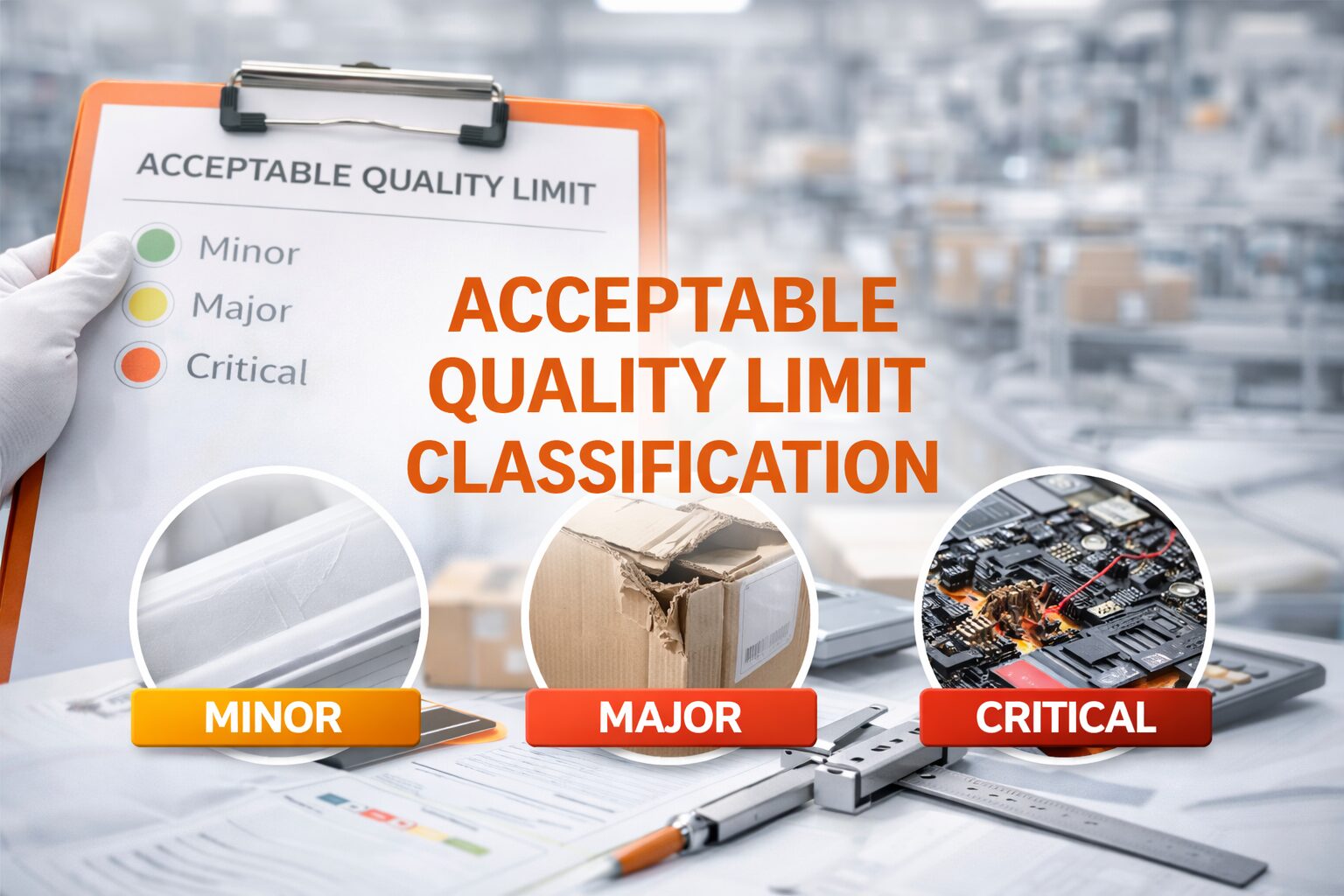
AQL (acceptable quality limit) defect classification is the practice of sorting defects found during aql sampling into severity classes—minor defects, major defects, and critical defects—and giving each class its own acceptance limit so inspection results turn into a clear accept/reject decision.
Instead of arguing “a defect is a defect,” you decide upfront which issues are still saleable, which ones are return-likely, and which ones are unsafe or noncompliant. That matters because misclassifying severity doesn’t just raise rework cost; it can trigger recalls, legal exposure, and fast brand damage.
This is not theoretical risk. Sedgwick’s recall index reported that product recalls across major sectors climbed to a multi-year high in 2023, which is a practical reminder that prevention and clear decision rules beat guesswork.
In this article you’ll learn how AQL defect classification works inside aql inspection tables (including why you usually set separate limits per class), how quality standards like ISO/ANSI sampling plans are applied, and how to define defect thresholds so different inspectors reach the same outcome.
You’ll also see how to build a product-specific defect list, choose an inspection level and lot size, calculate defect limits, and use aql tables for a worked example with accept/reject numbers.
Why is defect classification important in AQL?
Defect classification is the step that converts “we found something wrong” into a repeatable pass/fail decision with numbers, not opinions. When you classify a defect as minor, major, or critical, you’re linking it to a defined tolerance and an acceptance count, so product inspection doesn’t end in debate.
A simple measurement shows why this matters. If a desk spec says 66.0 cm and an inspector measures 66.7 cm, that 0.7 cm variance could be acceptable or rejectable depending on the tolerance bands you agreed.
Without those bands, the same result becomes “fine” for one inspector and “fail” for another, and your quality control system turns inconsistent.
Classification also reflects how you sell. A premium retailer may treat a visible surface flaw as a major defect, while a value brand may treat the same flaw as minor.
The risk is clear: if you downgrade major or critical defect conditions into “minor,” you increase returns, complaints, and recall exposure—and you lose control of product quality.
How is defect classification defined within AQL?
Defect classification within AQL is defined as a severity map that ties each potential nonconformity to (1) its impact on usability/saleability and (2) the AQL acceptance limit for that severity class.
You’re not only naming defects; you’re specifying how many are tolerated in the sample before the lot fails.
For measurable requirements, use tolerance bands. For example, you might define a 0.3–0.8 cm variance as “minor,” and anything beyond that as “major” for the same dimension. That’s how you keep decisions consistent across different inspection levels and suppliers.
Because context changes severity, you also need decision rules: clear thresholds, photos, and examples tied to your promise to customers. When you do that, two inspectors can review the same issue and arrive at the same classification—and your accept/reject calls stop drifting lot by lot.
What are AQL standards and how are they applied?
AQL standards are acceptance sampling rules that define the “worst tolerable quality level” you’re willing to accept in a lot, expressed as a defect percentage/rate and applied through random sampling rather than checking every unit.
In practice, buyers commonly use ISO 2859-1 or the ANSI/ASQ Z1.4 attribute sampling system.
The application logic is straightforward: choose a sampling plan (inspection type and general inspection level), choose AQL values per defect class, take a random sample, count defects by class, and compare those counts to the plan’s accept/reject numbers in the aql table.
Here’s the simple percentage illustration: if AQL is 1% on a lot of 1,000 units, you’re saying up to 10 defective items are tolerable against that threshold; at 11, the lot is rejectable. Many teams call that reject point the rejectable quality level (RQL) in everyday discussion, because it’s where the plan flips to “reject.”
Medical or safety-critical products run much stricter quality levels than low-risk consumer goods, which is why you usually split limits across minor/major/critical instead of one overall number.
What are the three defect classes in AQL inspections?
AQL inspections use three defect classes—minor, major, and critical—because they represent a practical severity ladder tied to customer outcome. Minor means the product is still saleable; major means it’s likely unsaleable or returned; critical means it’s unsafe, illegal to ship, or noncompliant.
The same physical issue can move between classes based on where it appears and what it affects. A scratch on a hidden underside might be minor, while a scratch on a front-facing surface might become major in a premium channel.
That’s why you don’t want “one rule for everything” when you’re setting defect severity.
Most buyers set separate acceptable quality level targets per class, with the strictest approach reserved for critical defects. Once those targets are in place, your team can use AQL consistently across suppliers, lots, and production runs—without changing the standard mid-inspection.
Minor defects
Minor defects are small departures from spec that keep the item saleable and are unlikely to trigger returns. A quick decision test helps: would most end users still accept it without complaining or sending it back? If yes, you’re usually looking at a minor issue.
Many minor defects are cosmetic or workmanship-related, or they sit inside a defined measurement band that doesn’t affect fit or function. Color is a classic example: a product intended to be cobalt blue might appear slightly more azure, and you only notice it when you compare it side-by-side with the approved golden sample.
To keep minor calls consistent, you want clear thresholds and reference photos. Next, it helps to break minor findings into common categories, so your checklist stays usable during real inspections.
What is the typical AQL for minor defects?
A typical benchmark for minor defects is AQL 4.0%, because these issues are often cosmetic and don’t affect function. You’ll still apply this through an AQL plan rather than “eyeballing” percentages, but the intent is higher tolerance than major defects.
A simple interpretation: in a batch of 100 items, up to 4 minor defects may be allowed before the batch fails—depending on the sampling plan’s sample size and acceptance number. The key point is discipline: higher tolerance does not mean unlimited, and exceeding the minor limit still rejects the lot under using AQL rules.
Delivery (Minor)
Minor delivery defects are packaging or handling issues that don’t compromise protection, traceability, or customer understanding. The product still arrives safe, and the buyer can still stock it without extra work.
Common examples include light carton scuffs, superficial outer-box marks, small packaging abrasions, and minor label placement issues that don’t affect scanning or readability. You still record these because repeated “small” packaging issues often predict bigger transit damage later, especially when sample sizes are small.
Appearance (Minor)
Minor appearance defects are small cosmetic issues that most customers won’t notice in normal use. A concrete example is a quarter-inch (~6.35 mm) scratch on the back of a 24-inch monitor—on a non-user-facing surface, with no impact on operation.
Color is also common: the difference is only obvious side-by-side with the approved golden sample. Other examples include faint rub marks, tiny blemishes in non-prominent areas, and light removable marks that don’t change perceived value in your channel.
Dimension (Minor)
Minor dimension defects are small variances that stay inside a pre-defined tolerance window and do not affect fit, assembly, safety, or function. Without that window, inspectors can’t classify consistently, and the argument starts after the inspection.
Set tolerance bands per feature. A tight tolerance may be necessary for a mating part, while a looser band can be fine for a purely cosmetic dimension. This “feature-based” approach reduces disputes and keeps your defect list aligned to how the product is actually used.
Printing (Minor)
Minor print defects are legible and accurate but have small execution issues. In other words, the content is correct, and required information remains readable.
Examples include slight misalignment that still reads cleanly, small ink smears that don’t obscure required text, and minor cosmetic print blemishes on non-critical areas. If readability or accuracy changes, the defect usually escalates to major or critical depending on what the print communicates.
Assembly (Minor)
Minor assembly defects are workmanship issues that don’t affect function, safety, or expected durability. The product works as intended, and the issue is usually cosmetic or low-impact.
Examples include small uniform gaps that sit inside cosmetic allowance, slightly loose parts that remain secure in normal use, and minor alignment variation that doesn’t affect operation. If the looseness causes intermittent function or early failure, you’re moving into major territory.
Weights (Minor)
Minor weight defects are small deviations that don’t affect performance, use, or declared net-quantity requirements in the target market. The product still feels and performs as intended.
Weight tolerances should connect to function. A small deviation might be irrelevant for a decorative item but important for a product where balance or stability matters. Tie the limit to customer experience and any label declarations so inspection decisions stay consistent.
Materials (Minor)
Minor material defects are small visual or texture imperfections that don’t weaken the product or create compliance risk. The item remains safe, functional, and consistent with the agreed appearance tolerance.
Examples include minor fabric slubs, small finish uniformity issues, and slight surface texture variation that stays within the agreed standard. If the material grade changes, contamination is suspected, or performance becomes unstable, the severity escalates.
Major defects
Major defects are departures from buyer specs that make the product likely unsaleable, likely to be returned, or clearly unacceptable to most customers. If you’re asking “will this create complaints at scale?” you’re already in major territory.
Functional examples are direct: a lock whose key doesn’t open it, or electronics that fail to power on reliably. “Truth in labeling” can also be major: clothing labeled “relaxed fit” produced as “skinny fit,” or packaging that claims one color while the product inside is completely different. These aren’t usually immediate safety hazards, but they still damage reputation and increase returns—especially in channels with strict customer expectations.
To apply major calls consistently, you’ll want category definitions that match how defects show up during unboxing and normal use.
What is the typical AQL for major defects?
A typical benchmark for major defects is AQL 2.5%, because these issues materially affect function, usability, or saleability. That lower tolerance is what protects you from shipping lots that “technically work” but still create return spikes.
A simple interpretation: in a batch of 100 items, around 2–3 major defects may be acceptable under a plan aligned to that tolerance, but above that you usually fail the lot. Your actual accept/reject numbers come from the aql tables once you set lot size and inspection settings.
Delivery (Major)
Major delivery defects break traceability, fulfillment accuracy, or retail readiness even when the product itself works. You can’t reliably receive, scan, stock, or ship the goods downstream.
Examples include missing labels, incorrect barcodes, cartons damaged enough to reduce protection or presentation, and shipping packs that raise the probability of transit damage. Treat these as major because they create cost and delay across the supply chain, not only inside the factory.
Appearance (Major)
Major cosmetic defects are obvious during normal unboxing or use and reduce sell-through. Customers notice them quickly, and many will return the item even if it functions.
Examples include prominent dents, highly visible scratches on customer-facing areas, and severe color mismatch that fails the advertised or approved appearance. This is where buyer positioning matters: high-end channels often classify appearance issues as major faster than value channels.
Dimension (Major)
Major dimensional defects are out-of-tolerance in ways that affect fit, assembly, interchangeability, or performance. The key difference from minor is outcome: the part no longer fits as intended, or it clearly violates the agreed spec.
Use a clean threshold rule: anything beyond your defined minor tolerance band becomes major when it changes assembly results, creates wobble, blocks installation, or causes functional interference. This keeps your “critical major” decision boundary clear when inspectors are under time pressure.
Printing (Major)
Major print defects include incorrect or misleading content even if the print itself looks clean. The problem is what the customer reads and believes.
Examples include wrong product information, wrong size/variant details, missing consumer information that affects saleability, and severe misprints that cause complaints. If the print relates to safety warnings or legal marks, the same issue may become critical instead of major.
Assembly (Major)
Major assembly defects degrade usability, durability, or functional operation. The product may work sometimes, but the assembly quality creates failure risk or obvious malfunction.
Examples include misaligned parts that hinder operation, fasteners loose enough to affect function, and poor assembly that leads to intermittent operation. When you see repeat assembly majors, the fastest fix is usually process control: tooling checks, torque standards, and line inspection points.
Materials (Major)
Major material defects are clear departures from the agreed material spec that affect performance or customer acceptance. You’re no longer looking at a minor texture variation; you’re looking at the wrong material outcome.
Examples include incorrect material grade versus specification, material issues that create quality instability, and contamination concerns that undermine acceptability. In regulated categories, incorrect material choices can also trigger compliance failures, which pushes severity toward critical.
Critical defects
Critical defects are unacceptable conditions that can cause injury, violate safety rules, or create severe liability and recall risk. In AQL terms, critical is where you stop negotiating because the downside is not “extra rework”; it’s harm, enforcement, or product withdrawal.
Physical hazard examples include splinters on wooden products, sharp points or burrs, and exposed edges that can cut users. Contamination is also common: insects, blood, or hair inside packaging. Functional safety failures belong here too, such as an overheating battery during cycle testing or furniture toppling during incline testing.
Critical classification must be backed by clear, non-subjective rules. If inspectors hesitate, you want your checklist to make the decision for them with a direct “fail” rule—because this is where zero tolerance protects you and your customers.
What is the typical AQL for critical defects?
A typical benchmark for critical defects is AQL 0%, meaning zero tolerance. Under most plans, finding even one critical defect is enough to fail the inspection because the risk is safety, regulatory, and legal exposure.
This doesn’t mean you never find critical issues; it means the decision rule is strict: the lot does not ship until corrective action, containment, and verification are complete. When you set AQL 0 for criticals, your team stops rationalizing unsafe outcomes as “rare.”
Delivery (Critical)
Critical delivery defects create direct harm risk or prevent safe and legal distribution. The product might work, but the way it’s packed or labeled makes it unsafe to handle or illegal to sell.
Examples include packaging contamination (insects, blood, hair), missing safety marks where required, and packaging that creates a hazard during handling or use. If the issue blocks safe traceability in a regulated market, treat it as critical and contain the shipment.
Appearance (Critical)
Appearance becomes critical when it creates a hazard or prevents safe use. This is not about “looks”; it’s about physical condition that can hurt someone.
Examples include sharp exposed edges, splintering surfaces, and hazard-relevant warnings made unreadable by finishing or surface treatment. If a customer can be injured by touching it or using it normally, it belongs in critical—even if the defect looks “small.”
Printing (Critical)
Critical print defects break safety communication or legal compliance. The product may be physically fine, but the missing or wrong information makes it unsafe or unlawful to distribute.
Examples include missing or incorrect safety labeling, wrong regulatory marks, and warnings that are missing, incorrect, or illegible at point of use. Treat these as critical because the failure mode is predictable: misuse, enforcement action, or mandatory recall.
How should you build a defect list for your product?
You should build a defect list by defining, in writing, what “wrong” looks like for your product and assigning each defect a severity class before anyone starts inspection. Every aql inspection runs off a checklist built from this predefined list, so your defect list is the foundation of consistent outcomes.
Don’t outsource this thinking completely. An inspection provider can help refine wording and add common defect types, but you should set the standards that match your brand promise and channel. Otherwise, you get a checklist that passes goods you would never sell.
Make the defect list practical: attach photos of each defect type, link each one to minor/major/critical, and define measurable thresholds where relevant. Also lock in a golden sample (approved reference) so inspectors and the factory share one visual target. Once this list is stable, the rest of AQL—sampling, thresholds, and decisions—becomes much easier.
What are practical tips for brainstorming defects?
You can brainstorm defects faster by using evidence from real customer dissatisfaction, not only engineering imagination. Start with return reasons, complaint tickets, and negative reviews for similar products in your line; they often reveal defect modes your team didn’t predict.
Next, use your specification sheet as a checklist: what should it look like, how should it function, what must be labeled, and what could fail at each requirement. Then review development history—prototype notes, sampling feedback, and supplier messages—because early samples often show the exact defects that later appear in mass production.
Finally, stress-test samples. Rigorous testing tends to reveal failure modes that remain hidden during quick visual checks, which is exactly what you want to prevent before the lot reaches final inspection.
How do you calculate AQL limits for defect classes?
To calculate AQL limits for defect classes, you follow a small set of steps: define your lot and inspection settings, pick AQL values per severity, then use aql tables or an AQL calculator to return the sample size and the accept/reject numbers for each class. This how-to section has 6 steps.
- Confirm your lot size and inspection type. Decide what counts as the lot (e.g., one PO line) and whether you’re inspecting final goods, in-process, or incoming components.
- Choose your inspection level. Many teams default to General Inspection Level II (Level II) for standard consumer goods because it balances effort and detection.
- Set AQL values per class. Choose separate aql levels for minor, major, and critical based on risk and channel promise.
- Use an AQL calculator or aql table. Enter lot size, inspection level, and your limit AQL targets; the tool returns sample size plus accept/reject points for each class.
- Apply the numbers during product inspection. Count defects by class in the sample and compare to defect limits to accept or reject.
- Record outcomes and adjust your quality plan. If lots fail repeatedly, change process controls or apply switching rules rather than arguing about individual defects.
Which inspection levels should you use for sampling?
You should use General Inspection Level II for most routine inspections unless your product risk, test method, or time constraints justify a different choice. In ISO/ANSI sampling plans, “General” inspection levels (often I/II/III) are the standard settings for attribute inspection, while “Special inspection” levels are used when you need smaller samples.
General Level II is a common default because it produces sample sizes that are practical for factory time and still meaningful for decision-making. Level I reduces inspection effort but lowers detection confidence; Level III increases sample size, which can improve confidence but increases cost and inspection time.
Special levels are useful for destructive tests (where you can’t test many units) or when inspection time is tightly limited. The point is to choose your inspection level intentionally, because it directly changes the sample size and how quickly defective products are likely to be detected.
When should you switch sampling inspection plans?
You should switch sampling inspection plans when you’re managing risk across a continuing stream of lots and your recent results show either quality drift or sustained stability. Switching rules exist so you tighten scrutiny after poor performance and reduce inspection burden after strong performance—without renegotiating rigor on every shipment.
Apply switching per defect class because performance can differ by severity: you might have stable minors but unacceptable majors, and the response should target that reality. Also put switching triggers into your quality plan so suppliers and inspectors can’t “bargain” the sampling rigor lot-by-lot.
Once you set switching governance, you’ll move between tightened, normal, and reduced plans based on evidence. The next four sections explain the most common transitions and the triggers that keep them fair and consistent.
Tightened inspection to normal inspection: when does it apply?
You move from tightened inspection back to normal inspection when recent lots show stable compliance and the process appears under control again. In practical terms, you want a run of consecutive passing lots, not one “good” result.
Before relaxing scrutiny, confirm corrective actions were actually implemented and are holding: tooling updates, operator retraining, material controls, or revised work instructions. This avoids a pattern where a supplier “passes once” and then immediately slips back.
Normal inspection to tightened inspection: when does it apply?
You switch from normal inspection to tightened inspection when normal results show repeated failures or a clear decline across recent lots. The purpose is speed: tighten quickly so you stop shipping avoidable risk.
Tightened inspection also forces corrective action earlier because the supplier feels the cost of poor quality through increased inspection pressure and greater chance of rejection. If you see major defects trending up, tightening is often cheaper than handling returns later.
Normal inspection to reduced inspection: when does it apply?
You move from normal to reduced inspection only after sustained, demonstrated good quality and stable production conditions. Reduced inspection is a reward for control, not a shortcut when you’re busy.
Use reduced inspection only when there are no known changes in materials, tooling, operators, or process settings. If the factory is changing inputs, reduced inspection can hide rising risk until it shows up as customer complaints.
Reduced inspection to normal inspection: when does it apply?
You return from reduced to normal inspection when any signal suggests risk has increased. A single failed lot under reduced inspection is a strong trigger, but it’s not the only one.
Supplier process changes, new operators, new material lots, or recurring customer complaints should also prompt reinstating normal inspection. The point is to restore a standard sample size quickly when the “stable conditions” assumption no longer holds.
How do you determine sample size and accept/reject numbers?
You determine sample size and accept/reject numbers by using a table workflow: match your lot size and inspection level to a code letter, then use that code letter with your chosen AQL to find the sample size and the accept/reject thresholds. This is why teams talk about “reading the aql table” rather than inventing thresholds.
For example, one common table output scenario is a large lot (e.g., 50,000 units) at a general inspection setting with AQL 2.5, which can result in inspecting 500 units with an acceptance limit of 21 defects; above 21 rejects the lot under that plan. Your exact numbers depend on the standard and plan you use, but the method stays the same.
Remember that the thresholds differ by defect class when you set different AQLs for minor/major/critical, so you’ll often track multiple accept/reject limits for a single inspection.
What does a worked AQL classification example look like?
A worked AQL classification example looks like a fixed set of inputs that produces a fixed set of accept/reject limits you can apply in the factory without debate. Use this scenario: order quantity 4,000 units, General Inspection Level II, AQL 2.5 for major defects, AQL 4.0 for minor defects, and critical defects not allowed.
Using the sampling tables, lot size plus inspection level maps to code letter L, and code letter L maps to a sample size of 200 units. The resulting limits are: critical accept 0 / reject 0; major accept 10 / reject 11; minor accept 14 / reject 15.
Now the decision rule is clean. If the inspector finds 11 major defects in the sample of 200, the lot fails for majors even if minors are within limit. This is the real benefit of classification: you don’t argue about “overall quality”—you apply the thresholds you agreed before shipment.
What are examples of defects by industry?
Defect severity is industry-dependent because the same issue can be minor in a low-risk item but major in a premium retail channel, while safety issues remain critical across industries. That’s why you should never copy a defect list from another category without adjusting thresholds to your customer promise.
The production process also shapes defects. Labour-intensive softlines introduce more variability across stitching and finishing, while automated processes (electronics assembly, injection moulding) can reduce random variation but still create systematic defect modes. Your job is to match classification to outcome: saleable vs return-likely vs unsafe.
The next sections give concrete examples by industry so you can translate theory into a checklist your inspectors can actually use.
Apparel and softlines
Apparel and softlines rely heavily on workmanship, so defect classification often focuses on stitching quality, print execution, and accessory function. Minor examples include untrimmed thread ends, blind stitching issues, snarled stitches, slight poor printing, fly yarn, and loop pull-outs.
Major examples include missing stitches, holes, broken or skipped stitches, open seams, shading issues that customers notice, and malfunctioning accessories such as zips or closures. Critical examples include a needle in the item, sharp points, mildew, foreign insects, and blood marks.
One nuance matters: some “minor” issues like untrimmed threads can escalate to major depending on your retailer standards and how strict your channel is about presentation.
Hardlines and home goods
Hardlines and home goods often split defects across cosmetic condition, structural integrity, and safety. Minor examples include light abrasion, dirt stains, oil stains, and light surface marks from handling that don’t affect saleability.
Major examples include deeper scratches on logos or branding, broken parts, and cracks that reduce customer perception and resale value. Critical examples include burrs or sharp points that can cause injury, plus foreign hair or contamination found with the product.
Furniture adds a safety layer: instability or toppling failures should be treated as critical because the injury risk is high, even if the defect looks “mechanical” rather than cosmetic.
Electronics and electrical items
Electronics classification usually separates cosmetic condition from functional reliability and electrical safety. Minor examples include removable marks, flow marks, dirty marks, rough surface, short scratches, poor printing, and minor poor assembly that doesn’t affect function.
Major examples include malfunction or non-function, insensitive buttons, intermittent operation, connectivity issues, turn-on failure, and display problems that affect usability. Even small burrs or rust can become major when they reduce perceived quality or suggest process instability.
Critical examples include damaged wiring with exposed conductors, loose earth terminals, metal residue causing shorts, failed earth continuity tests, and other conditions that create shock or fire risk.
Automotive products
Automotive products demand strict classification because many parts affect safety and fitment. Minor examples include small paint scratches and minor trim misalignments that don’t affect performance.
Major examples include faulty components that impact usability such as door latch problems, air conditioning malfunctions, or electrical system errors that stop features from working reliably. Critical examples include brake failure, airbag malfunction, or other defects that pose direct safety risks to occupants.
Because the downstream risk is high, you’ll often use tighter AQL values and more conservative acceptance limits in automotive programs than in general consumer goods.
Industrial components
Industrial components often hinge on machining tolerances, material certification, surface finish, and labeling accuracy. Minor examples can include surface imperfections such as small welding protrusions that don’t affect intended function (depending on application).
Major examples include out-of-tolerance non-critical dimensions and measurement or weight deviations that become unacceptable when they affect fit, process integration, or performance. Critical examples include rust or corrosion before shipping when it signals accelerated degradation and potential failure—especially for parts used with water or gas.
In this category, traceability matters too: missing or incorrect material certs and markings can quickly become major or critical depending on contract and regulatory requirements.
How can you prevent quality defects before inspection?
You can prevent quality defects before inspection by putting controls into the production flow so problems get caught early instead of being “discovered” at pre-shipment. AQL is a decision rule, not a magic shield—prevention is what keeps you from repeatedly rejecting lots.
Start with supplier audits so you verify the factory’s quality system and capability before mass production. Then align commercial reality with risk: unrealistic pricing often drives material substitution or rushed output, which increases defect rates even when the supplier means well.
Lock in a golden sample and use it as a shared reference for cosmetics and function. Finally, use detailed checklists and manuals with measurable tolerances, because clarity raises compliance and reduces the “we thought it was acceptable” argument at the end of the line.
What should a custom quality checklist include?
A custom quality checklist should include the exact requirements that let an inspector make the same call you would make if you were standing on the factory floor. Start with product specifications (dimensions, materials, functional requirements) written as measurable criteria.
After that, include defect classifications that define what counts as minor, major, and critical for this product, plus the inspection points that deserve extra attention (packaging, labeling, key components). Finally, add on-site test requirements and compliance checks relevant to your market, including UK-market labeling expectations where applicable.
How do you embed defect classification into an inspection checklist?
You embed defect classification into an inspection checklist by listing each known defect, assigning it a severity, and writing the exact decision rule or tolerance that controls the classification. That way inspectors classify findings by comparing what they see to the checklist’s defect list, not to personal judgment.
Attach defect photos and clear examples so two inspectors classify the same issue the same way. You can’t predict every possible defect, but a more complete list increases supplier compliance and reduces surprises during final inspection—especially when multiple factories are producing the same SKU.
What are common mistakes to avoid with AQL classification?
The most common mistake with AQL classification is leaving defect definitions vague, which makes inspection outcomes inconsistent and dispute-prone. If your checklist says “scratch” without size and location thresholds, you’ll get different results depending on who inspects and how strict they feel that day.
Another frequent failure is skipping tolerances for measurable specs like dimensions and weights, which forces subjective calls and creates supplier pushback. Many teams also rely entirely on a third party to define defects; that can produce a checklist that doesn’t match your brand expectations or customer promise.
Finally, don’t treat AQL as a guarantee of “overall lot defect percentage.” AQL is a sampling-plan decision rule tied to accept/reject thresholds per class. If you keep severity aligned to customer outcome—saleable vs return-likely vs unsafe—you’ll prioritize corrective action correctly and avoid repeating the same quality problems.
What should you do after defects are found during inspection?
After defects are found during inspection, you should make a decision based on the defect counts versus the allowed limits for each class, then choose the corrective action that removes risk before shipment. Start by comparing results to the accept/reject numbers: accept, reject, hold for sorting, or require rework.
Corrective actions often include supplier rework or replacement of affected goods depending on severity and feasibility. After rework, reinspect to verify defects were actually corrected and not reintroduced. If you have it in your supply terms, apply commercial remedies such as chargebacks for quality issues and recovery of inspection costs.
When goods cannot be made saleable or safe, containment matters: destroy or quarantine items so they don’t leak into the market. This is how you keep the AQL system honest and protect downstream customers.
Cоnclusion
AQL classification works only when you define defects precisely, set tolerances for measurable specs, and agree acceptance limits before inspection starts. When those pieces are in place, your inspection results produce clear accept/reject decisions that hold up under pressure from suppliers, deadlines, and internal teams.
Minor defects let you manage cosmetic variability without over-rejecting good production. Major defects protect saleability and customer satisfaction by limiting issues that trigger returns and complaints. Critical defects protect safety and legal compliance, which is why they’re typically set to zero tolerance and handled with immediate containment.
If you want AQL to improve outcomes rather than create arguments, treat classification as a product-specific contract: clear thresholds, photos, and decision rules that match your channel promise. Once that’s done, the sampling plan becomes a tool you can trust—not a number you negotiate every time a shipment is ready.