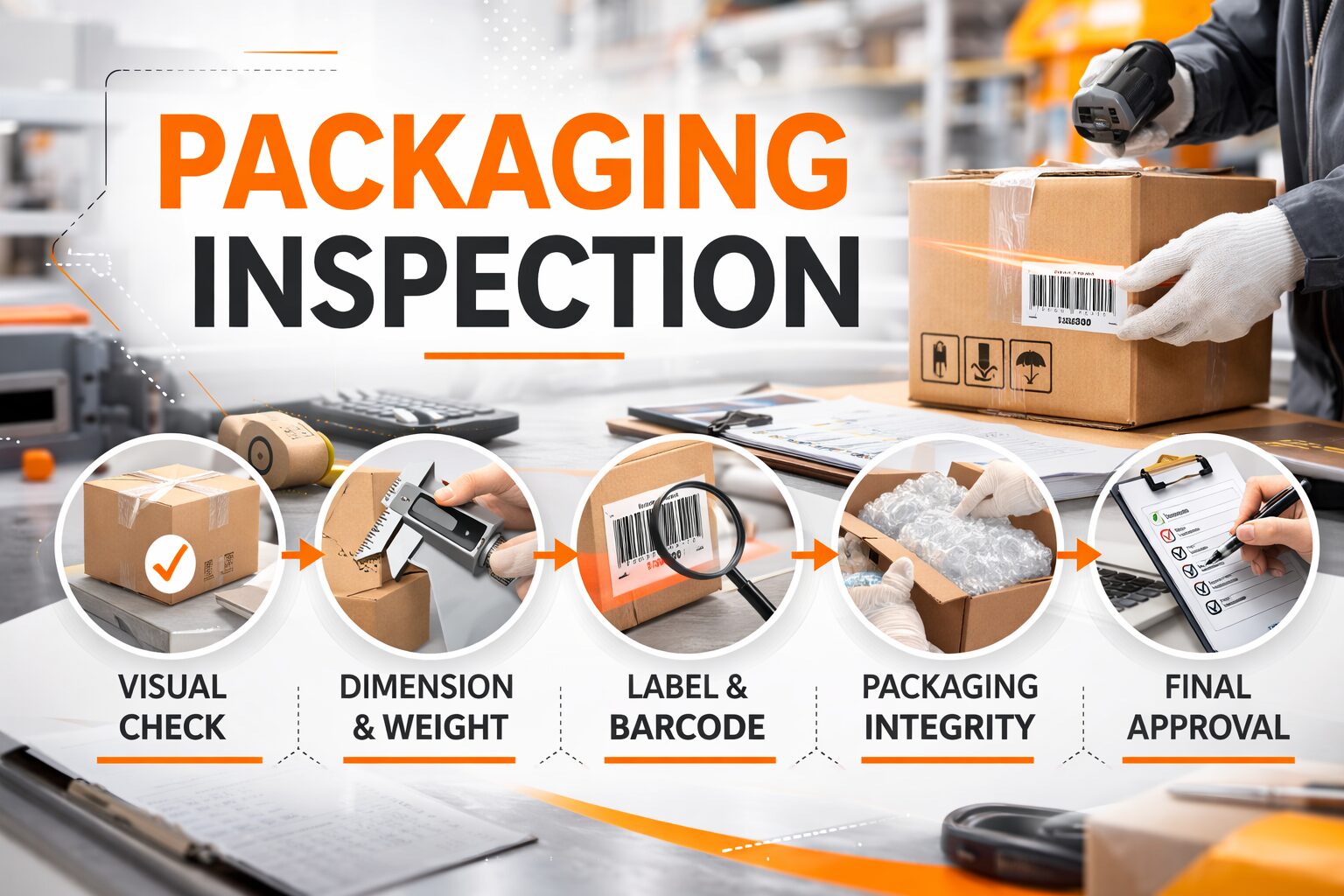
Packaging inspection is one of the most consequential steps in the entire production and quality control cycle — and consistently one of the most underestimated.
US retailers receive over $260 billion in merchandise returns annually, with a significant portion traceable to quality failures that thorough inspection would have caught before shipment.
This guide covers everything you need: the main types of inspection and the factors that shape them, the step-by-step process, common defects, industry-specific requirements, AQL sampling, automated vision systems, regulatory compliance obligations, and cost benchmarks
Whether you source internationally from Asia or manage domestic manufacturing, understanding how packaging inspection fits into your wider quality assurance workflow is what separates consistent, on-time delivery from costly, avoidable surprises.
What is Packaging Inspection?
Packaging inspection is a structured quality control process in which packaging materials and finished packaged goods — the inputs — are evaluated against predefined specifications, regulatory requirements, and performance criteria to produce a defect classification report with a shipment recommendation — the output.
The packaging inspection process covers visual checks, dimensional verification, structural integrity testing, labeling accuracy, seal integrity, and contamination detection.
Packaging inspection applies at multiple production stages: from raw material receipt through pre-shipment, serving as the primary checkpoint that confirms your product’s first line of physical defense is genuinely fit for purpose before it enters the supply chain.
What are the Types of Packaging Inspection?
Packaging inspection encompasses several distinct methods, each designed to catch specific failure types at specific production stages.
Selecting the right combination depends on your product, packaging format, and supply chain risk profile.
The five main packaging inspection types are:
- Visual inspection — Examines surfaces, components, and construction for defects detectable by eye or imaging system.
- Dimensional inspection — Measures packaging dimensions and tolerances against approved specifications.
- Mechanical testing — Subjects packaging to physical stress tests that simulate real-world transit conditions.
- Material testing — Analyzes the composition and barrier properties of packaging materials.
- Labeling inspection — Verifies that all label data, barcodes, and regulatory markings are accurate and legible.
Visual Inspection
Visual inspection examines packaging surfaces, components, and finished construction for defects detectable by eye or camera. In packaging quality control, it’s the first and most broadly applied screening step — catching obvious problems before more resource-intensive tests begin. Inspectors compare each unit against a golden sample, logging tears, punctures, deformation, print smearing, missing accessories, and contamination.
The process can be manual or fully automated using machine vision, with cameras flagging anomalies in real time across high-volume production lines. It’s fast, scalable, and the baseline check against which all other inspection methods build.
Dimensional Inspection
Dimensional inspection measures the physical dimensions and tolerances of cartons, inner boxes, polybags, and labels against the purchase order specifications. Incorrect dimensions affect product fit, stacking efficiency, retail shelf compatibility, and safe packing of containers. Inspectors use calipers, measuring tapes, and coordinate measuring tools.
Even a few millimeters of deviation creates downstream problems: cartons that won’t stack correctly, products that shift in transit, or retail packaging that doesn’t fit its designated shelf slot. Dimension verification is particularly important before any high-volume production run is approved for shipment.
Mechanical Testing
Mechanical testing subjects packaging to controlled physical stresses that replicate the handling, stacking, and transit conditions it will encounter.
Common tests include compression (verifying stacking load resistance), drop tests (assessing impact resistance), burst tests (measuring wall strength), and vibration tests (checking for content shifting under repeated motion).
These tests confirm that carton grade, flute type, and wall thickness deliver the protection level you’ve specified — not just that the carton looks adequate at the factory. For fragile, heavy, or high-value products, mechanical testing is non-negotiable.
Material Testing
Material testing analyzes the physical and chemical composition of packaging materials to confirm suitability for the intended product and environment.
Key tests include moisture resistance, oxygen and light barrier performance measured through MVTR (Moisture Vapor Transmission Rate) and OTR (Oxygen Transmission Rate), and chemical compatibility between packaging and product.
For pharmaceutical packaging, compatibility testing confirms that no interaction between the drug compound and its primary container will affect efficacy or safety.
For food packaging, material testing verifies that no harmful substances can migrate into the product — a core requirement under FDA, EFSA, and equivalent global frameworks.
Labeling Inspection
Labeling inspection verifies that every label, marking, and printed element is accurate, legible, correctly positioned, and compliant with destination-market regulations.
Inspectors check product name, quantity, country of origin, batch codes, expiry dates, allergen declarations, barcodes, recycling symbols, and all required safety or handling warnings. Each label element is compared against a pre-approved artwork file; barcodes are scanned to confirm readability and correct SKU linkage.
A mislabeled shipment can be seized at customs, recalled from retail, or — in regulated sectors — create direct legal liability. Labeling inspection is your last line of defense before these consequences become irreversible.
Which Key Factors Should Guide a Packaging Inspection Program?
Effective inspection programs aren’t built generically — they’re designed around the specific demands of your product, market, and supply chain. Six primary factors determine what gets checked, how rigorously, and how often.
The main factors are:
- Product type and characteristics — Fragility, sensitivity, and category-specific risks define baseline packaging requirements.
- Regulatory and safety requirements — Applicable laws in each destination market set non-negotiable compliance thresholds.
- Packaging materials and formats — The specific materials and construction methods determine which tests apply.
- Environmental conditions and storage — Expected temperature, humidity, and storage duration affect barrier and structural requirements.
- Logistics, shipping, and handling risks — Transit mode, distance, and handling intensity determine required mechanical performance.
- Functionality and usability in end-use — How the consumer interacts with the packaging shapes design and inspection criteria.
Product Type and Characteristics
Product characteristics define what your packaging needs to do, which directly determines what inspection must verify. Fragile products require thick cushioning and reinforced cartons, making drop and compression tests central to inspection.
Perishables need sealed, temperature-stable packaging, elevating seal integrity and barrier testing to critical priority.
Electronics demand anti-static materials and precise foam inserts. When you define your inspection scope, start with the product’s physical characteristics — weight, fragility, chemical nature, and size — as every inspection decision flows from there.
Regulatory and Safety Requirements
Every destination market imposes its own packaging regulations, and non-compliance carries consequences from customs seizure to legal penalties.
The FDA governs food-contact material safety in the US; the EU Packaging and Packaging Waste Directive regulates material composition and labeling across European markets; the UK’s Packaging (Essential Requirements) Regulations 2015 set fundamental safety and producer responsibilities; Australia’s APCO targets 100% reusable, recyclable, or compostable packaging nationally.
When you ship across multiple markets, your inspection criteria must account for the most stringent applicable ruleset — not just your home-market standard.
Packaging Materials and Formats
The materials and construction formats you use determine which inspection tests apply and what failure modes to prioritize.
Corrugated cartons are assessed for board grade, flute type, and burst strength. Flexible packaging — polybags, pouches — requires seal integrity and puncture resistance testing.
Rigid plastics need wall uniformity and closure fit verification. Blister packs used in pharmaceuticals and consumer goods require cavity alignment and seal checks. Your inspection checklist must be built around the specific material composition of your packaging, not a generic template that ignores format-specific vulnerabilities.
Environmental Conditions and Storage
The conditions your packaging faces during storage and distribution shape the structural and barrier properties you need to inspect for. Products in high-humidity environments need strong moisture barrier performance — verified through MVTR testing.
Goods crossing multiple climate zones need packaging that resists temperature extremes without deforming or losing seal integrity. Extended warehouse storage elevates compression resistance to a critical specification.
Inspectors should confirm that packaging materials were actually tested under the expected environmental conditions, not only assessed visually at the time of production.
Logistics, Shipping, and Handling Risks
Transit mode and route characteristics determine the mechanical performance your packaging must deliver.
Ocean freight exposes packaging to prolonged vibration, humidity, and stacking loads across multi-week journeys.
Air freight introduces pressure changes and dense handling at transfer points. E-commerce last-mile delivery creates multiple contact points with limited secondary protection.
Drop, vibration, and compression tests should be calibrated to the actual logistics scenario your packaging will face — a real-world scenario, not a generic lab benchmark that doesn’t reflect handling conditions your product will actually encounter.
Functionality and Usability in End-Use
How the consumer interacts with the packaging creates inspection requirements that go beyond structural protection.
Child-resistant closures must function correctly under the applicable regulatory standard. Easy-open features must work without tearing the product.
Retail-ready packaging must be shelf-stable and display-functional. Inspection should include usability testing of all functional packaging elements — zippers, reseal closures, spouts, handles — under conditions that replicate normal consumer use.
Packaging that fails at the point of consumer interaction generates warranty claims and damages your brand reputation long after the shipment has been accepted.
How is a Packaging Inspection Conducted?
A packaging inspection follows a defined sequence — setting criteria, sampling, physical examination, functional testing, defect classification, and corrective action — with each stage building on the previous to produce a reliable, documented quality outcome.
Step 1: How do you Define the Inspection Scope and Criteria?
Inspection scope is defined by translating your packaging specifications, buyer requirements, and regulatory obligations into precise, measurable inspection criteria.
Vague instructions like “check packaging quality” are insufficient.
Inspectors need specific, testable standards: “cartons must withstand a 1.2m drop test without structural failure,” “barcode must scan correctly on the first attempt with a standard scanner,” “label text must be legible at 30cm distance.”
The scope document should also specify which inspection type applies (PSI, DUPRO, CLC), which AQL level governs defect acceptance, and which tests will be performed on-site versus in an accredited laboratory.
How do you create a Packaging Quality Control Checklist?
A packaging QC checklist is built by converting approved specifications and regulatory requirements into structured, verifiable line items — each with a defined check method and acceptance criterion. A complete checklist covers:
- Carton dimensions, gross weight, and board grade vs. specification
- Inner packaging materials, cushioning type, and quantity per carton
- Seal integrity for all closures and packaging tape
- Label content, placement, language, and legibility
- Barcode type, version, and scannability
- Shipping marks on outer and inner cartons
- Artwork version and print quality vs. approved artwork file
- Packing ratio (units per inner box, inners per master carton)
- Drop test result and compression test result
- Product-specific or market-specific regulatory requirements
The checklist should be reviewed and updated whenever specifications, materials, or destination-market regulations change.
Step 2: How Should Samples be Selected (AQL and Risk-Based Sampling)?
Samples should be selected using the AQL (Acceptable Quality Limit) method under ISO 2859 (ANSI/ASQ Z1.4), which provides statistically representative sampling plans based on batch size and defect threshold.
For most consumer goods, AQL 2.5 applies to major defects and AQL 4.0 to minor defects. Critical defects are typically held to zero tolerance — one instance triggers batch failure.
Selection must be genuinely random: inspectors draw cartons from throughout the batch, not from a section the factory has pre-positioned. Higher-risk orders, new suppliers, or products with a history of packaging failures warrant tightened sampling plans or 100% inspection on specific attributes.
Step 3: How do you Examine Packaging for Visual and Structural Defects?
The visual and structural examination applies the checklist systematically to sampled units, with each attribute physically assessed and documented with photographs. Inspectors check carton surfaces for deformation, moisture marks, crushing, or tape failure; verify inner packaging for correct placement and completeness; and compare every label element against the approved artwork file.
Structural checks go beyond surface appearance: inspectors apply manual pressure to assess carton rigidity, verify tape adhesion, and confirm flap closures seal without gaps.
Every deviation is recorded by defect type, location, severity classification, and number of affected units.
Step 4: How do you Test Packaging Functionality and Performance?
Functionality testing confirms that your packaging performs under real-world conditions, not just visual review. On-site tests typically include:
- Drop test — Cartons dropped from specified heights onto flat, edge, and corner orientations to simulate handling impact
- Compression test — Stacking loads applied to verify the carton won’t crush in transit or warehouse storage
- Seal integrity check — Closures and tape tested for adhesion and leak resistance
- Barcode scan — Every barcode verified for first-pass readability with a calibrated scanner
- Odor check — Relevant for food and cosmetics to detect off-gassing or contamination from packaging materials
All test results are recorded numerically where applicable, with pass/fail outcomes against predefined acceptance criteria.
Step 5: How do you Isolate and Disposition Defective Packaging?
Defective packaging units must be physically separated from the accepted batch immediately upon identification to prevent accidental mixing.
Rejected units are tagged, moved to a designated hold area, and documented with a defect description and count. Disposition decisions — rework, replace, or reject — are based on defect classification and batch AQL result. If major defect count exceeds the AQL threshold, the entire batch fails and cannot ship without rework and re-inspection.
Minor defects below the threshold may be accepted with a documented corrective action request issued to the factory.
Step 6: How Should Findings be Recorded and Defects Categorized?
All inspection findings must be documented in a structured report that classifies every defect by severity, links findings to photographic evidence, and delivers a clear shipment recommendation. Three defect categories apply:
- Critical defects — Create safety hazards or regulatory violations; zero tolerance; e.g., exposed sharp edges on children’s product packaging
- Major defects — Significantly affect function, usability, or compliance; e.g., missing allergen declaration on food packaging
- Minor defects — Cosmetic issues with minimal functional impact; e.g., slight print color variation within accepted deviation tolerance
Reports should include batch information, inspection date and location, sampling plan used, total units inspected, and a final accept/hold/rework recommendation.
Step 7: How are Corrective and Preventive Actions Implemented?
CAPA addresses both the immediate defect and its root cause.
A corrective action request (CAR) is issued to the factory documenting each non-conformance, the required resolution, and a deadline.
Preventive action targets the underlying process failure — machine miscalibration, unauthorized material substitution, or inadequate in-process QC.
A follow-up inspection confirms that reworked packaging now meets specification before shipment is approved. Documented CAPA responses over time build a supplier performance record that informs future inspection intensity and risk classification decisions.
What are the Procedural Stages of a Packaging Inspection?
Every packaging inspection moves through four operational phases that structure the workflow from start to approved shipment.
Preparation
Preparation determines inspection quality before a single carton is touched. The inspector reviews the purchase order, approved specifications, and previous supplier findings; confirms that reference samples and approved artwork files are available on-site; calculates the sampling plan based on batch size and AQL; finalizes the checklist; and verifies that test equipment is calibrated and ready.
Without thorough preparation, inspectors arrive with incomplete information and produce reports that lack the clarity needed to make defensible accept/reject decisions.
Conducting the Inspection
The inspection proceeds systematically through sampled units: quantity verification first, then visual assessment, dimensional measurement, functional testing, and labeling review — in sequence, with all findings documented in real time using photographs and notes.
Rejected units are physically separated and tagged as they are identified.
For pre-shipment inspections, this phase takes place when 80–100% of production is complete and at least 80% is packed, so the inspection reflects the actual shipment condition rather than a partially complete batch.
Reporting and Documentation
The inspection report must be completed and delivered within 24 hours — the recognized industry standard for third-party inspection providers.
A credible report includes the scope, sampling plan, all findings classified by severity, photographic evidence for every non-conformance, test results with pass/fail outcomes, and a clear overall recommendation: approve shipment, hold the batch, or require rework before re-inspection.
Reports that deliver only a vague “pass” or “fail” without supporting evidence leave you with data but without the direction needed to act.
Corrective Action and Follow-Up
Once the report is delivered, the buyer reviews findings, issues a corrective action request to the factory, and specifies required resolution and timeline.
Batches on hold require a follow-up inspection to confirm rework meets specification.
All resolutions and agreed improvements are documented in the supplier’s performance file. This creates a continuous improvement loop: each inspection cycle informs the next, and recurring patterns can be escalated to supplier audits, sourcing reviews, or enhanced inspection coverage until the root cause is eliminated.
Which Common Packaging Defects and Issues Should Be Watched For?
Packaging defects fall into seven defined categories. Understanding each category allows you to build a more targeted checklist and train inspectors to recognize failure patterns rather than isolated faults.
Physical Damage and Cosmetic Defects
Physical damage and cosmetic defects are surface-level failures: scratches, dents, tears, creasing, discoloration, and contamination on packaging exteriors. These result from rough handling during production, poor stacking, inadequate individual wrapping, or low-grade carton material. While they may not compromise structural integrity, they directly affect consumer perception and retail acceptance. Many major retailers reject shipments with visible cosmetic packaging damage even when the enclosed product is unaffected.
Structural Integrity and Material Failures
Structural failures occur when packaging material cannot perform its protective function: cartons collapse under stacking loads, corrugated walls delaminate, or plastic components crack under transit stress. Root causes include unauthorized material substitution (lower board grade than specified), moisture exposure during production, or inadequate construction. A carton that looks intact at the factory can fail during a ten-day ocean shipment. Compression and burst testing during inspection are specifically designed to catch these failures before they result in damaged goods at destination.
Protection and Cushioning Deficiencies
Insufficient internal cushioning is a leading cause of product damage in transit, particularly for fragile or high-value items. Deficiencies include foam inserts of incorrect thickness or density, missing bubble wrap, inadequate corrugated partitions between units, and polybags that provide no meaningful impact buffer. This defect type is common when factories reduce material costs without buyer authorization. Drop testing directly evaluates whether the cushioning configuration absorbs the energy of a realistic fall — and it’s one of the most important on-site tests in any packaging inspection.
Packing Arrangement and Fit Problems
Packing arrangement defects occur when products are incorrectly positioned within packaging: units loose inside cartons, accessories in wrong inner boxes, or quantities not matching the purchase order. These issues cause product shifting and damage in transit, inventory discrepancies at the receiving warehouse, and consumer complaints about missing items. Inspectors verify packing ratio, confirm that the product fits correctly without excessive empty space, and check that no items are missing, substituted, or incorrectly assembled.
Labeling, Markings, and Documentation Errors
Labeling errors surface at the worst possible moment: customs, retail receiving, or point of sale. Common errors include missing or incorrect country of origin, wrong batch or lot codes, barcodes that don’t scan or link to the wrong SKU, missing allergen declarations, and incorrect language for the destination market. A shipment with incorrect labeling can be held at customs, returned to origin, or recalled from retail — costing far more than the pre-shipment inspection that would have caught the error.
Regulatory, Safety, and Hygiene Nonconformities
Regulatory nonconformities create legal exposure beyond commercial loss. Missing child-resistant closures on pharmaceutical packaging, absent suffocation hazard warnings on polybags for children’s products, use of PFAS-restricted materials in food packaging, or missing recycling symbols required under EPR laws are all failures with serious consequences. Food packaging contaminated by foreign particles, moisture, or pests creates direct public health risk. Inspection must verify compliance with all applicable regulations for each destination market — not just the most obvious general requirements.
Assortment and Component Mismatches
Assortment mismatches occur when package contents don’t match the specification: wrong SKUs, mixed variants, missing accessories, incorrect color or size combinations, or substituted components. In e-commerce, where consumers open packages without retailer mediation, assortment errors generate immediate negative reviews and returns. In B2B supply chains, they disrupt inventory accuracy and cause operational delays. Inspection verifies product variety and quantity against the purchase order, checks all barcodes and SKU linkages, and confirms every listed accessory and insert is present and correctly placed.
Which Key Areas are Evaluated During Packaging Inspection?
A thorough packaging inspection program evaluates nine functional areas. Each addresses a distinct dimension of packaging performance and compliance, and together they provide comprehensive coverage of the risks your packaging faces.
Packaging Materials and Specifications
Material evaluation confirms that packaging components — board grade, plastic type, foam density, barrier film, and adhesive — match the purchase order specifications. Any supplier-initiated material substitution without buyer approval is flagged as a non-conformance. Material testing data (MVTR, OTR, migration test reports) should be available and verified against approved specifications.
Carton Construction and Durability
Carton construction is assessed through visual inspection of flap alignment, glue joints, tape application, and box score integrity, combined with compression testing. The carton’s ECT (Edge Crush Test) or BCT (Box Compression Test) value should meet or exceed the load it will bear during stacking and transit in the expected logistics scenario.
Sealing Integrity and Closures
Seal integrity covers all closure types: carton tape, heat seals, adhesive closures, caps, and blister seals. Visual inspection checks for gaps, bubbles, or incomplete adhesion; physical testing — vacuum decay or pull tests — verifies the seal holds under realistic stress. In food and pharmaceutical packaging, a failed seal is a critical defect with immediate regulatory implications.
Cushioning and Internal Protection
Internal protection is evaluated by checking the type, thickness, density, and placement of foam inserts, bubble wrap, corrugated dividers, and inner liners against the approved packaging spec. The configuration is then tested through drop simulation to confirm it actually prevents product movement and absorbs the impact energy of realistic handling falls.
Product Fit and Packing Arrangement
Inspectors verify that the product fits correctly within its primary and secondary packaging without excessive movement or compression. Correct fit means no product shifting in transit, no pressure on fragile components, and no dead space that inflates package dimensions and increases shipping cost unnecessarily.
Labeling, Barcodes, and Markings
Every label element is verified against the approved artwork file and regulatory checklist. Barcodes are scanned with a calibrated reader to confirm readability, GS1 compliance, and SKU accuracy. Shipping marks on outer cartons — PO number, destination, handling instructions — are checked for legibility and correct content.
Printing Quality and Legibility
Print quality inspection checks for smearing, color inconsistency, misregistration, fading, and resolution failures. Blurry or faded print that makes safety warnings or handling instructions unreadable is classified as a major defect in most inspection protocols. High-resolution, correctly registered print is equally important for brand integrity and regulatory compliance.
Packaging Compliance with Standards
Compliance verification confirms that packaging meets all applicable standards for the product category and destination market: material restrictions, labeling mandates, environmental requirements, and retailer-specific requirements. Walmart and Amazon FBA impose packaging standards that go beyond general regulatory compliance; failure to meet them triggers shipment rejection or account-level penalties.
Palletization and Container Loading
Container loading inspection verifies that cartons are correctly positioned and secured on pallets, that pallet dimensions and weight comply with buyer specifications, and that the container is free of pre-existing damage — rust, moisture, or pests — before loading begins. Weight distribution and loading sequence are checked to prevent carton deformation during the journey.
What is the Carton Drop Test Standard, and How is it Performed?
The carton drop test is a standardized packaging durability test that evaluates whether a filled carton can withstand the impact of a fall without structural failure or product damage. Referenced in ISTA (International Safe Transit Association) protocols and ASTM D5276, it’s one of the most frequently required on-site tests in packaging inspection, simulating the falls packages experience during warehouse handling, loading operations, and last-mile delivery.
What are the Carton Drop Test Methods?
Drop tests are performed by releasing a filled carton from a defined height onto a hard, flat surface in a prescribed sequence of orientations: flat face drops on each of the six faces, edge drops on each of the twelve edges, and corner drops on each of the eight corners. Each orientation stresses a different structural element. The flat face drop tests overall board strength; the corner drop concentrates maximum stress on the carton’s structurally weakest points. A full corner and edge sequence is typically required before pre-shipment approval on retail consumer goods.
What are the Drop Height Standards?
Drop height is determined by the gross weight of the filled carton, referenced against standardized tables in ISTA or ASTM documentation. As a general guideline, cartons up to 10 kg are typically tested at 60–80 cm; cartons in the 10–20 kg range at 45–60 cm. Buyer-specific requirements may set different heights — for example, certain product categories require that cartons withstand a 1.2m drop test without damage. Any deviation from buyer-specified drop heights is a protocol non-conformance that must be documented in the inspection report.
What Should be Checked After a Drop Test?
After each drop, inspect the carton and its contents for: carton corner and edge bursting, flap separation, tape failure, inner packaging displacement, product contact with the carton wall, and any visible product damage. The test passes if the carton maintains structural integrity across all drop orientations and the product inside remains undamaged and correctly positioned. A single failure on any drop orientation constitutes a packaging defect that requires material or construction correction before the shipment can be approved.
Which Industries and Product Categories Rely on Packaging Inspection?
Packaging inspection applies across virtually every product category in global trade. The scope, focus, and regulatory intensity vary by sector, but the underlying need — verifiable packaging quality before shipment — is universal.
Consumer Electronics
Electronics packaging inspection prioritizes anti-static protection, foam insert quality, and
reinforced carton construction to prevent electrostatic discharge damage and physical impact damage during transit. Inspectors verify foam insert density and placement, confirm anti-static bags are correctly sealed, and check that compliance markings (CE, FCC, RoHS) are correctly applied. Drop testing is mandatory for most electronics shipments given the value and fragility of the products.
Textiles and Apparel
For textiles and apparel, inspection focuses on polybag type and gauge (with suffocation hazard warnings required for children’s products), folding consistency, hanger and tag placement, and carton construction relative to garment weight. Label accuracy — fiber content, care instructions, country of origin, size — is a primary focus because mislabeling in apparel is a frequent regulatory violation in major import markets including the US and EU.
Toys and Children’s Products
Toys require some of the most rigorous packaging inspection because of strict child safety regulations in every major market. Inspectors check that polybags have mandatory air holes or suffocation warnings, that age restriction markings comply with ASTM F963 (US) or EN 71 (EU), and that all required warning labels are present and legible. Blister pack alignment and closure integrity are also evaluated, since packaging that is difficult to open safely creates injury risk for the target age group.
Home Goods and Furniture
Home goods and furniture packaging inspection addresses both product size and fragility. Large items require heavy-duty corrugated construction with defined compression strength, foam corner protectors, and stretch wrap. Flat-pack furniture packaging must protect individual components from scratching without creating unnecessary material waste. Drop test parameters are set based on the finished carton weight, which can be substantial for furniture pieces and requires higher-grade board specifications.
Cosmetics and Personal Care Products
Cosmetics packaging inspection adds a layer of attention to packaging-product compatibility: the material must not interact chemically with the formula inside. Inspectors verify seal integrity on pumps, caps, and nozzles; check lot codes and expiry date labeling; and confirm that ingredients, usage instructions, and warnings comply with cosmetics regulations in the destination market. Odor testing also applies to detect off-gassing from packaging materials that could transfer to the product.
Other High-Risk Sectors (Food, Pharma, Automotive)
Food, pharmaceutical, and automotive sectors carry the most severe consequences for packaging failures. Food packaging inspection integrates with HACCP plans and FSMA requirements, verifying seal integrity, absence of contamination, and compliant labeling at every supply chain stage. Pharmaceutical packaging requires sterility assurance, compatibility testing, and serialization label accuracy. Automotive parts packaging must prevent corrosion and physical damage to precision components, with specific requirements for rust-inhibiting materials, desiccant inclusion, and traceable part identification labeling.
What are the Benefits of Performing Regular Packaging Inspections?
Regular packaging inspection protects your revenue, regulatory standing, and brand simultaneously — making it one of the highest-return quality investments in any supply chain. Here are nine benefits, ordered by impact:
- Prevents product damage and financial loss — Catching packaging failures before shipment avoids damage claims, replacement costs, and the operational disruption of managing large-scale returns.
- Reduces the risk of product recalls — Defective packaging that allows contamination or product failure triggers mandatory recalls; inspection finds the problem at the source.
- Protects brand reputation — Consistently well-packaged goods reinforce the quality signal your brand projects; damaged or poorly packaged products create lasting negative impressions.
- Ensures regulatory compliance — Inspection verifies that labeling, materials, and construction meet destination-market requirements, preventing customs seizures and regulatory fines.
- Increases customer satisfaction — Products arriving undamaged, correctly labeled, and complete generate fewer complaints and higher repeat purchase rates.
- Reduces return rates — Catching packaging defects before shipment directly reduces the volume of returns caused by transit damage, missing items, or mislabeling.
- Improves supplier accountability — Systematic inspection creates a documented performance record that holds suppliers to agreed standards and surfaces chronic failure patterns early.
- Supports retail compliance — Major retail channels impose specific packaging requirements; regular inspection ensures consistent compliance without costly receiving-dock rejections.
- Enables supply chain optimization — Inspection data over time identifies where packaging costs can be reduced without sacrificing protection, informing material and design improvements.
How do Automated Inspection and Vision Systems Enhance Packaging Inspection?
Automated inspection and machine vision systems bring speed, consistency, and detection accuracy to packaging quality control that manual inspection cannot match at scale. They are particularly valuable on high-volume production lines where the throughput demands of the operation outpace what human inspectors can reliably cover.
What is a Packaging Inspection System?
A packaging inspection system is an automated quality control platform that uses sensors, cameras, and processing software to evaluate packaging components and finished goods at production line speed, without manual intervention. These systems replace the need for human inspectors to physically open and assess each carton, instead scanning packaging attributes — label placement, seal integrity, barcode readability, fill levels, and carton completeness — automatically, with results logged in real time.
What are the Types of Packaging Inspection Systems?
The main system types are: machine vision systems (using 2D and 3D cameras to detect surface and structural defects), X-ray inspection systems (detecting foreign objects and fill anomalies inside sealed packaging), checkweigher systems (verifying each package meets its specified weight), metal detection systems (identifying metallic contaminants in food and pharmaceutical packaging), and seal integrity testers (applying vacuum or pressure to detect micro-leaks). Most production lines integrate several of these technologies in sequence to provide layered, comprehensive inspection coverage.
Which Automated Tools and Sensors are Commonly Used?
Common automated tools include high-resolution industrial cameras paired with image processing software, laser displacement sensors for dimensional verification, infrared sensors for heat-seal temperature monitoring, ultrasonic sensors for detecting voids in packaging materials, and RFID readers for traceability verification. Barcode and label verification systems use multi-angle cameras to read all package surfaces simultaneously and compare scanned data against a master product database in real time, flagging mismatches instantly without stopping the production line.
How do Vision Systems Work in Packaging Lines?
Machine vision systems use high-resolution 2D or 3D cameras positioned at defined points on the packaging line. Each camera captures an image of every passing package and sends it to image processing software that applies trained algorithms to detect predefined defect types: crooked labels, missing seals, surface damage, color deviations, and fill level inconsistencies. Systems like Wayne Automation’s WVI and WVI-FC inspect up to 65 cases per minute and connect to the MES (Manufacturing Execution System) to scan SKUs and verify correct product-container pairing. Cases that fail are automatically diverted to a side lane for human resolution — preventing non-conforming packaging from proceeding down the line.
How is Data Analysis Applied to Inspection Outputs?
Every automated inspection cycle generates a timestamped data record: product SKU, inspection result, and — for failures — defect type and location. Aggregated over production runs, this data identifies systematic patterns: a label printer producing misregistered output on specific shifts, a sealing machine generating micro-leaks when ambient temperature drops, or a specific supplier’s carton failing corner drops at a higher rate than specification allows. Root cause analysis driven by inspection data supports targeted corrective actions, making quality improvement faster and more cost-effective than periodic generic audits.
What are the Benefits of Automated Inspection Systems?
Automated packaging inspection delivers advantages that manual inspection cannot replicate at high production volumes. Here are six core benefits:
- Eliminates human error — Machine vision systems maintain consistent detection accuracy regardless of shift duration, operator fatigue, or line speed.
- Achieves faster throughput — Systems operating at up to 65 cases per minute provide full inspection coverage at production speed with no bottleneck.
- Delivers statistical traceability — Every package generates a data record, enabling complete audit trails and trend analysis unavailable through paper-based manual inspection.
- Detects over 99% of defects — Calibrated automated systems consistently outperform manual inspection accuracy, particularly for subtle defects like micro-leaks or minor label shifts.
- Reduces labor costs — Replacing manual end-of-line inspection with automated systems reallocates staff from repetitive visual tasks to higher-value quality activities.
- Enables real-time corrective action — Immediate detection and rejection of non-conforming packages prevents defect accumulation across the production run, reducing downstream rework.
Where are Visual Inspection Systems Typically Applied?
Visual inspection systems are deployed primarily at end-of-line packaging stages — after filling, sealing, and labeling — where the finished packaged product can be evaluated in final form before case packing. They are also applied at the case-packing stage to verify carton loading and sealing. In pharmaceutical and food manufacturing, vision systems are additionally positioned at upstream production points to catch contamination or fill anomalies before secondary packaging is applied.
What are Common Inspection Challenges and How Can They Be Resolved?
Packaging inspection faces several recurring operational challenges: inconsistent criteria across facilities or supplier locations, manual documentation errors and delays, inspector fatigue on long shifts, vague or outdated specifications that enable subjective judgment, and supplier resistance to independent inspection access. Left unaddressed, each challenge reduces the effectiveness and commercial value of the inspection program.
What Solutions Mitigate These Inspection Issues?
Digital inspection platforms eliminate the most common manual inspection failures. Standardized digital checklists ensure every inspector at every location follows the same procedure, removing subjective judgment from the process. Mobile inspection apps with photo capture, e-signature, and offline capability remove documentation delays and illegibility from the workflow. Precise, measurable specifications updated before each production run remove the ambiguity that allows supplier non-compliance to go undocumented. When suppliers resist third-party access, treat it as a risk signal: reliable manufacturers actively support independent verification because it builds the commercial trust that sustains long-term sourcing relationships.
How Often Should Packaging Inspections be Conducted?
Packaging inspections should be conducted at every pre-shipment stage as a baseline, with frequency adjusted upward based on supplier history, product risk, and regulatory requirements. For most businesses sourcing internationally, a pre-shipment inspection on every order is the minimum defensible standard. Regular packaging audits — reviewing materials, specifications, compliance, and supplier performance holistically — are recommended a few times per year. Regulated sectors like pharmaceuticals and food require more frequent inspection with third-party verification. New supplier relationships always justify increased inspection frequency: the production run where you reduce oversight is typically where problems first appear.
What are the Best Practices for Planning and Executing Packaging Inspections?
Effective packaging inspection starts before any inspector visits the factory — in how you specify, plan, and communicate requirements. The following practices consistently separate buyers who catch problems before shipment from those who discover them after arrival.
How do you Provide Clear Packaging Specifications?
Clear specifications are the foundation of every effective inspection. Your spec document must define every measurable attribute of your packaging — dimensions, material grades, seal type, label content, and test requirements — with no ambiguous language. Share specifications with the factory and the inspector before production begins. Reference specific standards where applicable (e.g., AQL 2.5 under ISO 2859, ISTA 2A for transit testing), and include all buyer-specific or retailer-specific requirements as a named annex.
When Should you Conduct Pre-Production Packaging Approval?
Pre-production packaging approval should happen when the first production-representative samples are available — before full production begins. Reviewing and approving physical packaging samples at this stage catches specification deviations, material substitutions, and labeling errors when correction is still inexpensive. A physical sample review validates that what the factory intends to produce matches what you ordered. Changes after full production is underway are exponentially more costly, making the upfront sample approval investment straightforward to justify.
Why Should Packaging Inspection be Combined with Product Inspection?
Packaging and product inspection conducted separately misses critical interaction effects. You need to evaluate them together: Does the product fit correctly in its packaging without undue pressure on fragile components? Do product labels and packaging labels align in SKU, version, and regulatory content? Running packaging and product inspection concurrently during the pre-shipment stage is both more efficient and more comprehensive than treating them as separate programs.
How is AQL Sampling Used for Carton Selection?
AQL sampling for carton selection uses the batch size and agreed AQL level to calculate the minimum number of cartons that must be inspected for statistically representative results. For a batch of 1,000 cartons at AQL 2.5 (General Level II under ISO 2859), the standard table specifies the exact sample size and acceptance number. Random selection is non-negotiable: inspectors must draw cartons from throughout the batch, not from a section the factory has pre-positioned. If defective cartons exceed the acceptance number, the batch fails.
How Should Packaging Requirements be Documented in Purchase Orders?
Purchase orders should include a dedicated packaging section specifying: carton dimensions and weight limits, material grades, labeling requirements, packing ratio, and all applicable test requirements with pass criteria. Requirements stated only in a separate spec document not referenced in the PO create ambiguity about contractual obligation. When packaging requirements are embedded in the PO itself, non-conformance has clear commercial consequences and the supplier has no basis to dispute that the requirements formed part of the order.
When is Multi-Stage Inspection Necessary?
Multi-stage inspection — covering pre-production, during-production, and pre-shipment — is necessary for large orders, new supplier relationships, complex products, high-risk categories, and orders where previous inspections found systematic issues. A pre-production check verifies materials and factory setup before production starts; a DUPRO inspection at 20–80% completion confirms quality mid-run; the final PSI validates the packed batch. Each stage catches a different class of problem at the point where correction costs the least — making multi-stage inspection a net cost reduction, not an added expense.
Who Should Invest in Packaging Inspection?
Any business that sells physical products has a commercial interest in packaging inspection, but the investment is most critical for importers sourcing internationally, brand owners who cannot physically access supplier factories, retailers supplying to channels with strict compliance requirements, and e-commerce sellers on platforms like Amazon FBA where packaging failures trigger account-level consequences. If your brand is on a product and you don’t control the factory that makes it, packaging inspection is your primary mechanism for verifying that what ships is what you ordered — not what the supplier decided to produce.
Which Regulations and Compliance Requirements Impact Packaging Inspection?
Packaging inspection operates within a global regulatory framework where requirements vary by product category, destination market, and material type. Non-compliance creates consequences ranging from customs delays to product recalls and legal action.
How is Packaging Integrated into Food Safety Systems?
Food packaging inspection integrates into formal food safety systems including HACCP, FSMA (US), and GFSI-recognized schemes such as BRC, SQF, and FSSC 22000. Within these frameworks, packaging is treated as a potential source of physical and chemical contamination hazards. Inspection checkpoints are embedded at material receipt, during filling and sealing, and pre-shipment to verify that packaging doesn’t introduce hazards into the food product.
How is Validation of Food-Contact Materials Demonstrated?
Validation of food-contact packaging is demonstrated through a Declaration of Compliance (DoC) from the packaging supplier, confirming that all materials meet applicable food contact regulations: EU 10/2011 for plastics in Europe, FDA 21 CFR for US food-contact materials, and Health Canada’s Food and Drug Regulations Division 23 for Canada. Migration testing reports from accredited laboratories provide the technical evidence behind the DoC. Request, verify, and archive these documents as part of your supplier qualification and annual audit process.
What Traceability is Required for Packaging Components?
Packaging components in regulated sectors must be traceable from raw material supplier through to the consumer. ISO 9001:2015 Clause 8.5.2 and food safety regulations require that every batch of packaging material — label stock, board, film, and inks — links to a specific lot and production run. In a product recall, this traceability defines the scope precisely, preventing unnecessary withdrawal of unaffected goods. Your inspection records should capture supplier lot numbers for packaging materials, not just final inspection outcomes.
How Should Change Management Address Sustainability Pressures?
Sustainability pressures are driving rapid changes in packaging material specifications — from single-use plastics to recyclable alternatives, from PFAS-coated food liners to PFAS-free substitutes. Each material change introduces new performance variables that require inspection validation before full production rollout. Your change management process should require any material substitution — even a sustainability-motivated one — to go through formal qualification: physical testing against existing performance benchmarks, regulatory compliance verification, and a supplier-approved specification update before production authorization.
Which New Sustainability Regulations (e.g., EPR Laws) Affect Packaging?
Extended Producer Responsibility (EPR) laws are expanding across the EU, UK, Canada, and multiple US states, placing legal obligations on brands to fund collection and recycling of their packaging waste. These laws require packaging to be designed and labeled in ways that support recycling — specific recyclability content, material identification codes, and compliant recycling symbols. Non-compliance results in fines and market access restrictions. Your packaging inspection program should verify EPR-required markings and material composition as standard elements of the labeling and materials review.
How do Tariffs and Trade Rules Influence Packaging Compliance?
Country-of-origin marking requirements are a direct consequence of customs regulations, and incorrect or missing origin declarations can result in customs holds, tariff reclassification, and penalties. US CBP requirements, EU customs rules, and other market-specific regulations specify that origin must be permanently and conspicuously marked on both the product and its packaging. When tariff classifications change or new trade measures apply, the affected packaging labeling requirements change with them. Inspection should always verify origin marking against the current regulatory requirement for the specific destination market.
When Should Packaging Audits Take Place, and Why Does Timing Matter?
Packaging audits should take place before new product launches, when a packaging supplier changes, when materials are reformulated or substituted, when entering a new market with different regulatory requirements, and on a regular scheduled basis — at minimum annually for established product lines. Timing is critical: an audit conducted after production is complete can only document problems, not prevent them. The most effective audit cycle is proactive — audit packaging specifications and supplier capabilities before committing to a production run, then verify compliance through inspection as production proceeds and before shipment is authorized.
What Tools, Equipment, and Software are Used in Packaging Inspection?
Inspectors rely on a combination of measurement tools, testing equipment, and digital platforms to complete thorough packaging inspections efficiently and with full documentation.
Common tools and equipment include:
- Calipers and measuring tapes — Dimensional verification of carton and product dimensions against specification
- Digital scales and checkweighers — Verification of gross weight of filled cartons against specified tolerances
- Barcode scanners and label verifiers — Confirmation of barcode readability, GS1 compliance, and SKU accuracy
- Drop test fixtures — Standardized carton drop tests at buyer-specified heights on all orientations
- Compression testing machines — Verification of carton stacking load resistance through BCT/ECT measurement
- Seal integrity testers — Vacuum or pressure devices for detecting micro-leaks in sealed packaging
- Colorimeters and spectrophotometers — Print color accuracy verification against approved artwork
- Machine vision cameras (WVI/WVI-FC systems) — Automated line-speed inspection of filled and sealed cases
- X-ray inspection systems — Foreign object detection and fill level verification inside sealed packaging
- Metal detectors — Metallic contaminant detection in food and pharmaceutical packaging
- Digital inspection platforms (GoAudits, SafetyCulture, TradeAider) — Mobile checklist execution, photo documentation, real-time reporting, and corrective action tracking
- Compliance management software (FoodChain ID) — Food-contact material compliance documentation, Declaration of Compliance generation, and regulatory change monitoring
How Much Does Packaging Inspection Typically Cost?
Third-party packaging inspection in Asia — China, Southeast Asia, South Asia — typically costs $200–$300 USD per man-day, with most standard pre-shipment inspections completed in a single man-day. In Europe and North America, rates generally range from $400–$700 USD per man-day. A man-day represents one full working day of dedicated inspection work, covering all preparation and on-site execution. Complex orders requiring two or more man-days can be staffed with either one inspector over multiple days or multiple inspectors completing the work in one day.
Seven key factors determine total inspection cost:
- Geographic location — Rates in Asia are significantly lower than in Western markets; costs also vary by city and factory accessibility within a country.
- Inspection type and scope — A pre-shipment inspection is typically one man-day; multi-stage programs covering pre-production, DUPRO, and PSI multiply the man-day requirement accordingly.
- Order complexity and product category — Products requiring specialized lab testing or technical expertise add cost beyond the standard man-day fee.
- Sample size and AQL level — Tighter AQL levels or larger batch sizes increase the number of units inspected, potentially extending the inspection beyond one man-day.
- Turnaround time — Standard 24-hour report delivery is included in most packages; emergency inspection scheduling or same-day delivery may carry a premium.
- Third-party versus in-house inspection — Third-party inspection converts quality control into a variable cost; in-house inspection requires investment in staff, equipment, and documentation infrastructure.
- Frequency and contract terms — High-volume buyers with regular inspection needs often negotiate reduced per-man-day rates through inspection service agreements compared to ad-hoc bookings.
How Does Packaging Inspection Integrate with Manufacturing and Distribution Workflows?
Packaging inspection integrates into manufacturing and distribution as a series of defined quality gates — checkpoints at which product cannot proceed or ship until inspection criteria are met.
At the inbound stage, packaging materials from suppliers are inspected against specifications before entering production.
During production, DUPRO inspections verify correct packaging application as manufacturing proceeds. At the outbound stage, pre-shipment inspection validates the final packed batch, and container loading inspection confirms correct loading before the container is sealed. In distribution, receiving inspections at warehouses or distribution centers confirm that packaging integrity has survived the transit journey.
Each gate generates documented records that contribute to end-to-end supply chain traceability — essential for both quality management and regulatory compliance.
What is a Practical Next Step to Improve Packaging Inspection?
The most immediately impactful improvement to your packaging inspection program is formalizing your specifications.
If your current specs are verbal, embedded in emails, or described as “same as last time,” you have no reliable basis for holding suppliers accountable or training inspectors to consistent standards. Write a formal packaging specification document for each product line — with measurable acceptance criteria for every inspectable attribute. Share it with your supplier and your inspection provider.
Then run a pre-shipment inspection on your next order using that document as the checklist baseline. The gap between what you find and what you expected will tell you exactly where your inspection program needs to develop.
Conclusion
Packaging inspection is a non-negotiable quality gate in any supply chain where product integrity, regulatory compliance, and brand reputation are at stake.
Done well, it prevents the kinds of failures — damaged goods, mislabeled shipments, customs rejections, product recalls — that cost far more to resolve after the fact than the inspection itself would have cost up front.
Whether you’re relying on manual third-party inspectors following AQL protocols, deploying machine vision systems evaluating 65 cases per minute at line speed, or building a multi-stage program covering pre-production through container loading, the underlying logic remains constant: define clear criteria, inspect systematically, document everything, and act on what you find.